

Baby & Family
The Best Toddler Tricycles: 4 Compared (and One to Skip)
We compared convertible push trikes, a classic pedal trike and a balance bike on the numbers that decide whether a toddler actually rides: manufacturer-stated age range, rider weight limit, how much the thing itself weighs, published fit data, restraint type and wheels.
The short version
The Joovy Tricycoo 4.1 is the pick for most families: Joovy states four stages from 10 months through 30 months and beyond, a 44 pound rider limit and a 14.4 pound assembled weight, plus a pedal locking system and a rear brake. The Radio Flyer 4-in-1 Stroll 'N Trike is the value choice and has the highest stated rider limit of the trikes here at 49 pounds and a listed age range of 1 to 5 years, though Radio Flyer lists no brake and no wheel material. The Strider 12 Sport is the depends pick: at 6.7 pounds with a published 12 to 18 inch inseam range it is the best tool here for learning to ride, and the wrong tool if you wanted something to push a one year old around the park in. Skip the Schwinn Roadster Tricycle 12in unless the retro look is the point, because the product page states no age range, no rider weight limit and no assembled weight, and the frame, rims, hubs and crank are all steel. Buy on the trike's own weight and on published fit numbers, not on the number of stages. Best for: parents choosing a first set of wheels for a child between roughly 10 months and 4 years.
Our picks at a glance
- Joovy Tricycoo 4.1 - Buy. The convertible trike with the most usable published numbers and the lightest frame of the trikes here.
- Radio Flyer 4-in-1 Stroll 'N Trike - Buy. The value convertible: the highest stated rider weight limit of the trikes here and the longest listed age range, with a thinner spec sheet.
- Strider 12 Sport Balance Bike - It depends. Not a trike at all, and for teaching a child to ride that is the point.
- Schwinn Roadster Tricycle 12in - Skip. A handsome all-steel retro trike sold without the three numbers a parent most needs.
The verdict in 30 seconds
What mattered most
- Type
- Maker's stated age range
- Rider weight limit
- Product weight
- Published fit data
- Parent push handle
Toddler trikes look interchangeable in a listing photo and behave nothing alike in a driveway. The category really splits three ways: convertible push trikes with a parent handle that start around 10 to 12 months, classic pedal trikes aimed at roughly 2 to 5 year olds, and balance bikes, which have no pedals at all and are the option a lot of families now reach for first. We picked four products that sit in different corners of that split, and we judged them on what manufacturers actually publish rather than on how many stages the marketing claims. The single most useful number turned out to be the weight of the trike itself, because a heavy trike a toddler cannot push is the complaint that comes up over and over.
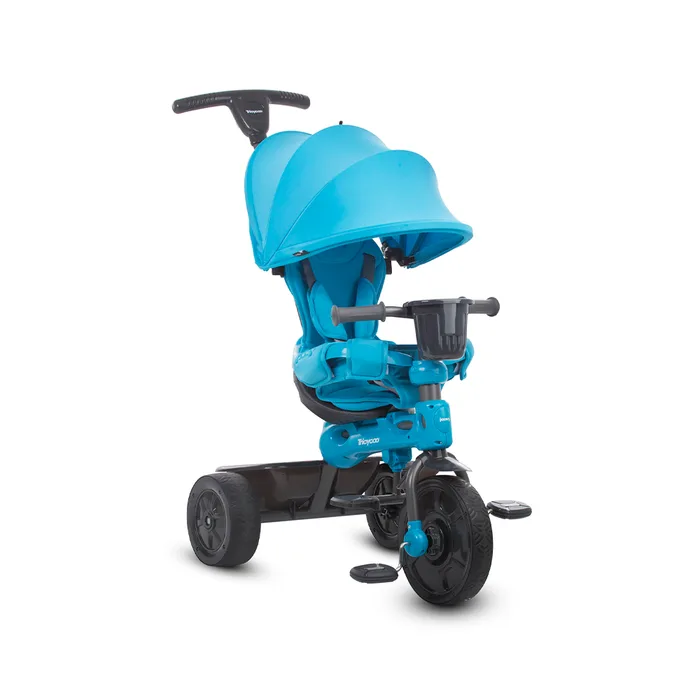
The convertible trike with the most usable published numbers and the lightest frame of the trikes here.
Best for: A family that wants one trike to carry a child from the stroller stage through solo pedaling without buying twice.
- Joovy states four stages covering 10 months through 30 months and beyond, so one purchase spans the push phase and the pedal phase.
- At a stated 14.4 pounds assembled it is the lightest of the three trikes we compared, which is what decides whether a toddler can actually move it.
- It is the only trike here whose maker lists both a pedal locking system and rear brakes.
- The 44 pound rider limit is the lowest of the four products, so bigger preschoolers age out sooner.
- Joovy does not state wheel or tire material anywhere on the product page.
- The page describes the restraint as an adjustable 3-point harness in the narrative and a 5-point harness in the feature list, so confirm which one ships.
- No seat height or inseam figures are published, only assembled dimensions.
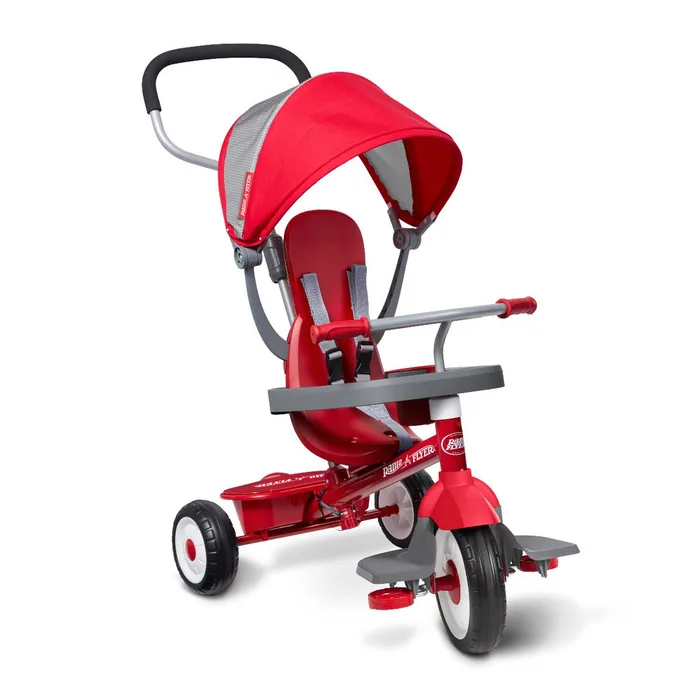
The value convertible: the highest stated rider weight limit of the trikes here and the longest listed age range, with a thinner spec sheet.
Best for: Parents who want a four-stage push trike with a generous weight ceiling and are willing to trade a brake and detailed specs for a lower price.
- Radio Flyer states a 49 pound weight capacity and an age range of 1 to 5 years, the widest listed span among the trikes we compared.
- It ships with a 3-point harness and a high back seat for the earliest stage, plus a removable front wheel footrest.
- The adjustable Steer & Stroll push handle has a foam grip and comes off completely once the child is riding alone.
- At a stated 15.87 pounds it is the heaviest product in this comparison that a toddler is expected to pedal.
- Radio Flyer lists no brake of any kind on the product page.
- No wheel or tire material is stated, only that the rear wheels are wide.
- The listed age range starts at 1 year, so it is not aimed at the 10 to 12 month push phase the way some rivals are.
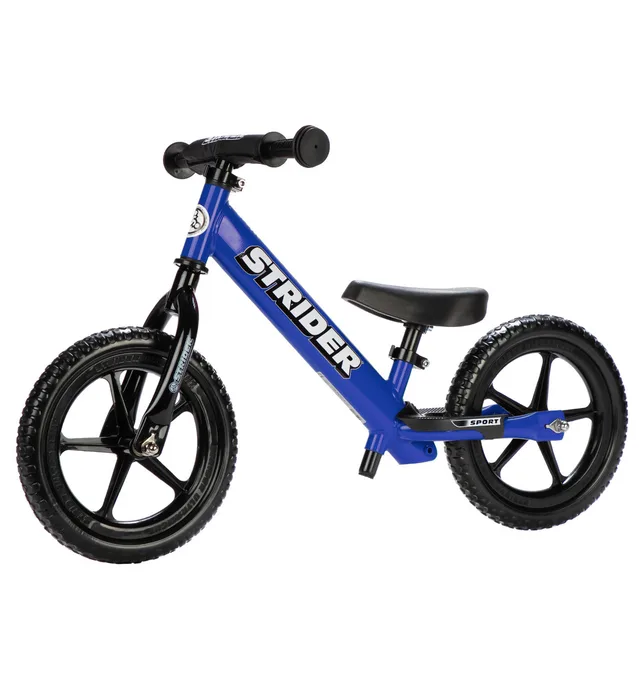
Not a trike at all, and for teaching a child to ride that is the point.
Best for: A confidently walking toddler whose parents care more about the transition to a pedal bike than about strolling.
- At a stated 6.7 pounds assembled it is less than half the weight of any trike here, so a small child can pick it up and carry it.
- Strider is the only maker in this group that publishes fit data: 12 to 18 inch inseam, 11 to 17 inch seat height, 18 to 22 inch handlebar height.
- The stated 60 pound maximum rider weight is the highest of the four, and the flat-free foam rubber tires never need air.
- There are no pedals, so a child who wants to pedal today will not get that from this bike.
- There is no parent push handle, no harness and no canopy, so it does nothing to replace a stroller on a long walk.
- Strider lists no brake in the tech specs, which means feet are the only stopping mechanism.
- It only works once a child walks confidently, so it is a poor gift for a pre-walker.
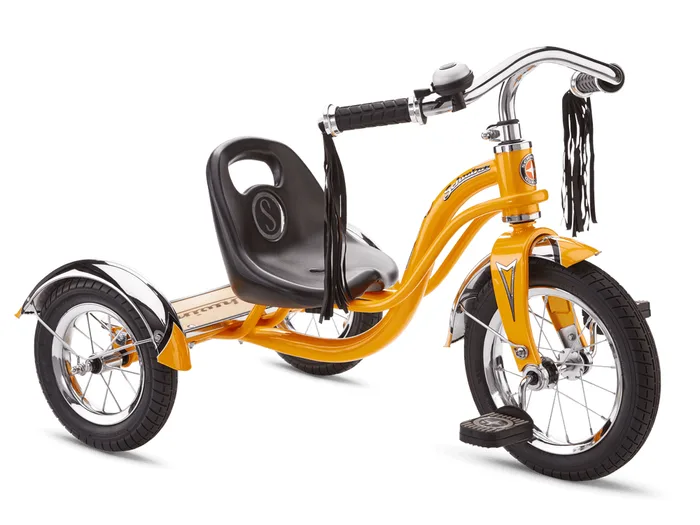
A handsome all-steel retro trike sold without the three numbers a parent most needs.
Best for: A buyer who wants the vintage Schwinn look for photos and a short driveway, and who can size the fit in person before buying.
- The five-position bucket saddle slides forward and back, so the fit can be tuned for growing legs.
- Construction is genuinely traditional: Hi-Ten steel frame, steel single-wall rims, chrome fenders and a real wood rear deck.
- Schwinn backs the frame with a limited lifetime warranty and one year on parts and accessories.
- The product page states no age range, no rider weight limit and no assembled weight, which makes it impossible to size or plan around.
- Frame, rims, rear hub, crank and handlebar are all steel, so this is the heavy option in a category where weight is the main failure point.
- The crank is described as fixed, meaning the pedals turn whenever the front wheel does and the child cannot coast.
- No brake and no parent push handle are listed, so there is no assisted mode and no way to slow the trike down a slope.
| Criteria | Tricycoo 4.1 Top pick | 4-in-1 Stroll 'N Trike | 12 Sport Balance Bike | Roadster Tricycle 12in |
|---|---|---|---|---|
| Verdict | Buy it | Buy it | It depends | Skip it |
| Best for | A family that wants one trike to carry a child from the stroller stage through solo pedaling without buying twice. | Parents who want a four-stage push trike with a generous weight ceiling and are willing to trade a brake and detailed specs for a lower price. | A confidently walking toddler whose parents care more about the transition to a pedal bike than about strolling. | A buyer who wants the vintage Schwinn look for photos and a short driveway, and who can size the fit in person before buying. |
| Price tier | $$ · mid-range | $ · budget | $$ · mid-range | $$ · mid-range |
| Type | Convertible push trike, 4 stages | Convertible push trike, 4 stages | Balance bike, no pedals | Classic pedal trike, fixed crank |
| Maker's stated age range | 10 months to 30 months and beyond | 1 to 5 years | 1 to 4 years | Not stated on product page |
| Rider weight limit | 44 lb | 49 lb | 60 lb | Not stated on product page |
| Product weight | 14.4 lb | 15.87 lb | 6.7 lb | Not stated on product page |
| Published fit data | Assembled dimensions only | Assembled dimensions only | Inseam 12 to 18 in, seat 11 to 17 in | Height 24 in, length 33 in |
| Parent push handle | Height-adjustable, removable | Adjustable, removable, foam grip | None | None |
| Restraint and brake | Harness plus removable safety guard; rear brakes | 3-point harness, high back seat; no brake listed | No harness; no brake listed | No harness; no brake listed |
| Wheels and tires | Wide rear wheels, material not stated | Wide rear wheels, material not stated | Flat-free foam rubber, 12 in | 12 x 2.25 in front, 10 x 2.25 in rear, steel rims |
Which one is right for you?
- A family that wants one trike to carry a child from the stroller stage through solo pedaling without buying twice. Buy it Joovy Tricycoo 4.1
- Parents who want a four-stage push trike with a generous weight ceiling and are willing to trade a brake and detailed specs for a lower price. Buy it Radio Flyer 4-in-1 Stroll 'N Trike
- A confidently walking toddler whose parents care more about the transition to a pedal bike than about strolling. It depends Strider 12 Sport Balance Bike
- A buyer who wants the vintage Schwinn look for photos and a short driveway, and who can size the fit in person before buying. Skip it Schwinn Roadster Tricycle 12in
How we judged the field
Five things decide whether a toddler trike gets ridden or gets abandoned behind the garage. First is the weight of the trike itself, because a child at this age has very little leg strength and a trike that resists them teaches them that pedaling is not fun. Second is the manufacturer’s stated age range paired with a rider weight limit, since those two numbers together tell you how many seasons you are actually buying. Third is published fit data, meaning inseam and seat height rather than just a box size, because fit is what lets a child reach the pedals through a full rotation. Fourth is adjustability of both the seat and the parent handle, which is what turns a one-year purchase into a three-year one. Fifth is the restraint and control package: harness type, safety guard, pedal lock and brake. We took every number in this piece from the manufacturer’s own product page, and where a page does not publish something we say so rather than guessing.
The field splits more sharply than the listings suggest. Convertible push trikes are essentially strollers that turn into trikes, and they are the option that suits a child under about 18 months, since the others need a child who can already pedal or walk steadily; the Joovy Tricycoo 4.1 and the Radio Flyer 4-in-1 Stroll ‘N Trike are the two mainstream versions of that idea, and we picked one of each price tier. Classic pedal trikes like the Schwinn Roadster Tricycle 12in skip the push phase entirely and ask the child to supply all the power from day one, which is a much bigger ask than it sounds. And balance bikes are the genuinely different answer, so we put the Strider 12 Sport in the field rather than pretending the question does not come up: it is the product a lot of parents should be comparing against, and its numbers make the case better than any argument does.
Joovy Tricycoo 4.1
Buy itJoovy publishes the numbers you actually need to plan around, which by itself puts the Tricycoo 4.1 ahead of most of the category. Four stages run from 10 months through 30 months and beyond, the rider limit is 44 pounds, and the assembled weight is 14.4 pounds, the lightest of the three trikes we looked at. That weight matters more than the feature list, because a toddler who cannot get the cranks turning simply stops trying. The pedal locking system lets you decide when the pedals start moving, which keeps the front wheel from spinning the pedals into a passenger’s shins while you push. Rear brakes, flip-down footrests, a removable safety guard, a height-adjustable parent handle and a removable UPF 50 canopy round it out. Two gaps are worth knowing about: Joovy states no wheel or tire material, and the page calls the restraint a 3-point harness in one place and a 5-point harness in another. This is for the parent who wants one trike to cover the whole stretch from stroller to solo riding.
Radio Flyer 4-in-1 Stroll ‘N Trike
Buy itThe Radio Flyer 4-in-1 Stroll ‘N Trike is the volume seller in this category and it earns that on breadth rather than refinement. Radio Flyer states 1 to 5 years, a 49 pound weight capacity that is the highest of the three trikes here, and an assembled weight of 15.87 pounds. Four ways to ride take it from infant trike through steering trike and learn-to-ride trike to classic trike, with a 3-point harness and high back seat for the earliest stage, a removable front wheel footrest, a UV-blocking canopy, a wrap-around tray with a cup holder and a rear storage bucket. The trade-offs are real. It is the heaviest thing here that a toddler is expected to pedal, Radio Flyer lists no brake at all, and the page states nothing about wheel or tire material. The listed range also starts at 1 year rather than 10 months, so the very earliest push phase is not the target. Get it if the higher weight ceiling and the lower price outrank the missing brake.
Strider 12 Sport Balance Bike
It dependsThe Strider 12 Sport is in this comparison because it answers the question most parents are actually asking, which is how to get a child riding. It weighs a stated 6.7 pounds assembled, less than half of either trike, and Strider is the only maker in this group that publishes real fit numbers: 12 to 18 inch inseam, 11 to 17 inch seat height, 18 to 22 inch handlebar height and a 60 pound maximum rider weight, all adjustable with tool-free clamps. The 12 inch flat-free foam rubber tires never need air, the frame is steel, and there are built-in footrests for coasting. What it will not do is the other half of the job. There are no pedals, no harness, no canopy and no parent handle, and Strider lists no brake, so feet are the stopping mechanism. It also needs a child who already walks well. Right for a family focused on riding skills, wrong for anyone who wanted a stroller substitute.
Schwinn Roadster Tricycle 12in
Skip itThe Schwinn Roadster Tricycle 12in is the trike people buy with their eyes, and the look is genuinely good: chrome fenders, mustache cruiser bars, tassels, a bell and a real wood rear deck with a burned-in logo. Underneath, the Hi-Ten steel frame, steel single-wall rims, steel bolt-on rear hub and one-piece steel handlebar and stem add up to the heaviest construction in this group, on a 12 by 2.25 inch front tire and 10 by 2.25 inch rears. The five-position bucket saddle slides fore and aft, which is a genuinely useful adjustment. The problem is what is missing from the page. Schwinn states no age range, no rider weight limit and no assembled weight, which makes it impossible to size for a specific child or to compare against anything else. The crank is described as fixed, so the pedals turn whenever the wheel does and there is no coasting, and no brake or push handle is listed. Buy it for the photograph, not for the ride.
Sources
Specs in this review come from these pages.
- Joovy - Tricycoo 4.1 Kids Tricycle product page (joovy.com)
- Radio Flyer - 4-in-1 Stroll 'N Trike product page (radioflyer.com)
- Strider - 12 Sport Balance Bike product page (striderbikes.com)
- Schwinn - Roadster Tricycle 12in product page (schwinnbikes.com)
- eCFR - 16 CFR Part 1250, Safety Standard for Toys (ecfr.gov)
- American Academy of Pediatrics - HealthyChildren.org, Bicycle Safety: Myths and Facts (healthychildren.org)
Joovy Tricycoo 4.1 vs Radio Flyer 4-in-1 Stroll ‘N Trike: which should you buy?
The Joovy Tricycoo 4.1 and the Radio Flyer 4-in-1 Stroll ‘N Trike sell the same idea, a trike that starts as a pushed seat and finishes as a solo ride, and they differ in exactly the places that matter. Joovy is lighter at a stated 14.4 pounds against 15.87, starts earlier at 10 months against 1 year, and is the only one of the two with a listed rear brake and a pedal locking system. Radio Flyer answers with a higher stated ceiling, 49 pounds against 44, and a listed age range that runs to 5 years rather than tapering off after 30 months. Neither maker publishes wheel material or seat height, so on those questions the two are equally uninformative.
Choose by which end of the range you are buying for. If your child is under 18 months and you want the trike to do stroller duty on real walks, take the Joovy: the earlier start, the lighter frame, the brake and the pedal lock all pay off in that phase, and a lighter trike is easier to lift into a trunk fifty times. If your child is already past two, on the taller or heavier side, and you mainly want a pedal trike with a handle for the tired stretch home, take the Radio Flyer: the extra five pounds of rider capacity buys you real months, and by that age the missing pedal lock no longer matters. If neither phase is what you want and the goal is riding a bike, neither of these is the answer and the Strider is.
What to look for
- Weigh the trike, not the child: the stated assembled weight is the number that predicts whether a toddler will pedal it or push it around by hand, and the spread across mainstream trikes is wide enough to matter.
- Demand two numbers, not one: an age range on its own tells you almost nothing without a rider weight limit next to it, and a page that publishes neither is a page that cannot be compared.
- Look for inseam or seat height: most trike makers publish only assembled dimensions, so if a listing gives you a seat height range or an inseam range, that is a strong signal the maker expects you to size the product properly.
- Check that the handle adjusts, not just that it exists: a fixed-height push handle set for an average adult means someone in the household stoops for the whole walk, and both convertible trikes we recommend list height adjustment.
- Find out what stops it: a rear brake is not standard in this category, and on a trike with a fixed crank the child’s legs are the only brake, which is worth knowing before you meet your first slope.
- Treat wheel material as a real spec: foam and rubber tires grip and cushion differently from hard plastic, but many trike pages state nothing at all, so if the ride surface matters to you, ask before you buy rather than assuming.
Our final take
Buy the Joovy Tricycoo 4.1 if you want one product to carry a child from the push phase to solo pedaling, because it is the lightest of the trikes here, it starts the earliest, and it is the only one whose maker lists both a pedal lock and a rear brake. Take the Radio Flyer 4-in-1 Stroll ‘N Trike if the higher stated rider ceiling and the lower price matter more to you than the missing brake. If what you actually want is a child who can ride a bike, buy the Strider 12 Sport instead of a trike and skip the intermediate step entirely. And leave the Schwinn Roadster Tricycle 12in on the shelf unless you can size it in person, because a product page with no age range, no weight limit and no weight is not something you can buy sight unseen.
Questions, answered
Should we get a trike or a balance bike first?
It depends on what you want out of it in the next twelve months. A convertible trike is really two products: a pushed seat for a child too young to steer, and a pedal vehicle later, and that first job is the one a balance bike cannot do at all. A balance bike is the better tool for the specific skill of riding a two-wheeler, because balancing and steering are the hard parts and pedaling is comparatively easy to add afterwards. Weight is the honest tiebreaker: Strider states 6.7 pounds for the 12 Sport, while the trikes here are stated at 14.4 and 15.87 pounds. If your child already walks confidently and you mostly want them moving under their own power, start with the balance bike. If you want something that also replaces a stroller on a park walk, get the convertible trike.
At what age can a toddler actually pedal?
Manufacturers answer this indirectly through their stage descriptions rather than with a single number. Joovy structures the Tricycoo 4.1 around four stages and describes independent riding at 30 months and beyond, with earlier stages covering pushing and steering. Radio Flyer lists its 4-in-1 for 1 to 5 years across four ways to ride, from infant trike up to classic trike. Both designs assume a long stretch where the adult supplies the power and the child supplies the enthusiasm. The practical test is whether the child's legs can push a crank through a full circle without the seat needing to be so far forward that their knees hit the handlebar, which is why a seat that slides and a low overall trike weight matter more than the stated age.
Is the parent push handle a gimmick?
No, it is the feature that determines how early the trike is useful and how long it stays useful. Without it you have a vehicle a child can only use once they can already pedal and steer, which is a much narrower window. Joovy lists a height-adjustable handle and Radio Flyer lists an adjustable Steer & Stroll handle with a foam grip, and both come off once the child rides alone. Height adjustment is the part to check, because a handle set for a shorter adult forces a taller one to stoop for the length of a walk. Neither the Strider 12 Sport nor the Schwinn Roadster lists a push handle, which is a deliberate design choice in both cases rather than an omission.
Is a heavier trike more stable?
Stability comes from wheelbase, track width and how low the seat sits, not from mass. A heavier trike is harder for a toddler to get moving, harder to stop once it is moving down a slope, and harder for a parent to carry up stairs or lift into a trunk. The Schwinn Roadster illustrates the trade: an all-steel build with steel rims and hubs looks and feels solid, and Schwinn does not publish its assembled weight. Among the products that do publish it, the range here runs from 6.7 pounds to 15.87 pounds, which is more than a two to one spread. If two trikes have similar footprints, take the lighter one.
Does a toddler need a helmet on a trike?
Treat it as yes and build the habit early, because the habit is the point. The American Academy of Pediatrics states through HealthyChildren.org that a child needs to wear a helmet on every bike ride, no matter how short or how close to home. A trike sits low and moves slowly, which makes the risk smaller than on a two-wheeler, but a child who only wears a helmet sometimes will fight you about it later when the speeds are higher. A helmet that fits a toddler head sits level, not tipped back, and the strap should be snug enough that the helmet moves the scalp when you wiggle it. Fit it once properly and re-check the fit each season.
Deciding between the top two? See our head-to-head: Joovy Tricycoo 4.1 vs Radio Flyer 4-in-1 Stroll 'N Trike.
More Baby & Family reviews
 The Best Toddler Utensils: 4 Compared (and One to Skip)
  The Best Toy Storage Organizers: 4 Compared (and One to Skip)
  The Best Train Sets: 4 Compared (and One to Skip)
  The Best Travel Strollers: 4 Compared (and One to Skip)
  Best Video Baby Monitors: What Actually Earns a Spot in the Nursery (and One to Skip)
  The Best Weighted Stuffed Animals: 4 Compared (and One to Skip)