Explained
Toddler Step Stools and Kitchen Helper Towers, Explained
After reading, you'll understand which numbers on a toddler tower listing predict how safe and how long-lived it is, and which ones are decoration.
In this guide
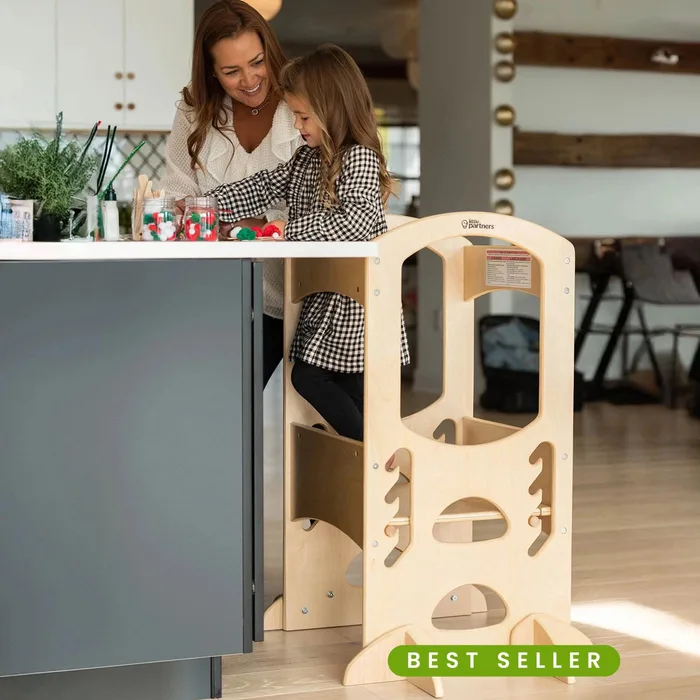
First-time buyers almost always shop on overall height and looks, and those are the two least useful signals in the category. The listing photo shows a smiling toddler at a counter, but nothing tells you whether that platform sits at 12 inches or 18, which is the difference between a usable tower and one your child cannot reach the counter from. The other trap is the word safe. Almost every listing uses it, very few say what the product was tested against, and the chemical tests most makers cite have nothing to do with whether the platform holds. Learning to read four or five numbers takes about a minute and rules out most of the field.
The 30-second version
- Platform height is the spec that matters, and overall height is the one most listings lead with because it sounds bigger.
- An enclosure is not a rail on one side, and the recall record in this category includes tipping and platforms that loosen.
- Base width is a safety spec, because current wide bases exist as a direct response to earlier narrow models that tipped over.
- The federal rule covers folding stools, so a rigid learning tower sits in a gap where no mandatory standard was written for it.
- Weight capacity ranges from 60 to 250 pounds, which tells you more about how a product was engineered than any marketing line.
The products this guide is about
Our verdict on each, with the full reasoning on the companion review.
- Buy Little Partners The Learning Tower Toddler Tower The widest platform-height range here, wrapped in four-sided railings on a frame rated to 250 pounds. Amazon
- Buy Guidecraft Classic Kitchen Helper Toddler Tower A folding hardwood tower with removable front and back panels that fits a 23 by 23 inch square of floor and disappears when you are done. Amazon
- It depends Simplay3 Toddler Tower Adjustable Stool Double wall plastic on a deliberately wide base, with the lowest published starting platform of the three towers and the lowest weight ceiling. Amazon
- Skip Cosco 2-Step Kitchen Stepper Folding Step Stool, Premium Safety Series A folding stool that Cosco itself rates for ages 4 and up, which makes it the wrong tool for the toddler this category is about. Amazon
What actually matters
- Platform height - the distance from the floor to the standing surface, and the only number that predicts whether your child can work at the counter. Compare it against your counter height minus roughly your child's chest height.
- Adjustability - how many positions the platform has and whether changing it needs tools. Four positions with no tools means you will actually move it as the child grows, rather than leaving it wrong for a year.
- Enclosure - whether the standing area is closed on all four sides or has open gaps. Open gaps at the front or back of the standing area are a hazard worth checking for on any tower.
- Footprint and base width - the floor area the product occupies, and how wide the base is relative to the platform. A wide base is what resists tipping when a child leans out toward the counter.
- Weight capacity - the maker's stated maximum load. It is rarely about a toddler's actual weight and mostly a proxy for how the joinery, fasteners and frame were designed.
- Non-slip surfaces and feet - texture or a mat on the platform and steps, plus rubber feet at the floor. Products often have one and not the other, and the listing will only mention the one they have.
- Stated age range - the window the maker will stand behind. It varies from 18 months to 7 years down to 1.5 to 5 across otherwise similar towers, and buying at the low end of a wide range gets you more years.
The specs, in plain English
Green flags vs red flags
Green flags
- Every platform position is listed in inches, not just the overall height.
- The standing area is enclosed on all four sides, or panels and nets are included rather than sold separately.
- The base is visibly wider than the platform, with rubber or non-skid feet at every corner.
- The maker publishes both a weight capacity and a specific age range with a minimum and a maximum.
- A structural standard is named, such as ASTM F2613, rather than only a chemical or emissions certification.
Red flags
- Only an overall height is given, with no platform or standing height anywhere on the page.
- Large open gaps at the front or back of the standing area, which lets a child lean or slip through.
- No weight capacity, no age range, or an age range with no upper bound.
- The word safe used repeatedly with no standard, test or certification named alongside it.
- A generic brand name on a marketplace listing with no manufacturer website, so there is nobody to contact if a recall lands.
Who's who: the brands
- Little Partners - Makes The Learning Tower, the rigid four-sided wooden tower with the widest platform-height range in this comparison, backed by a lifetime warranty.
- Guidecraft - Owns the Kitchen Helper line, including the folding hardwood Classic Kitchen Helper tower.
- Simplay3 - US-made double wall plastic children's furniture, including the wipe-clean Toddler Tower with a wide six-footed base.
- Cosco - A long-standing maker of household folding step stools and ladders, sold for adults and older children rather than toddlers.
- Ette Tete - A European brand known for Montessori-styled wooden helper towers, including foldable and convertible tower-to-table designs.
How to read a listing without getting fooled
Start at the specifications block rather than the bullet list, because the bullets are marketing and the block is what the maker will stand behind. Find the platform or standing height first, and if the page only gives an overall height, treat the listing as incomplete and move on. Then look for the footprint as width by depth, because depth is what will surprise you in a narrow kitchen, and compare it to the platform size to judge how wide the base really is. Check the weight capacity and the age range together: a product rated to 60 pounds and one rated to 250 are built differently, whatever they look like in the photo. Finally, read what the safety claims actually reference. Chemical certifications like GREENGUARD Gold and toy standards like ASTM F963 are real but narrow, and a structural specification such as ASTM F2613 is the one that speaks to whether the thing holds a child.
How much should you spend?
The budget tier is dominated by plain folding step stools and by marketplace towers from brands with no manufacturer site, and the latter are the hardest to follow up when a recall lands. Mid-range is where the category actually works: folding hardwood towers and moulded plastic towers from established makers, with published platform heights, real weight ratings and a company to call when something goes wrong. The premium tier buys you the widest range of platform positions, heavier construction with a much higher weight rating, and longer warranties, and whether that is worth it depends mostly on whether you have the floor space to keep a rigid tower up permanently. Accessories like trays, mats and safety nets are usually sold separately across every tier, so factor them in when a listing describes an enclosure that turns out to be an add-on.
Questions, answered
Do I need the non-slip mat, or is it a gimmick?
It is worth having on any platform that is bare finished wood, because wet hands and a wooden surface are a bad combination and the platform is exactly where the water lands. Some towers include one, and Guidecraft ships a mat with the Classic Kitchen Helper. Plastic towers usually mould texture into the platform instead, which does the same job without an extra part to lose. What you should not do is treat a mat as a substitute for non-slip feet at the floor, since those two solve different problems.
Can two children share one tower?
Some towers are built wide enough for it and some are not, and the weight capacity is where you check rather than the platform size. A tower rated to 60 pounds is not a two-child product once both children are past toddlerhood, whereas a 250 pound rating leaves plenty of headroom. If you are considering doubling up on a single-width platform, remember that two children shifting independently is a harder load case than one, especially near the edge.
Wood or plastic?
Plastic wins on cleaning and weight, since a moulded tower wipes down after a flour-and-egg session and is light enough to move with one hand. Wood tends to win on weight capacity, on how long the maker rates it, and on looking like furniture in a room you spend hours in. The safety difference is not really about material, it is about enclosure and base width, and there are good and bad examples in both. Choose on how messy your cooking gets and how much you mind seeing it in the kitchen.
Where should the tower actually go in the kitchen?
Away from the cooktop and away from anything sharp within arm's reach, which is the part no product feature covers. A tower puts a toddler's hands at counter level, and that means every knife, hot pan handle and mixer on that counter is now reachable. The practical approach is to pick one prep zone that stays clear, keep the tower there, and move the child rather than the hazards. Most towers are designed to sit flush against the counter, so pushing it in tight also removes the gap a child could slip a foot into.
Or jump to the head-to-head: Little Partners The Learning Tower Toddler Tower vs Guidecraft Classic Kitchen Helper Toddler Tower.