

Baby & Family
The Best Toddler Step Stools and Kitchen Helper Towers: 4 Compared (and One to Skip)
We compared four ways to get a toddler up to counter height on the numbers that decide how safe and how useful they are: platform height and how far it adjusts, footprint, weight capacity, and whether the standing area is actually enclosed.
The short version
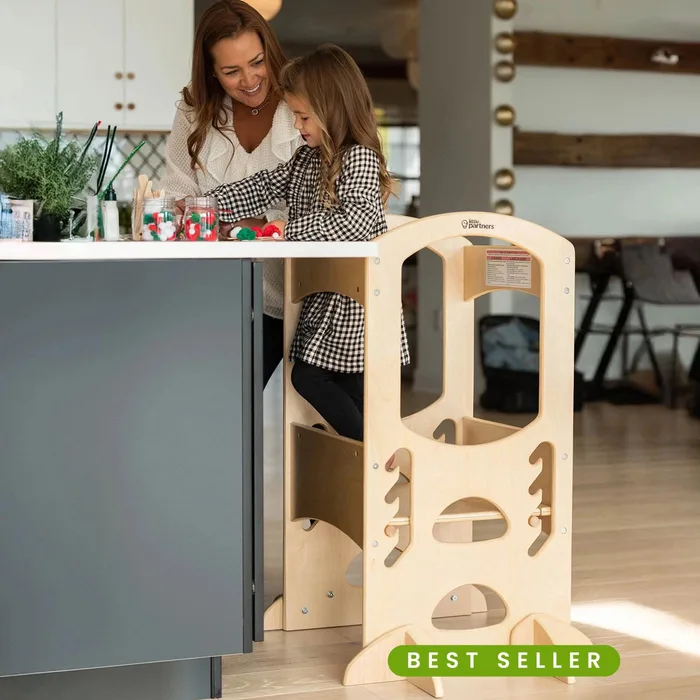
The Learning Tower Toddler Tower from Little Partners is the pick if you have the floor space: four tool-free platform positions from 10.59 to 18.39 inches, four-sided railings, and a 250 pound rating on a layered birch and poplar frame. Guidecraft's Classic Kitchen Helper Toddler Tower is the value choice and the better fit for a small kitchen, because it folds flat, ships almost assembled, and covers 18 months to 7 years with removable front and back panels around the standing area. The Simplay3 Toddler Tower Adjustable Stool suits anyone who wants wipe-clean plastic and a low 12 inch first platform, but its stated 60 pound maximum and 1.5 to 5 year range are the tightest here. Skip the Cosco 2-Step Kitchen Stepper for this job: the maker rates it for ages 4 and up, and its only guard is a rear safety bar, which is not the same thing as an enclosure. Note that Guidecraft, Little Partners and Simplay3 have all had a tower recalled, on models other than the ones here, so check the label under your platform before you use anything secondhand. The safety point that survives all of it is that an enclosed platform and a wide base change the odds, and supervision covers what neither can. Best for: parents who want a toddler at counter height with a rail on every side and a platform that drops low enough to actually be used at two.
Our picks at a glance
- Little Partners The Learning Tower Toddler Tower - Buy. The widest platform-height range here, wrapped in four-sided railings on a frame rated to 250 pounds.
- Guidecraft Classic Kitchen Helper Toddler Tower - Buy. A folding hardwood tower with removable front and back panels that fits a 23 by 23 inch square of floor and disappears when you are done.
- Simplay3 Toddler Tower Adjustable Stool - It depends. Double wall plastic on a deliberately wide base, with the lowest published starting platform of the three towers and the lowest weight ceiling.
- Cosco 2-Step Kitchen Stepper Folding Step Stool, Premium Safety Series - Skip. A folding stool that Cosco itself rates for ages 4 and up, which makes it the wrong tool for the toddler this category is about.
The verdict in 30 seconds
What mattered most
- Platform height
- Height positions
- Footprint (W x D)
- Weight capacity
- Enclosure
- Stated age range
Getting a toddler up to the counter is one product decision with four very different answers: an enclosed wooden tower, an enclosed plastic tower, a folding helper stool, and a plain open step stool. They are not interchangeable, and the difference shows up in the one number most listings bury, which is how high the platform sits. The category also has a live safety story: CPSC and the makers have published toddler tower recalls for tipping and for platforms that collapse or detach. We picked four products that are currently sold by their makers, pulled every spec from the manufacturer's own page, and checked each brand against the CPSC recall record.
The widest platform-height range here, wrapped in four-sided railings on a frame rated to 250 pounds.
Best for: A family with room for a permanent tower who wants the platform to drop low enough to use at two and still work at five.
- Platform adjusts to four heights, 10.59, 13.19, 15.79 and 18.39 inches, with no tools needed to change it.
- Four-sided railings enclose the standing area, and the frame is rated to 250 pounds.
- Little Partners covers it with a lifetime warranty and rates it for ages 2 to 6.
- The assembled footprint is 23.18 by 33.14 inches, which is a lot of floor in a narrow kitchen.
- The product page describes no folding option, so there is no flat-storage option when you want the space back.
- Assembly is a real job rather than attaching a couple of feet.
- The safety testing the maker cites, ASTM F963-17 and 16 CFR Part 1307, covers lead, heavy metals and phthalates, not structural stability.
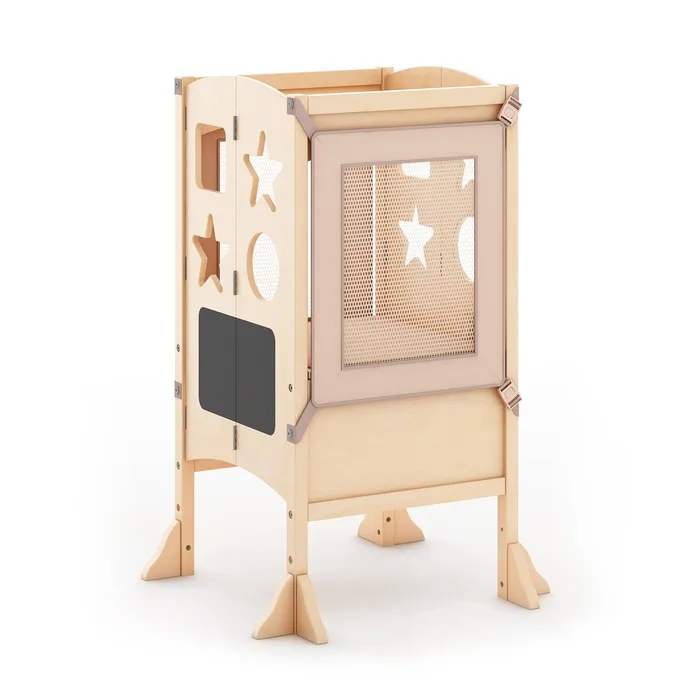
A folding hardwood tower with removable front and back panels that fits a 23 by 23 inch square of floor and disappears when you are done.
Best for: A small kitchen where the tower has to fold away, and a household that wants the same stool to still work at six.
- Folds flat for storage and ships almost fully assembled, with only the feet to attach.
- Non-slip glides on the steps plus an included non-slip mat for the platform, and anti-tip feet at the base.
- Rated 18 months to 7 years, the widest stated age span in this group, and GREENGUARD Gold certified.
- Two platform positions only, 15 and 18 inches, so there is no low setting for a brand new climber.
- The 125 pound rating is half what the Little Partners tower carries.
- Guidecraft recalled Classic and Contemporary Kitchen Helper towers sold between June 2022 and October 2023 because the platform could loosen or detach, so check the item and lot number on the foil sticker under any older unit.
- Removable front and back panels are only doing their job while they are actually installed.
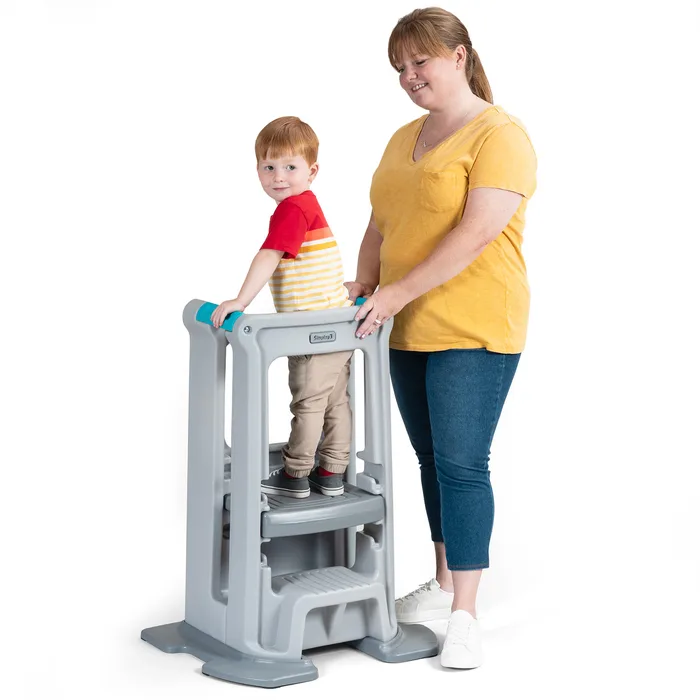
Double wall plastic on a deliberately wide base, with the lowest published starting platform of the three towers and the lowest weight ceiling.
Best for: Messy-cooking households that want something they can hose off, and toddlers young enough to need a 12 inch platform.
- Platform sets at 12, 15 or 18 inches, so a 1.5 year old gets a usable first height.
- A 26 by 20.5 inch base with six non-skid rubber feet, plus high sides around the standing area.
- Double wall plastic wipes clean, weighs 15 pounds, and is made in the USA with minimal adult assembly.
- Stated maximum weight is 60 pounds, well under the wooden towers here.
- Rated only to 5 years, so the runway is shorter than Guidecraft's 7.
- It does not fold, though it is designed to store under most standard counters.
- Simplay3 recalled an earlier Toddler Tower, model 41807, for tipping over and offered free stabilizing bases, so check which version you have.
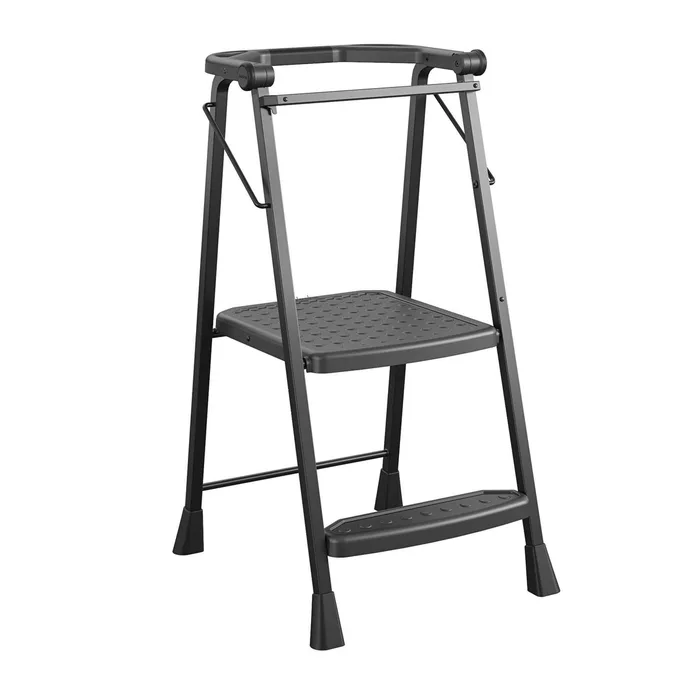
A folding stool that Cosco itself rates for ages 4 and up, which makes it the wrong tool for the toddler this category is about.
Best for: An adult who wants a compact kitchen stool, or an older child of four or more who is past needing an enclosure.
- Rated to 225 pounds with a 10 year limited warranty.
- Weighs 10.63 pounds and folds flat for storage.
- A rear safety bar with a locking mechanism.
- Cosco states ages 4 and up, so it is not rated for the 18 month to 3 year old most people are shopping for.
- The only guard is a rear safety bar, with nothing at the front or sides where a child leans toward the counter.
- The top step height, the number that actually decides whether a child reaches the counter, is not published on the product page.
- A folding mechanism is one more thing that has to stay locked under a moving child.
| Criteria | The Learning Tower Toddler Tower Top pick | Classic Kitchen Helper Toddler Tower | Toddler Tower Adjustable Stool | 2-Step Kitchen Stepper Folding Step Stool, Premium Safety Series |
|---|---|---|---|---|
| Verdict | Buy it | Buy it | It depends | Skip it |
| Best for | A family with room for a permanent tower who wants the platform to drop low enough to use at two and still work at five. | A small kitchen where the tower has to fold away, and a household that wants the same stool to still work at six. | Messy-cooking households that want something they can hose off, and toddlers young enough to need a 12 inch platform. | An adult who wants a compact kitchen stool, or an older child of four or more who is past needing an enclosure. |
| Price tier | $$$ · premium | $$ · mid-range | $$ · mid-range | $ · budget |
| Platform height | 10.59, 13.19, 15.79, 18.39 in | 15 or 18 in | 12, 15 or 18 in | Not published |
| Height positions | 4, tool-free | 2 | 3 | Fixed two-step |
| Footprint (W x D) | 23.18 x 33.14 in | 23 x 23 in | 26 x 20.5 in | Not stated on product page |
| Weight capacity | 250 lb | 125 lb | 60 lb | 225 lb |
| Enclosure | Four-sided railings | Rails plus removable front and back panels | High sides on a wide base | Rear safety bar only |
| Stated age range | 2 to 6 years | 18 months to 7 years | 1.5 to 5 years | 4 years and up |
| Material | Layered birch and poplar | Solid hardwood and birch plywood | Double wall plastic | Not stated on product page |
| Assembly and storage | Assembly required | Attach feet only, folds flat | Minimal assembly, stores under counters | Folds flat |
Which one is right for you?
- A family with room for a permanent tower who wants the platform to drop low enough to use at two and still work at five. Buy it Little Partners The Learning Tower Toddler Tower
- A small kitchen where the tower has to fold away, and a household that wants the same stool to still work at six. Buy it Guidecraft Classic Kitchen Helper Toddler Tower
- Messy-cooking households that want something they can hose off, and toddlers young enough to need a 12 inch platform. It depends Simplay3 Toddler Tower Adjustable Stool
- An adult who wants a compact kitchen stool, or an older child of four or more who is past needing an enclosure. Skip it Cosco 2-Step Kitchen Stepper Folding Step Stool, Premium Safety Series
How we judged the field
Five things decide whether one of these is worth owning. First is platform height and how many positions it has, because that single number sets whether the child can reach the counter at all and how many years you get out of the purchase. Second is footprint, since a tower lives on the floor of the busiest room in the house. Third is the enclosure: whether the standing area is closed on all four sides, or whether there are open gaps a child can lean or slip through. Fourth is the base and the feet, because tipping is what CPSC keeps citing when it pulls these off the market. Fifth is weight capacity and stated age range, which together tell you what the maker actually engineered for.
The field splits into forms that are not really substitutes. A rigid wooden tower is the maximum-enclosure, maximum-lifespan version and costs you floor space. A folding wooden tower trades one platform position and some weight capacity for the ability to disappear behind a door. A plastic tower is the wipe-clean option with the lowest starting platform and the lowest weight ceiling. And a plain step stool is a different product that people buy for this job anyway. We took the best-verified example of each, pulled every number from the manufacturer’s own page rather than a retailer listing, and cross-checked each brand against CPSC’s recall database.
Little Partners The Learning Tower Toddler Tower
Buy itLittle Partners builds the tower most people picture when they hear the phrase, and the spec that justifies the price is the range of platform positions. It sets at 10.59, 13.19, 15.79 and 18.39 inches, and moves between them without tools, which matters because the height a two year old needs is not the height a five year old needs and you will change it more than once. Four-sided railings enclose the standing area, with two steps and openings sized for climbing in and out. The frame is layered birch and poplar that Little Partners describes as EPA TSCA Title VI compliant, rated to 250 pounds, and covered by a lifetime warranty for ages 2 to 6. The trade-offs are floor space and permanence: assembled it is 23.18 inches wide by 33.14 inches deep and 38.07 inches tall, the page describes no folding option, and assembly is a genuine session rather than a five minute job. Buy it if you have the corner to give it.
Guidecraft Classic Kitchen Helper Toddler Tower
Buy itGuidecraft’s Classic is the answer for a kitchen that cannot spare a permanent 33 inch footprint. It measures 23 inches square and 36 inches tall, folds flat, and ships almost fully assembled so the only step is attaching the feet. The platform adjusts to 15 or 18 inches, the steps carry non-slip glides, a non-slip mat is included for the platform, anti-tip feet sit at the base, and the front and back panels can be removed when you need to get a child in and out more easily. Solid hardwood and birch plywood, GREENGUARD Gold certification, and a stated 18 months to 7 years give it the longest official runway here. The limits are honest ones: 125 pounds rather than 250, and only two platform positions, so there is no low setting for a new climber. Guidecraft also recalled Classic and Contemporary towers sold between June 2022 and October 2023, which is why the label under the platform is worth reading on anything used.
Simplay3 Toddler Tower Adjustable Stool
It dependsThe Simplay3 is the plastic answer, and it is a real answer rather than a downgrade. The standing platform sets at 12, 15 or 18 inches, which gives it the lowest published first position among the towers apart from Little Partners, and it sits on a deliberately wide 26 by 20.5 inch base with six non-skid rubber feet and high sides around the standing area. Double wall plastic made in the USA wipes down after the kind of cooking session that ruins a wooden platform, the whole thing weighs 15 pounds, assembly is minimal, and it is designed to tuck under most standard counters. Two numbers make this a conditional recommendation rather than a straight one: the stated maximum weight is 60 pounds, and the rated range stops at 5 years. Simplay3 also recalled an earlier Toddler Tower, model 41807, for tipping over, which is the context for the wide base on this one. Right product, narrower window.
Cosco 2-Step Kitchen Stepper Folding Step Stool, Premium Safety Series
Skip itCosco’s Kitchen Stepper is a good stool being asked to do a job it was not built for. On its own terms it is a sensible stool: rated to 225 pounds, 10.63 pounds in weight, folding flat, with a rear safety bar locking mechanism and a 10 year limited warranty. The problem is the age line. Cosco states ages 4 and up, which is past the window most people are shopping for, and the only guard is at the back, so there is nothing between a child and the counter edge at the front or sides where they actually lean. The top step height is not published, so you cannot tell from the listing whether it even brings a child to counter level. Add a folding mechanism that has to stay locked under a moving child and it is the wrong buy for a toddler, and a perfectly reasonable one for an adult or an older kid.
Sources
Specs in this review come from these pages.
- Little Partners - The Learning Tower Toddler Tower product page (littlepartners.com)
- Guidecraft - Classic Kitchen Helper Toddler Tower product page (guidecraft.com)
- Simplay3 - Toddler Tower Adjustable Stool product page (simplay3.com)
- Cosco - 2-Step Kitchen Stepper Folding Step Stool product page (coscoproducts.com)
- eCFR - 16 CFR Part 1232, Safety Standard for Children's Folding Chairs and Children's Folding Stools (ecfr.gov)
- CPSC - Guidecraft Children's Standing Towers recall, May 2026 (cpsc.gov)
Little Partners The Learning Tower Toddler Tower vs Guidecraft Classic Kitchen Helper Toddler Tower: which should you buy?
The choice between the Little Partners tower and the Guidecraft Classic comes down to floor space and how young your child is. Little Partners wins on range: four platform positions starting at 10.59 inches means a two year old can use it properly on day one, and 250 pounds of rated capacity with four-sided railings is the most substantial build here. Guidecraft wins on living with it: 23 inches square instead of 33 inches deep, folds flat behind a door, arrives needing only its feet attached, and stays rated until 7. If your kitchen has an unused corner, the extra height range and the heavier frame are worth having. If you would end up moving the tower every evening, you will use the folding one more.
There is a second, quieter difference. Because the Guidecraft folds, it falls inside 16 CFR Part 1232, the mandatory federal rule for children’s folding chairs and folding stools, which requires compliance with ASTM F2613-21. The rigid Little Partners tower is not clearly covered by any mandatory rule written for this product, and the testing Little Partners cites, ASTM F963-17 and 16 CFR Part 1307, is chemical testing for lead, heavy metals and phthalates rather than a stability test. That is not a reason to avoid it, and the tower is visibly the heavier build of the two. It is a reason to read what a maker means when it says safety tested, in a category where the regulatory floor is thinner than most parents assume.
What to look for
- Platform height, not overall height: the standing surface is the number that decides whether your child reaches the counter, and overall height just adds the rails on top of it.
- A closed standing area: open gaps at the front or back of the standing area are a place a child can lean or slip through, so look for rails or panels on every side.
- Base width against tower height: the wide stabilizing bases you see on current models exist because the narrow ones tipped, and a base that is barely wider than the platform is a warning.
- Non-slip in two places: you want a textured or matted platform surface and non-slip feet at the floor, and plenty of listings quietly provide only one of the two.
- A published weight capacity and age range: these vary from 60 to 250 pounds across otherwise similar products, and a listing that omits both is telling you the maker did not want to commit.
- The label under the platform: item, model and lot or date codes are how every recall in this category is defined, so photograph it on arrival and check it on anything bought secondhand.
Our final take
Buy the Little Partners Learning Tower if you have the floor for it, because the 10.59 inch bottom platform and the four tool-free positions get you more usable years than anything else here, and the four-sided railings and 250 pound frame are the most reassuring build in the group. Buy the Guidecraft Classic if your kitchen is tight, and accept two platform heights in exchange for a tower that folds flat and ships nearly assembled. Take the Simplay3 if wipe-clean plastic and a 12 inch starting platform matter more than the 60 pound ceiling. Skip the open folding stool for a toddler. And place whichever one you choose away from the stove and away from the knife block, because that part is on you and no product solves it.
Questions, answered
Is an enclosed tower really safer than a step stool at the same height?
The hazard in this category is a fall from height, and an enclosure changes what happens when a child shifts their weight. On an open stool, leaning toward the counter or turning around puts the child past the edge of the platform with nothing in the way. A rail on all four sides gives them something to meet first. Recalls in this category have been issued for towers that tip and for platforms that loosen or collapse. That is a useful signal about what actually matters, which is a genuinely closed standing area and a base wide enough not to tip.
Is there a safety standard that covers learning towers?
Not one written for them. The closest mandatory federal rule is 16 CFR Part 1232, the Safety Standard for Children's Folding Chairs and Children's Folding Stools, which requires compliance with ASTM F2613-21, the Standard Consumer Safety Specification for Children's Chairs and Stools. By its own terms that part covers folding chairs and folding stools, so a folding helper tower falls inside it and a rigid, non-folding tower does not clearly land anywhere. That gap is worth knowing about when a listing says a product is safety tested. Ask what it was tested against, because chemical testing under ASTM F963 or 16 CFR Part 1307 covers lead, heavy metals and phthalates, and says nothing about whether the platform holds.
What platform height do I actually need?
Measure your counter, then subtract roughly your child's standing height minus the distance from their feet to their chest. Most kitchen counters sit around 36 inches, so a toddler who is about 34 inches tall needs a platform somewhere near 15 inches to work comfortably with their hands on the surface rather than at chin level. The number to look for on a listing is the platform or standing height, not the overall height, which includes the rails and tells you nothing. Two of these towers publish every position: Little Partners at 10.59 to 18.39 inches and Simplay3 at 12, 15 and 18. If the seller only gives you overall height, treat that as a gap.
Three of these brands have had a recall. Should that put me off?
It should make you check labels rather than avoid brands. Little Partners recalled the Grow 'N Stow Folding Learning Tower, model LP01711 with date codes 202409 through 202501, because the platform could collapse. Guidecraft recalled Classic and Contemporary Kitchen Helper towers in May 2026 for units sold between June 2022 and October 2023, identified by item and lot number on the foil sticker under the platform. Simplay3 recalled model 41807 for tipping. None of those covers the specific current models compared here, and in each case the firm offered a free repair. The practical rule is to find the label under the platform on any tower you buy secondhand and look the numbers up before a child stands on it.
When can a child start using a tower, and when do they stop?
The makers disagree, which is itself useful. Guidecraft rates the Classic Kitchen Helper from 18 months to 7 years, Simplay3 rates its Toddler Tower from 1.5 to 5 years, and Little Partners rates the Learning Tower from 2 to 6. The low end is really about whether the child can climb in and stand steadily without help, so a confident 18 month old and a wobbly two year old are different cases regardless of the label. The high end is about weight and reach: once a child can use a normal step stool safely and has outgrown the tallest platform setting, the tower is just furniture. Buying at the lower end of the range gets you more years out of it, provided the platform actually drops low enough.
Deciding between the top two? See our head-to-head: Little Partners The Learning Tower Toddler Tower vs Guidecraft Classic Kitchen Helper Toddler Tower.
More Baby & Family reviews
 The Best Toddler Tricycles: 4 Compared (and One to Skip)
  The Best Toddler Utensils: 4 Compared (and One to Skip)
  The Best Toy Storage Organizers: 4 Compared (and One to Skip)
  The Best Train Sets: 4 Compared (and One to Skip)
  The Best Travel Strollers: 4 Compared (and One to Skip)
  Best Video Baby Monitors: What Actually Earns a Spot in the Nursery (and One to Skip)