Explained
Tire Levers, Explained
After reading, you'll understand why levers break, what carbon safe means in practice, and the technique that makes the tool matter less.
In this guide
Tire levers are bought on impulse and remembered on the roadside. The category looks like it cannot be got wrong, and then a tubeless bead loads a thin blade sideways and it folds. Two things fix this. One is choosing a lever whose maker will describe how it is built. The other is a removal technique that generates slack before you apply force, which makes almost any decent lever adequate.
The 30-second version
- Cross-section beats thickness, which is why a hollow box section resists folding better than a flat blade.
- Levers are removal tools, and using them to install a tire is how tubes get pinched and carbon beds get gouged.
- Carbon safe means a soft contact surface, either a plastic lever or a shielded metal one, not a bare alloy blade.
- Push the beads into the rim's centre channel first, because the slack you gain there is worth more than any lever.
- A spoke hook is a technique enabler, since you need to hold one section of bead while working the next.
The products this guide is about
Our verdict on each, with the full reasoning on the companion review.
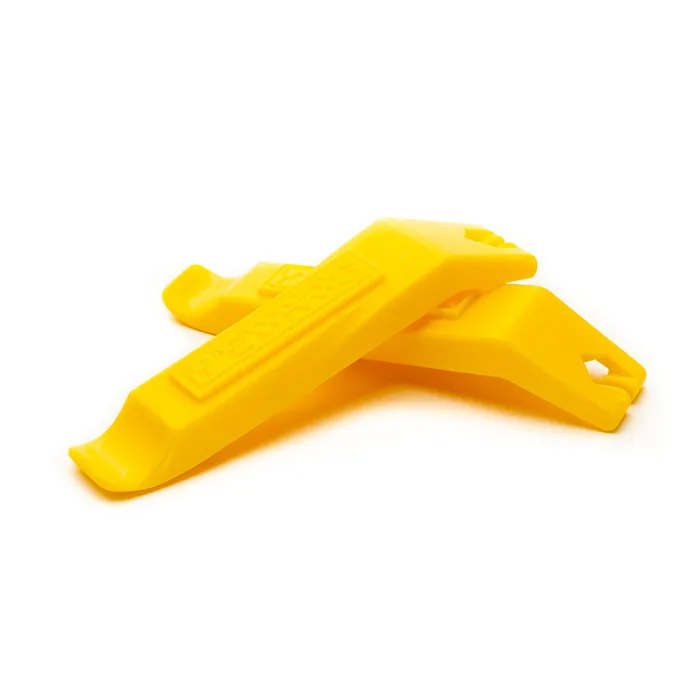
- Buy Pedro's Tire Levers The thick yellow lever that has survived a generation of tight tires.
- Buy SILCA Tire Levers Premio A forged alloy lever with a nylon rim shield, built for carbon rims and sold with real instructions.
- It depends Wolf Tooth 8-Bit Tire Lever and Disc Brake Multi-Tool One long lever that also carries an 8mm flare wrench and a rotor truing slot.
- Skip Muc-Off Rim Stix Tyre Lever A perfectly ordinary pair of levers sold on adjectives, with no material, weight or size published.
What actually matters
- Cross-section - the shape of the lever in profile. A hollow box section, like Pedro's molded box construction, is far stiffer for its weight than a solid flat blade, and stiffness is what stops a lever folding.
- Material - what the lever is actually made from. Named materials such as 7075-T6 aluminium or a nylon composite tell you something about stiffness and fatigue; unnamed high-strength materials do not.
- Tip geometry - the profile of the end that goes under the bead. A chisel or tapered angled tip slides in without needing a point, and a point is what catches inner tubes and rim tape.
- Rim contact surface - what touches the rim when you pull. On carbon this is the difference between a scuff and a gouge, which is why SILCA puts a reinforced nylon shield on a forged alloy body.
- Spoke hook - the notch or wing that lets you hang the lever on a spoke. It is how you hold a section of bead while walking a second lever around the rim.
- Length - leverage against packability. Wolf Tooth's 146mm 8-Bit lever gives noticeably more purchase on a stubborn mountain bike tire than a short lever, and takes up more room.
- Count per pack - two is the working minimum for the standard technique, and a third costs almost nothing and covers a break.
The specs, in plain English
Green flags vs red flags
Green flags
- The listing names the material and gives dimensions and a weight.
- The construction is described, such as a box section or a shielded alloy body.
- Carbon rim use is addressed with conditions rather than a bare claim.
- A spoke hook is present and visible in the photos.
- Levers are sold as a pair or more.
Red flags
- High-strength materials with no material named.
- Absolute claims such as works with all rim and tyre combos, or will not snap.
- A thin flat blade with no visible structural section.
- A sharply pointed tip, which catches tubes and rim tape.
- No spoke hook on a lever sold for tubeless use.
Who's who: the brands
- Pedro's - Massachusetts tool brand whose yellow molded box levers are the shop standard and are sold by the counter display.
- SILCA - Premium tools brand whose Premio lever pairs a forged alloy body with a nylon rim shield for carbon rims, under a lifetime warranty.
- Wolf Tooth - Minnesota component brand whose 8-Bit system combines a long nylon composite lever with machined brake and rotor tools.
- Muc-Off - UK brand better known for cleaning products, whose Rim Stix levers add a valve core remover and a spoke hook.
- Effetto Mariposa - Italian maker of sealants and workshop tools, including tire fitting aids aimed at tight tubeless setups.
How to read a listing without getting fooled
Read the specification block and ignore the headline. A lever listing that gives you a material, a set of dimensions and a weight has been engineered and measured, and one that offers strength adjectives has been moulded and photographed. After that, look at the tip in the photographs: you want a chisel or tapered profile, not a point, because a point is what goes through rim tape and into tubes. Check whether there is a spoke hook, since it determines whether you can use the standard two-lever technique. If you run carbon rims, look for explicit guidance and treat the absence of it as a warning rather than an oversight; the makers who take carbon seriously say so at length, including telling you to consult your wheel manufacturer. Finally, check the pack count, because a single lever is a supplement rather than a set.
How much should you spend?
This is a budget category and it should stay one. A good pair of plastic levers sits at the very bottom of the budget tier and is the correct purchase for the large majority of riders, particularly since the sensible ownership pattern is to buy more than one pair. The mid-range is where you find either a hybrid alloy and nylon design aimed at carbon rims, or a multi-tool that folds brake functions into the same part; both are defensible for specific reasons rather than as general upgrades. There is no premium tier worth chasing here, because the failure this tool has is structural and cheap to solve. The genuinely poor value is a lever sold at mid-range money whose listing publishes nothing at all.
Questions, answered
What is the correct technique for removing a tight tire?
Deflate fully, then work all the way round the wheel pushing both beads into the centre channel of the rim, which is deeper than the shoulders and gives you slack. Start levering opposite the valve. Get the tip well under the bead, lever a short section over the rim, hook the lever on a spoke, then insert a second lever a hand's width along and work round. If you are fighting it, you have not got enough bead into the channel yet.
Will a tire lever damage my rim tape?
It can, particularly with a pointed tip or an aggressive pull. Rim tape sits directly under the bead in a tubeless setup and a torn section will leak air through the spoke holes. Makers who have thought about this round the edges of the lever, as Wolf Tooth states it does on the 8-Bit. Keeping the lever angle shallow and taking short bites rather than long ones does more than any tool feature.
Should I carry levers if I run tubeless?
Yes. Sealant handles small punctures and a plug handles larger ones, but a cut too big to plug means fitting a tube, and that means getting one bead off the rim on the roadside. A pair of levers and a spare tube are the standard backup, and the levers are the small, cheap part of that kit. Carry two so the standard technique is available to you.
Do I need a separate tool for installing a tight tire?
Sometimes. A tire jack or bead-seating tool is designed to pull a bead over the rim, which is the opposite direction to what a lever does. SILCA is explicit that its levers are for removal only and should never be used to help install a tire. If a particular tire and rim combination defeats your thumbs every time, a jack is a better answer than pressing a lever into service for a job it was not designed for.
Or jump to the head-to-head: Pedro's Tire Levers vs SILCA Tire Levers Premio.