Explained
Super-Automatic Espresso Machines, Explained
After reading, you'll understand which super-automatic specs change your daily routine and which are brochure filler.
In this guide
First-time buyers usually compare drink counts and pump pressure, and neither tells you much about living with the machine. What matters day to day is how the milk system gets cleaned, how the brew group is maintained and how often you refill water and beans. Many listings also blur the line between a machine that makes milk drinks itself and one that only has a steam wand. This guide decodes the terms so you can read a spec sheet with that in mind.
The 30-second version
- Milk cleaning matters more than drink count, because a milk system that is a chore to clean is the most common reason people stop making lattes.
- Check the drink list for milk drinks, since some super-automatics only grind and brew and leave milk to a manual wand.
- A removable brew group means weekly rinsing, while a fixed one leans on the maker's cleaning program and tablets.
- Grind steps vary a lot between models, from 5 to 13 in our comparison, and more steps help with light and dark beans.
- Water filters can replace descaling, but only while you keep buying the maker's filters at the interval it sets.
The products this guide is about
Our verdict on each, with the full reasoning on the companion review.
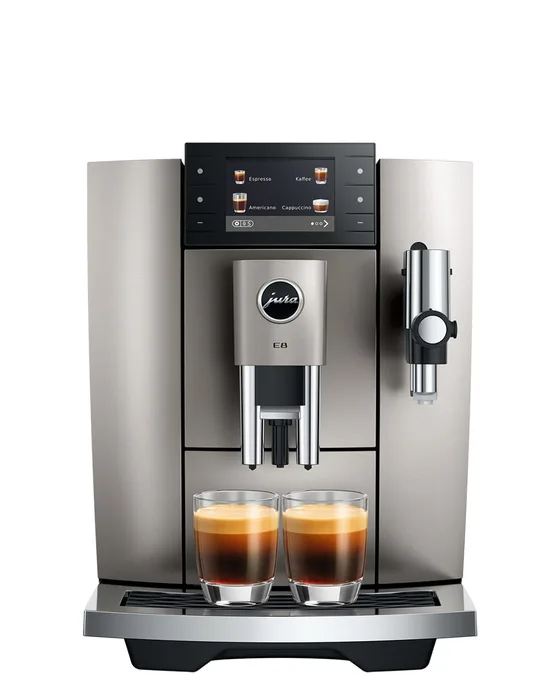
- Buy JURA E8 The fullest one-touch menu in the group, 27 specialties, with automatic milk system cleaning and a grinder JURA says resets after every grind.
- Buy Philips 3300 Series LatteGo (EP3347/90) The easiest milk system to keep clean, a removable brew group and 12 ceramic grind settings at a mid-range tier.
- It depends De'Longhi Rivelia (EXAM44055B) Two swappable bean hoppers and four user profiles make it the two-coffee household's machine, but you pay extra for that and cold milk drinks are an add-on.
- Skip Gaggia Magenta Plus A slim, well-known super-automatic that makes no milk drink by itself, which removes the main reason most people buy one.
What actually matters
- Milk system - Some machines draw milk through a pipe and clean it with an automatic program, others use a two-part jug you rinse. Both work; the question is whether you will do the cleaning every day.
- Grinder settings - Each step changes how fine the beans are ground, which changes extraction. More steps give finer control when you switch between beans.
- Brew group - This is the assembly that tamps and brews the coffee. Removable groups get rinsed by hand; fixed groups are cleaned by an internal program with tablets.
- Water tank size - A tank around 1.8 to 1.9 l covers several drinks a day before refilling. Smaller tanks mean more trips to the sink.
- Bean hopper - Hopper capacity sets how often you refill, and a sealed lid helps keep beans fresh. A few machines offer two hoppers for two different beans.
- Descaling and filters - Scale from hard water damages heaters and pumps over time. A maker's water filter can stretch or remove descaling intervals while it is in use.
- User profiles - Profiles store each person's strength and volume. They matter in a household with different tastes and are irrelevant for one drinker.
The specs, in plain English
Green flags vs red flags
Green flags
- A drink list that names cappuccino and latte, not just espresso and coffee
- A milk system with an automatic clean cycle or few, tube-free parts
- A grinder with 10 or more settings
- A water tank around 1.8 l or larger
- A published manual that explains brew group and descaling care
Red flags
- Milk drinks implied in photos but missing from the listed drink menu
- Grind adjustment limited to a handful of steps
- Cold drinks or app features that need accessories sold separately
- No clear guidance on how the milk system is cleaned
- Pump pressure used as the headline spec instead of grinder and milk details
Who's who: the brands
- JURA - Swiss maker focused only on automatic coffee machines, known for long drink menus and automatic milk cleaning.
- Philips - Known for the LatteGo milk system with two parts and no tubes, and removable brew groups.
- De'Longhi - Italian maker with a wide super-automatic range, from basic manual-frother models to the two-hopper Rivelia.
- Gaggia - Italian espresso brand known for the Classic Pro semi-automatic and a range of super-automatics.
How to read a listing without getting fooled
Start with the drink list, not the headline number of drinks, and confirm the milk drinks you want appear on it as one-touch options. Then find the milk system's cleaning method, the number of grind settings and whether the brew group is removable; these three decide your daily and weekly routine. Next check water tank and bean hopper capacity against how many cups your household makes. Finally read the box contents, because milk carafes, cold-drink kits and Wi-Fi modules are sometimes accessories. If a spec is only in the manual, download it; the manual often lists capacities the product page leaves out.
How much should you spend?
Mid-range super-automatics cover espresso, coffee and the core milk drinks with a simple milk system and a removable brew group, and they suit most households. Premium machines add longer menus, self-cleaning milk systems, user profiles and features like two bean hoppers. At every tier, the ongoing cost of the maker's cleaning tablets, descaler and water filters is part of the real price, so check what each machine requires before comparing.
Questions, answered
Does higher pump pressure mean better espresso?
Not in any useful way for these machines. Makers list figures such as 15 or 19 bar, but the pressure at the coffee during brewing is set by the grind and the machine's design. Grind settings and milk system design tell you far more about the drinks you will get.
Should I use filtered or bottled water?
Use the maker's water filter if the machine has one, or soft, filtered water if it does not. Hard water builds scale in the heater and pump. Many machines let you set your water hardness so they warn you when it is time to descale.
Can I put oily dark-roast beans in a super-automatic?
Many owners do, but very oily beans can stick in the hopper and grinder and need more frequent cleaning. If you prefer dark roasts, check the manual for the maker's guidance and clean the hopper and brew group on schedule.
How long does a super-automatic last?
Makers do not publish lifespans, but the parts that wear are the grinder, seals and brew group. Regular descaling, brew group care and using the specified cleaning products are what keep one running. Check the warranty length and whether the maker sells service parts.
Or jump to the head-to-head: JURA E8 vs Philips 3300 Series LatteGo (EP3347/90).