Explained
Coffee Canisters, Explained
After reading, you'll know the difference between airtight and air-removing, when a degassing valve matters, and how to size a canister to your habit.
In this guide
Coffee stales through oxidation, and the oxygen responsible is mostly the oxygen already in the container. That is why the useful distinction in this category is not between sealed and unsealed but between containers that trap air and containers that get rid of it. Light, heat and moisture do the rest of the damage, in roughly that order.
The 30-second version
- Airtight traps oxygen, so look for a mechanism that removes it instead.
- Fresh beans release carbon dioxide, which needs a one-way valve to escape safely.
- Light ages coffee too, so opaque beats clear unless the jar lives in a cupboard.
- Ground coffee stales in hours, which no container can prevent.
- The fridge is the worst option, because of condensation and absorbed odours.
The products this guide is about
Our verdict on each, with the full reasoning on the companion review.
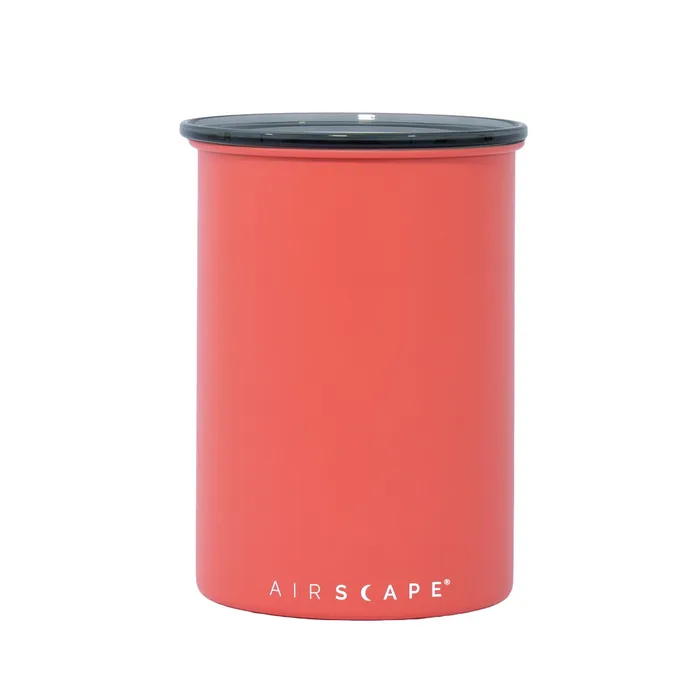
- Buy Planetary Design Airscape Classic Coffee Canister A plunger lid that pushes the air out, in steel, with nothing to charge or pump.
- Buy Fellow Atmos Vacuum Canister A genuine vacuum, in three sizes, with an electric version if you would rather not twist.
- It depends Normcore Coffee Bean Cellar Set Single-dose tubes with one-way valves, so only one morning's coffee is ever open.
- Skip KINTO TOTEM canister 800ml The most precisely specified jar here, and it says nothing about air.
What actually matters
- Air removal mechanism - a plunger lid that pushes headspace air out, a vacuum pump that evacuates it, or single-dose tubes that keep most of the coffee sealed. This is the whole product.
- Degassing - a one-way valve that lets carbon dioxide escape from recently roasted beans without letting air back in. Important in the first week or two after roasting.
- Body material and opacity - stainless steel is opaque and durable; glass shows the level and lets light in; polycarbonate is light and clear.
- Capacity - stated in grams of beans if the maker is thinking about coffee, in litres if they are thinking about jars. Whole beans are far less dense than you expect.
- Seal design - gaskets, valves and how many separate parts have to be cleaned and dried between refills.
- Stackability and footprint - canisters live on counters, and lid profiles and rubber bases determine whether they stack.
- Care requirements - dishwasher safety, thermal shock warnings on glass, and whether abrasives will mark the finish.
The specs, in plain English
Green flags vs red flags
Green flags
- An explicit mechanism for removing or excluding air.
- Capacity given in grams of coffee beans.
- A one-way degassing valve described.
- An opaque body, or a choice between opaque and clear.
- Materials named specifically, with dimensions.
Red flags
- Airtight claimed with no way to remove the air inside.
- Capacity given only in litres with no bean weight.
- No material named beyond premium or durable.
- No mention of how the lid is cleaned.
- Freshness claimed with no mechanism described at all.
Who's who: the brands
- Planetary Design - Maker of the Airscape range, built around a patented plunger lid that expels headspace air, in stainless steel and glass bodies and several sizes.
- Fellow - Design-led coffee equipment brand whose Atmos canisters pull a vacuum, offered in manual and electric versions across three capacities.
- Normcore - Value-focused espresso accessory brand whose Bean Cellars pre-portion beans into valved single-dose tubes with a filling hopper and stand.
- KINTO - Japanese housewares maker of precisely specified glass and stainless canisters designed for display and general dry goods rather than air removal.
- Hario - Japanese glassware specialist offering simple sealed glass canisters alongside its brewing range, with complete published specifications.
How to read a listing without getting fooled
Read past the word airtight and look for what the container does with the air already inside it. A plunger, a pump or a set of sealed single doses all count; a gasket does not. Then check whether capacity is given in grams of beans or in litres, because the first tells you it will fit your bag and the second tells you the maker is selling jars. Look for a one-way valve if you buy coffee close to its roast date. Decide about light honestly: if the canister will sit on a worktop, opaque is better, and if it will live in a cupboard, clear is fine and lets you see the level. Count the parts that need washing and drying, since anything with a valve or an inner lid is more work than a screw top. And on glass, read the care notes, because thermal shock warnings and abrasive restrictions are standard and easy to miss.
How much should you spend?
Coffee canisters are inexpensive relative to the coffee they protect, and a bag of good beans costs more than the difference between the options here. The budget end of the category is mostly plain sealed jars, which are the ones that do not solve the problem, so it is worth skipping. The mid-range buys a genuine mechanism: a plunger canister in stainless steel, a manual vacuum canister in a size that matches your bag, or a set of valved single-dose tubes. That is where essentially everyone should buy, and the differences between them are about habit rather than quality. Paying more buys an electric vacuum lid or a larger capacity, both of which are conveniences rather than improvements in preservation. The genuinely poor value is an expensive designer jar with no mechanism, because a cheap sealed container does the same job.
Questions, answered
Can I just keep coffee in the bag it came in?
For a week or two, yes, and roasters design those bags carefully with a one-way valve and a foil barrier. Roll the top down tightly and clip it, or use the resealable strip if there is one, and keep it out of the light. What the bag cannot do is remove the air that rushes in every time you open it, and the emptier it gets the more of that air is sitting against the beans. That is exactly the point at which a canister with a mechanism earns its place.
How big a canister should I buy?
Match it to the bag you buy rather than to your counter. A canister much larger than your usual purchase spends most of its life half full of air, which is the situation you are trying to avoid, unless it has a plunger that descends with the level. Planetary Design sizes its canisters as 250g and 500g of beans for exactly this reason. If you buy a kilo at a time, consider a large canister for the bulk and a small one for the week's coffee.
Will a canister work for ground coffee?
It will slow things down and it will not save you. Grinding multiplies the surface area exposed to oxygen enormously, which is why ground coffee loses its aroma within hours rather than weeks. If you buy pre-ground, a sealed canister with the air removed is still better than the bag, and the honest advice is that a modest grinder will improve your coffee more than any storage container will. Keep ground coffee in the smallest container that holds it.
How do I clean a canister without ruining it?
Wash by hand in warm soapy water and dry completely before refilling, because coffee oils go rancid and trapped moisture is worse than air. Pay attention to the parts people skip: the underside of a plunger lid, the gasket groove, and any valve. Do not put a vacuum or plunger lid in a dishwasher unless the maker says so, since heat and detergent degrade seals. On glass, avoid abrasives and steel wool, which KINTO calls out specifically, and never pour cold water into a warm jar.
Or jump to the head-to-head: Planetary Design Airscape Classic Coffee Canister vs Fellow Atmos Vacuum Canister.