Explained
Electric Kettles, Explained
After reading this you will know which kettle specs actually matter for how you drink, and which are marketing noise.
In this guide
An electric kettle looks simple, but the spec sheets pile on wattage numbers, preset counts, and words like 'gooseneck' that hide what really matters. What trips buyers up is chasing power and features when the things that decide daily happiness are temperature control you will actually use and the lid, gasket, and handle that tend to fail first. This guide decodes the terms so you can match a kettle to how you brew.
The 30-second version
- Wattage barely matters. Most full-size kettles reach a boil within about a minute of each other, so raw power rarely decides anything in daily use.
- Buy for what you drink. Black tea and instant coffee need only a plain boil, while green or white tea and pour-over coffee are where variable temperature earns its place.
- Durability lives in the mechanics. Kettles fail at the lid mechanism, the gasket, and the handle joint, not usually at the heating element or a degree of temperature drift.
- Gooseneck is a specialist tool. The narrow spout exists to control a thin pour for coffee; for filling mugs and pots it is slower and holds less.
- A recall outranks every spec. Always check for open safety actions before buying, because no feature offsets a scald hazard.
The products this guide is about
Our verdict on each, with the full reasoning on the companion review.
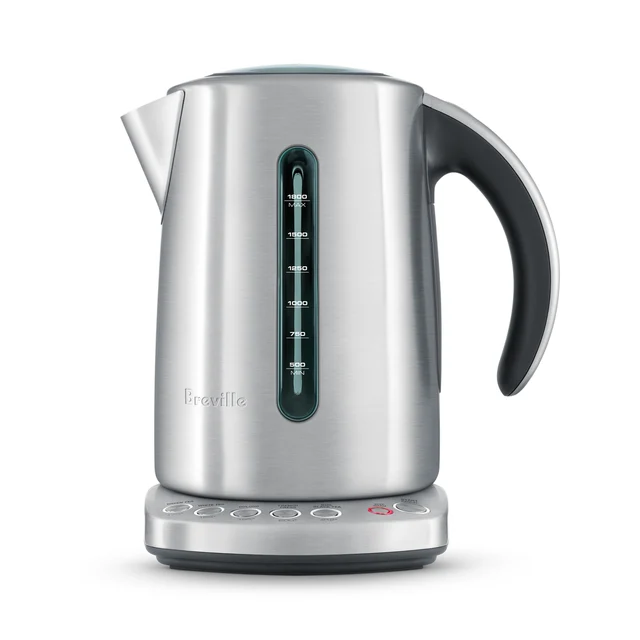
- Buy Breville IQ Kettle (BKE820) A fast, quiet everyday kettle with sensible presets and no glaring reliability flaw. Amazon
- Buy Fellow Stagg EKG Pro A precise gooseneck kettle built for pour-over coffee, not for filling the family pot. Amazon
- It depends Cuisinart PerfecTemp Cordless Electric Kettle (CPK-17P1) Capable and well-equipped for a mid-range price, but shadowed by long-term durability complaints. Amazon
- Skip Zwilling Enfinigy Electric Kettle A well-liked kettle undone by an active recall for a handle that can spill near-boiling water. Amazon
What actually matters
- Temperature control matters because water that is too hot scorches green tea leaves and light-roast coffee grounds; single-degree control is worth it only if you brew those, otherwise a plain boil or one or two presets is plenty.
- Capacity decides how often you refill and how much counter space you give up; a larger body suits a household, a compact one suits a single drinker or small kitchen.
- Build and materials determine how the kettle copes with mineral scale and repeated heating, and whether plastic ever touches your water; sealed stainless or glass interiors are the cleaner choice.
- Lid, gasket, and handle are the parts owners genuinely regret when they fail, so simple, sturdy hardware beats gadgetry for long-term satisfaction.
- Keep-warm and presets add convenience for tea rituals and pour-over, but they are a bonus rather than a reason to overlook a durability weakness.
- Safety status is non-negotiable; an active recall or a loose handle joint disqualifies a kettle no matter how good the rest of it is.
The specs, in plain English
Green flags vs red flags
Green flags
- A fully sealed stainless or glass interior with no plastic sitting in contact with the hot water
- A soft-opening or well-sealed lid and a solid, firmly anchored handle joint
- Temperature control that matches how you actually drink, whether that is a plain boil or to-the-degree
- A concealed element and a wide opening that make descaling and cleaning easy
- A quiet, sturdy feel and a clear water window on the side you fill from
Red flags
- Any open or active safety recall, especially involving the handle or scalding water
- A pattern of owner reports about leaking gaskets, a lid button that stiffens, or a cracking water window
- A plastic lid interior that sits in contact with the water if that matters to you
- Controls buried on the base that are awkward to reach, or gimmicky app features padding the price
- Marketing that leans hard on high wattage as the headline selling point
Who's who: the brands
- Breville - Premium everyday kettles with sensible presets, quiet operation, and thoughtful lids; a strong generalist pick.
- Fellow - Design-led gooseneck kettles built for pour-over coffee, with fine temperature control and built-in scheduling.
- Cuisinart - Feature-packed mid-range kettles that deliver a lot on paper but draw some long-term durability complaints.
- Zwilling - Kitchenware maker whose Enfinigy kettle earned praise for cool-touch design but is under an active recall.
- Cosori - Value-focused electric kettles with gooseneck and variable-temperature models aimed at coffee and tea drinkers.
How to read a listing without getting fooled
Start by ignoring the wattage headline and finding the temperature section: is it a plain boil, a handful of fixed presets, or full to-the-degree control, and does that match what you brew? Next read the capacity in litres against your counter and household, not the marketing adjective. Then look past the feature list to the materials and mechanics: what touches the water, how the lid opens and seals, and how the handle attaches, because that is where kettles fail. Treat app control, scheduling, and memory functions as bonuses, not deciders. Finally, search the model name plus the word 'recall' before you commit, because a safety action overrides every other line on the spec sheet.
How much should you spend?
Spend according to how you drink rather than to top the spec sheet. Entry-level kettles handle a plain boil perfectly well, and if you drink mostly black tea or instant coffee there is little reason to climb higher. The value sweet spot is a mid-to-upper kettle that pairs useful presets with a sealed interior and a lid, gasket, and handle built to last, since a sturdier body that you buy once often costs less over time than a cheaper one replaced early. Paying flagship money makes sense only for a dedicated pour-over gooseneck with fine temperature control; beyond that, extra money tends to buy connected gimmicks rather than a better cup, and a bargain kettle with documented durability complaints is rarely the saving it appears to be.
Questions, answered
Do I really need variable temperature control?
Only if you brew green or white tea or pour-over coffee, where water that is too hot scorches leaves or grounds and dulls the flavour. If you drink black tea, instant coffee, or just need hot water for cooking, a plain boil or one or two presets is all you need.
Is a gooseneck kettle worth it if I do not brew coffee?
Probably not. The narrow spout is built to control a thin, steady pour for pour-over coffee. For filling mugs, French presses, or pots it is slower and holds less water, so a standard wide-spout kettle serves everyday use better.
Does higher wattage mean a much faster kettle?
Not dramatically. Most full-size kettles reach a rolling boil within about a minute of each other, so a 1500-watt model is not meaningfully quicker in daily life than one rated slightly lower. Fill level and starting water temperature affect timing more than the wattage number.
Do plastic parts inside a kettle matter?
Somewhat. Fully sealed stainless or glass interiors keep plastic away from the hot water, which some owners prefer for taste and peace of mind. Many reliable kettles still use plastic lids or gauges, though; the bigger durability issue is usually the lid mechanism and gasket, not the material alone.
What part of a kettle is most likely to fail?
The mechanical bits, not the electronics. Owners most often report a lid button that stiffens and sticks, a gasket that begins to leak, or a handle that works loose, so favour simple, sturdy hardware and a well-sealed lid over feature count.
How do I check whether a kettle has been recalled?
Search the exact model name together with the word 'recall' before buying, and check the maker's support page. If a model is under an active recall for a burn or scald hazard, stop using it and pursue a refund rather than a repair.
Or jump to the head-to-head: Breville IQ Kettle (BKE820) vs Fellow Stagg EKG Pro.