Explained
Espresso Distribution Tools, Explained
After reading, you'll understand what distribution does, why WDT and levelers are different, and how to pick a tool that fits your basket.
In this guide
Puck prep tools look similar in photos, but they work in completely different ways. Some stir the coffee bed with needles, others spin on top to smooth it, and many are sized for one basket diameter. First-time buyers often end up with a leveler that does little, or a tool that does not fit their machine. A few terms make the choice straightforward.
The 30-second version
- Clumps are the real target, because they create the uneven density that causes channeling.
- Needles stir the whole bed, while spinning levelers only smooth the surface.
- Basket size matters, since mechanized tools and levelers are made for one diameter.
- A handheld WDT tool fits any basket, which makes it the safest first purchase.
- Distribution helps consistency, but it does not replace dialing in grind and dose.
The products this guide is about
Our verdict on each, with the full reasoning on the companion review.
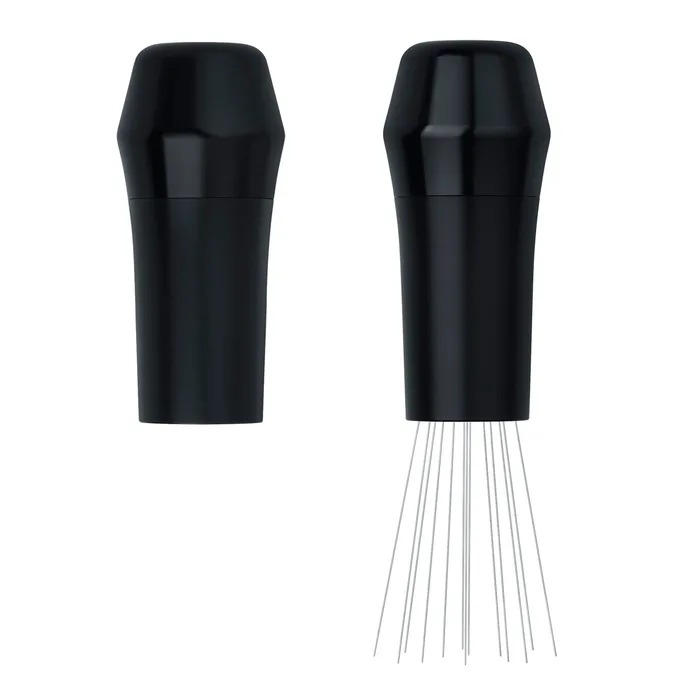
- Buy Normcore WDT Tool V4 A retractable handheld needle tool that breaks up clumps through the whole basket before you tamp.
- Buy Normcore Needle Distributor Tool V3 - Planetary Version A mechanized needle stirrer that spins and orbits 15 needles as you press down, for repeatable prep.
- It depends Weber Workshops MOONRAKER A precision-machined spirograph WDT tool for 58 mm baskets, built as much for pleasure as for function.
- Skip MATOW 58mm Coffee Distributor and Tamper A popular two-sided palm leveler and tamper that smooths the top of the dose instead of fixing clumps.
What actually matters
- Needle stirring - Needles reach into the coffee bed and break up clumps. This is the part of distribution that most affects channeling.
- Surface leveling - Spinning distributors smooth the top of the dose. They give a flat surface to tamp but do not reach deeper clumps.
- Basket diameter - Common sizes include 58, 54 and 51 mm. A sized tool must match your basket to work.
- Basket shape - Some tools need baskets with rounded or rolled lips. Flat-shouldered baskets can block them.
- Depth adjustment - Adjustable depth lets a tool suit different doses. Without it, results change when you change your dose.
- Repeatability - Mechanized tools repeat the same pattern each time. Handheld tools depend on technique.
- Needle care - Needles bend and wear. Spares and protected storage extend a tool's life.
The specs, in plain English
Green flags vs red flags
Green flags
- Needles that reach into the coffee bed
- A clear list of basket sizes it fits
- Adjustable depth or needle count
- Spare needles included
- Protected storage for the needles
Red flags
- Claims to prevent channeling with slopes only
- One size marketed for every machine
- No stated basket diameter
- A tamper side with no calibrated pressure sold as a feature
- Needles loose in the box with no spares
Who's who: the brands
- Normcore - Makes a wide range of puck prep tools, from handheld WDT tools to mechanized needle stirrers in several basket sizes.
- Weber Workshops - Known for precision-machined espresso tools and grinders, including the MOONRAKER spirograph WDT tool.
- MATOW - Sells budget espresso accessories, including popular two-sided distributors and tampers.
- Crema Coffee Products - Another maker of distributors and tamper combinations for common basket sizes.
How to read a listing without getting fooled
Start with how the tool works: does it put needles into the coffee, or does it spin on top? Then find the basket diameter it fits and compare it with your portafilter basket, since many home machines do not use 58 mm. Check whether the depth or needle count is adjustable and whether spare needles are included. If a listing promises less channeling but only describes slopes smoothing the surface, treat that claim with care.
How much should you spend?
Handheld WDT tools sit in the budget tier and deliver most of the benefit. Mechanized needle stirrers are mid-range and buy you repeatability. Precision-machined tools reach the premium tier and are as much about craftsmanship as results. Palm levelers are cheap, but a low price does not help if the tool does not address clumps.
Questions, answered
Can I make my own WDT tool?
Many people start with a cork and a few thin needles or acupuncture needles. It works, but a purpose-built tool protects the needles and is easier to use consistently. Once you know you like WDT, a dedicated tool is a small upgrade.
Should I use a leveler after WDT?
It is optional. WDT does the important work of breaking up clumps, and a gentle tap or a level tamp handles the surface for most people. A leveler can tidy the top if you like, but it is not required.
Do I need a distribution tool with a good grinder?
Even good grinders produce some clumping, especially with fresh beans. A WDT tool is cheap insurance for more consistent shots. It matters less on grinders that produce very little clumping, but it rarely hurts.
How do I know my basket size?
Check your machine's manual or measure the inside diameter of the basket rim. Many Breville home machines use baskets smaller than 58 mm. Buying a sized tool without checking is a common mistake.
Or jump to the head-to-head: Normcore WDT Tool V4 vs Normcore Needle Distributor Tool V3 - Planetary Version.