Explained
Espresso Tampers, Explained
After reading, you'll know what pressure to aim for, whether you need a calibrated tamper, and how to size the base to your basket.
In this guide
Tamping compresses ground coffee into a uniform puck so that water passes through it evenly rather than finding a weak spot and rushing past. Two things can go wrong: too much or too little force, and a bed that is not level. Calibrated tampers fix the first, self-levelling tampers fix the second, and the better ones do both.
The 30-second version
- Consistency beats force, so the same pressure every time matters more than a high number.
- Around 10 to 15 kilograms is the useful range, not the thirty pounds often quoted.
- An angled tamp causes channelling, which is what self-levelling collars prevent.
- Base diameter should match the basket, and a slightly larger base leaves less coffee unpacked at the edge.
- Fix the grinder first, since a tamper cannot rescue an uneven grind.
The products this guide is about
Our verdict on each, with the full reasoning on the companion review.
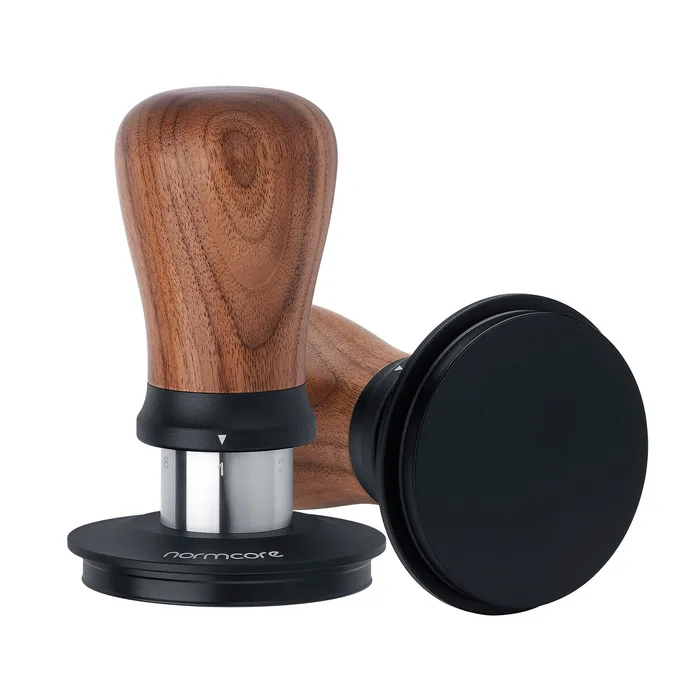
- Buy Normcore V5 Spring Loaded Tamper Six calibrated pressures on a dial, with everything about the tamper published.
- Buy Weber Workshops Really Nice Tamper Two spring rates, three base sizes, no electronics and nothing superfluous.
- It depends Timemore FLOW Self-Levelling Tamper The hardest base coating here and the only one sized to your hand, with no pressure figure.
- Skip Fellow Series 1 Tamper One sentence, three finishes, and no specification of any kind.
What actually matters
- Tamping pressure - the force the tamper applies before it releases, in kilograms. Calibrated tampers state it; flat tampers apply whatever you push with.
- Adjustability - whether pressure can be changed, and how: a dial with presets, a swappable spring, or not at all.
- Self-levelling - a collar or mechanism keeping the base parallel to the basket rim so the puck cannot be tamped at an angle.
- Base diameter - typically 58, 58.5, 54, 51 or 49 millimetres. Measure the basket, not the portafilter.
- Base coating - diamond-like carbon, titanium PVD or anodising, which determine how well the working face resists scratching.
- Weight and height - the feel in the hand, from light and quick to heavy and deliberate, and whether the handle suits your grip.
- Modularity - interchangeable bases and handles, which let one tamper serve several machines or change its feel.
The specs, in plain English
Green flags vs red flags
Green flags
- A tamping pressure published in kilograms, ideally as a range with steps.
- The levelling mechanism described by its parts.
- Base diameter given to a tenth of a millimetre.
- The base coating named specifically.
- Weight, height and body material published.
Red flags
- A spring-loaded tamper with no pressure figure.
- Self-levelling claimed with no mechanism described.
- Base diameter given only as 58mm with no tolerance.
- No weight or height on a hand tool.
- A one-sentence description at a premium price.
Who's who: the brands
- Normcore - Value-led espresso accessory brand publishing full specifications, with multi-spring calibrated tampers offering selectable pressure ranges.
- Weber Workshops - High-end espresso equipment maker whose Really Nice Tamper is fully mechanical and modular, with swappable bases and handles.
- Timemore - Chinese brewing equipment brand collaborating with competition baristas, using DLC coatings and ergonomic sizing on its tampers.
- Fellow - Design-led American brand whose tampers accompany its Espresso Series 1 machine, documented minimally compared with its kettles and grinders.
- Pesado - Australian maker known for precisely machined tamper bases sized to a tenth of a millimetre for specific basket types.
How to read a listing without getting fooled
Look for a tamping pressure in kilograms first, and treat its absence on a spring-loaded tamper as a serious gap, because that number is the product. If a range is given, note how many steps it has and how you move between them, since a dial and a spring swap are very different in daily use. Then read the levelling claim and check whether a mechanism is described: a collar resting on the basket rim is a real design, and the word self-levelling on its own is not. Measure your basket's internal diameter and match the base, remembering that a base half a millimetre larger covers more of the bed. Check the base coating, since that is the surface that wears. Then look for a weight and a height, because a tamper is a hand tool used several times a day and 433 grams feels very different from 250. Finally check whether bases and handles can be changed, which decides whether the tamper survives your next machine.
How much should you spend?
Tampers span a wide range for what is, in the simplest form, a metal disc on a handle. A plain flat tamper costs very little and works perfectly well once your technique is consistent, and it is the right purchase if your grinder is the current limiting factor. The premium tier buys calibration and self-levelling, which together remove two variables from every shot, and is the sensible upgrade for someone who already weighs doses and times shots but still gets inconsistent results. The flagship tier buys machining quality, modular bases and handles, and the simplest possible mechanism. What is difficult to justify at any price is a tamper in the premium bracket that publishes no pressure figure, since you are paying for a calibrated tool and being told nothing about the calibration.
Questions, answered
Should I distribute before tamping?
Yes, and it matters more than the tamp itself. Grounds fall into a basket unevenly, with clumps and voids, and tamping only compresses whatever distribution you started with. Stirring the dry bed with fine needles, a technique usually called WDT, breaks clumps and evens the bed out before you tamp, and most people find it makes a bigger difference to consistency than any tamper upgrade. A levelling distribution tool that spins across the top is a different thing and does not reach the clumps lower down.
Do I need to polish or twist the tamp?
No, and the habit persists long after the reason for it disappeared. Twisting the tamper at the end was meant to seal the surface of the puck, and with a modern grinder and a flat base it does nothing useful while risking cracking the bed as you lift. Tamp straight down, hold briefly, and lift straight up without twisting. If a self-levelling tamper is doing its job, the bed is already flat and parallel to the basket rim when the mechanism releases.
Why do my shots still run unevenly with a good tamper?
Almost always the grind or the distribution rather than the tamp. Channelling starts wherever the bed has a weak point, and a clump, a void or a crack from a knocked portafilter will create one no matter how perfectly you tamp. Check that the grinder is producing a consistent particle size, that you are distributing before tamping, and that you are not bumping the portafilter between tamping and locking it in. A tamper fixes the compression step and nothing before it.
How do I look after the base?
Wipe it after use and keep it off hard surfaces. Coffee oils build up on the working face and go rancid, which affects taste before it affects appearance, so a wipe with a damp cloth after each session is enough. The base is also the part that gets scratched, which is why the coating matters and why Normcore applies titanium PVD and Timemore uses diamond-like carbon. Use a tamping mat rather than a worktop, and never store a tamper face down on bare stone or metal.
Or jump to the head-to-head: Normcore V5 Spring Loaded Tamper vs Weber Workshops Really Nice Tamper.