

Home & Kitchen
The Best Espresso Tampers: 4 Compared (and One to Skip)
We compared four espresso tampers on published tamping pressure, base diameter and coating, self-levelling mechanism, weight and modularity.
The short version
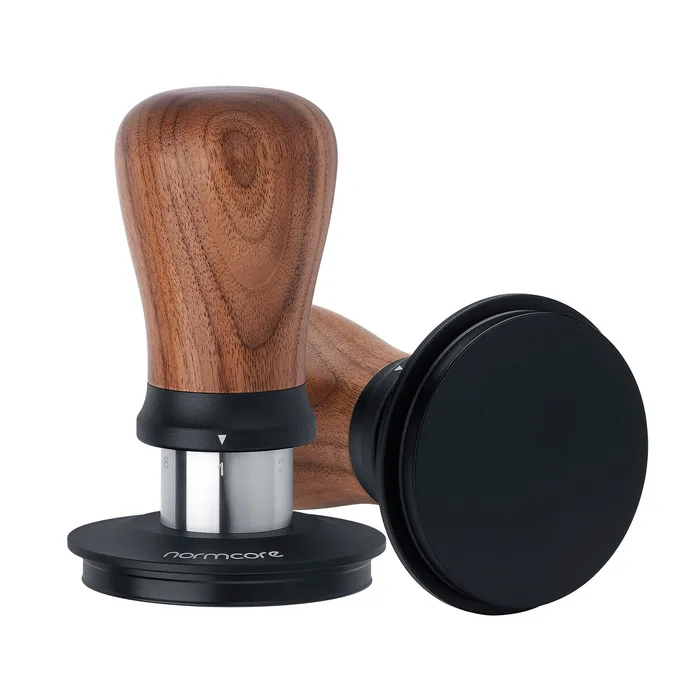
The Normcore V5 Spring Loaded Tamper is the one to buy: a patented tri-spring system with six preset pressures from 10.5 to 15.5 kilograms selected by rotating a knurled dial with no tools and no spring swaps, confirmed by an audible click and a tactile snap, on a titanium PVD coated base in 58.5, 58, 53.3 and 51 millimetres, with a CNC-machined aluminium body, a height of 10 centimetres, a weight of 433 grams and a tamping stand included. The Weber Workshops Really Nice Tamper is the runner-up, a fully mechanical self-levelling tamper with a 9 kilogram spring installed and a 12 kilogram spring in the box, in 58, 54 and 49 millimetre bases with swappable base and handle kits. The Timemore FLOW self-levelling tamper uses a diamond-like carbon coated base and a 69 millimetre collar with a proprietary wave spring to keep the tamp level, sized by the width of your palm. The Fellow Series 1 Tamper is the one to skip: it is described in a single sentence and publishes no pressure, no spring, no base material and no weight. Best for: anyone whose shots run at wildly different times from the same dose.
Our picks at a glance
- Normcore V5 Spring Loaded Tamper - Buy. Six calibrated pressures on a dial, with everything about the tamper published.
- Weber Workshops Really Nice Tamper - Buy. Two spring rates, three base sizes, no electronics and nothing superfluous.
- Timemore FLOW Self-Levelling Tamper - It depends. The hardest base coating here and the only one sized to your hand, with no pressure figure.
- Fellow Series 1 Tamper - Skip. One sentence, three finishes, and no specification of any kind.
The verdict in 30 seconds
What mattered most
- Pressure
- Changing pressure
- Self-levelling
- Base sizes
- Base coating
- Body material
A tamper exists to apply the same force to the same bed of coffee every time, and the difference between a good one and an expensive one is whether it tells you what that force is. A calibrated spring tamper releases at a known load and clicks; a flat tamper applies whatever you put through your wrist. The other half of the job is staying level, because a puck tamped at an angle channels water down one side and no grind adjustment fixes it. Three of these four publish a pressure figure or a spring rating. One publishes the colour of the handle.
Six calibrated pressures on a dial, with everything about the tamper published.
Best for: Anyone dialling in different coffees who wants to change tamping pressure as a deliberate variable.
- Six preset pressures from 10.5 to 15.5 kilograms, selected by rotating a knurled titanium dial with no tools and no spring swapping, so you can match a dense light roast and a soft blend without owning two tampers.
- A patented tri-spring system using three precision-calibrated springs working together, which Normcore says doubles durability against single-spring tampers, with an audible click and a tactile snap confirming the pressure has locked in.
- Fully specified: 10 centimetres tall, 433 grams in the 58.5mm version, a titanium PVD coated base in 58.5, 58, 53.3 or 51 millimetres, a CNC-machined aluminium alloy body, and a tamping stand in the box.
- The most mechanically complex tamper here, with three springs and a gear selector to go wrong.
- Normcore states the body is non-disassemblable and that dismantling voids the warranty, but does not publish the warranty term.
- Interchangeable bases are sold separately, so covering two basket sizes costs more.
- It is heavy at 433 grams, which some people prefer and others find tiring over a shift.
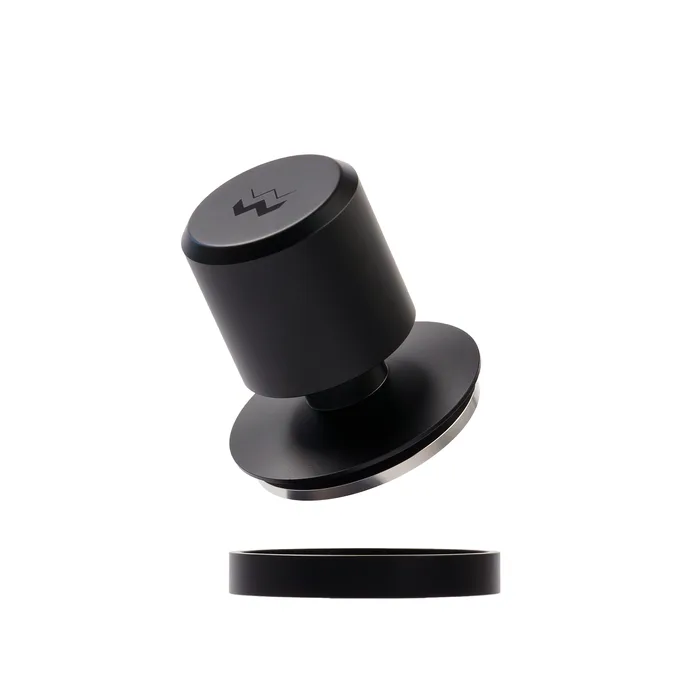
Two spring rates, three base sizes, no electronics and nothing superfluous.
Best for: Someone who wants self-levelling with the fewest moving parts, and a tamper that adapts to more than one machine.
- Fully mechanical self-levelling with, as Weber Workshops puts it, no batteries, no apps and no fluff, giving a smooth and precise action from a simpler mechanism than a multi-spring design.
- A 9 kilogram spring is pre-installed and an easily swappable 12 kilogram spring is included, so both common tamping pressures are covered in the box rather than sold as an upgrade.
- Available for 58, 54 and 49 millimetre portafilters in premium anodised silver and onyx, with separate base kits and wooden handle kits so one handle can follow you across machines.
- Two spring rates against six preset pressures on the Normcore, and changing between them means physically swapping the spring.
- No weight, height or base coating is published.
- The base kit and handle kits are separate purchases, and Weber Workshops is explicit that neither includes the rest of the tamper.
- It is the most expensive tamper in this comparison.
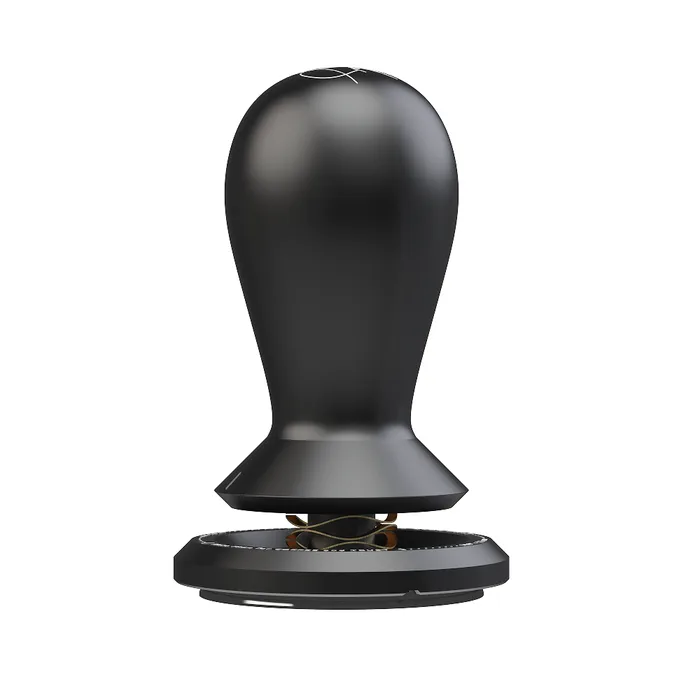
The hardest base coating here and the only one sized to your hand, with no pressure figure.
Best for: 58 millimetre machines where levelling matters more than choosing a pressure, especially for smaller or larger hands.
- A diamond-like carbon coated base, which is a harder surface treatment than the titanium PVD or anodising used by the others and is specifically there to resist scratching.
- A 58.5 millimetre base giving full bed coverage in a 58 millimetre basket, which Timemore says prevents coffee building up around the edges.
- Anti-vacuum engineering using a 69 millimetre collar and a proprietary wave spring to keep the tamp level, and the only tamper here sized by the user, offered small for palms under 16 centimetres and large for palms above.
- No tamping pressure is published anywhere, which on a spring-loaded tamper is the single most important specification.
- 58.5 millimetres only, with no 54 or 49 millimetre option for smaller portafilters.
- No weight, height or body material is given.
- Timemore notes it is restocking, so availability is uncertain.
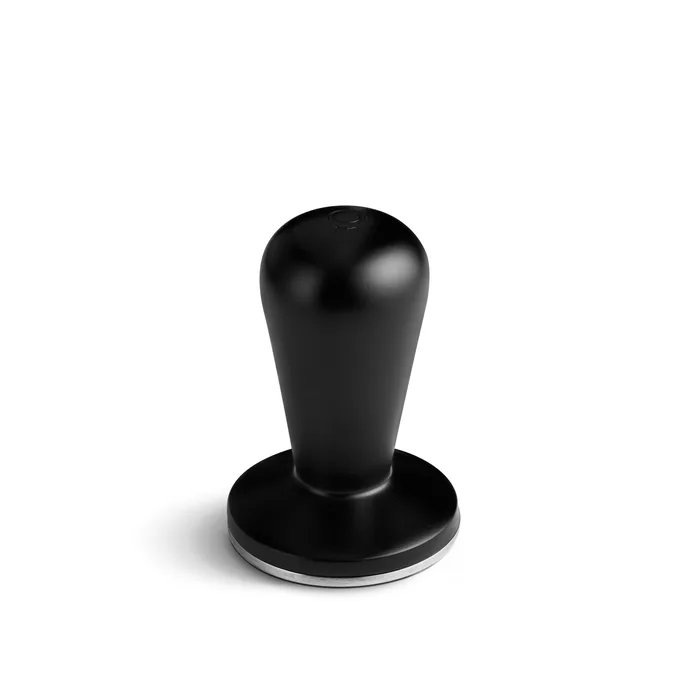
One sentence, three finishes, and no specification of any kind.
Best for: Espresso Series 1 owners who want a matching tamper and will judge pressure by feel.
- Designed specifically for Fellow's Espresso Series 1 machine and its 58 millimetre portafilter, so the fit is not in doubt on that machine.
- Three finishes, in matte black, maple and walnut, which is more choice of material than most tampers offer.
- It pairs with Fellow's own tamping mat and espresso accessories if you are building a matched set.
- No tamping pressure and no spring of any kind, so it is a flat tamper competing against three calibrated ones.
- No base material, coating or diameter tolerance is published.
- No weight, height or handle dimensions appear on the page.
- The entire product description is a single sentence about which machine it suits.
| Criteria | V5 Spring Loaded Tamper Top pick | Really Nice Tamper | FLOW Self-Levelling Tamper | Series 1 Tamper |
|---|---|---|---|---|
| Verdict | Buy it | Buy it | It depends | Skip it |
| Best for | Anyone dialling in different coffees who wants to change tamping pressure as a deliberate variable. | Someone who wants self-levelling with the fewest moving parts, and a tamper that adapts to more than one machine. | 58 millimetre machines where levelling matters more than choosing a pressure, especially for smaller or larger hands. | Espresso Series 1 owners who want a matching tamper and will judge pressure by feel. |
| Price tier | $$$ · premium | $$$$ · flagship | $$$ · premium | $$ · mid-range |
| Pressure | 10.5 to 15.5 kg, 6 presets | 9 kg installed, 12 kg included | Not published | None, flat tamper |
| Changing pressure | Rotate a dial, no tools | Swap the spring | Not applicable | Not applicable |
| Self-levelling | Tri-spring system | Fully mechanical | 69 mm collar and wave spring | No |
| Base sizes | 58.5, 58, 53.3, 51 mm | 58, 54, 49 mm | 58.5 mm only | 58 mm |
| Base coating | Titanium PVD | Anodised | Diamond-like carbon | Not published |
| Body material | CNC-machined aluminium alloy | Anodised metal, not specified | Not published | Not published |
| Weight | 433 g | Not published | Not published | Not published |
| Height | 10 cm | Not published | Not published | Not published |
| Sizing | One size | One size | Small or large by palm width | One size |
| In the box | Tamper and tamping stand | Tamper with two springs | Tamper | Tamper |
Which one is right for you?
- Anyone dialling in different coffees who wants to change tamping pressure as a deliberate variable. Buy it Normcore V5 Spring Loaded Tamper
- Someone who wants self-levelling with the fewest moving parts, and a tamper that adapts to more than one machine. Buy it Weber Workshops Really Nice Tamper
- 58 millimetre machines where levelling matters more than choosing a pressure, especially for smaller or larger hands. It depends Timemore FLOW Self-Levelling Tamper
- Espresso Series 1 owners who want a matching tamper and will judge pressure by feel. Skip it Fellow Series 1 Tamper
How we judged the field
A tamper has one measurable output, the force it applies, and the first thing we looked for was whether that force is published. It divides this group immediately: Normcore gives a range and the number of steps within it, Weber Workshops gives two spring ratings, Timemore gives nothing despite selling a spring-loaded tamper, and Fellow does not have a spring at all.
Second, levelling, because tamping at an angle is the most common fault and the one a tamper can actually design out. That means a collar or a mechanism that keeps the base parallel to the basket rim, and the three calibrated tampers here each solve it differently. Third, the base: its diameter relative to a 58 millimetre basket, since a larger base leaves less coffee unpacked at the edge, and its coating, since the base is the part that takes wear and shows scratches. Fourth, the physical specification, weight and height and body material, which determines how the thing feels in a hand that will use it several times a day. And fifth, modularity, because portafilter sizes vary between machines and a tamper that can change base is a tamper you keep.
The Normcore V5 is the most completely specified tamper in this comparison and the only one that treats pressure as something you adjust rather than something you accept. Six preset pressures run from 10.5 to 15.5 kilograms, and you move between them by rotating a knurled titanium dial: no tools, no disassembly and no buying a second spring. Underneath is a patented tri-spring system, three precision-calibrated springs working together, which Normcore says both eliminates uneven compression and doubles durability against a single-spring design, with an audible click and a tactile snap confirming the setting has engaged. The specification is published in full: 10 centimetres tall, 433 grams in the 58.5 millimetre version, a titanium PVD coated base available at 58.5, 58, 53.3 or 51 millimetres, a CNC-machined aluminium alloy body, and a tamping stand included. The limitations follow from the ambition. It is the most complex mechanism here, with more to go wrong. Normcore states the body is non-disassemblable and that taking it apart voids the warranty, without saying how long that warranty lasts. Interchangeable bases are sold separately. And 433 grams is a lot of tamper.
The Weber Workshops Really Nice Tamper is the argument for doing less, well. The description is refreshingly direct, calling it a fully mechanical self-levelling tamper with no batteries, no apps and no fluff, and the action is described as silky smooth and precise. There are two spring rates and both are in the box: a 9 kilogram spring comes pre-installed and an easily swappable 12 kilogram spring is included for anyone wanting more, which covers the useful range without an upgrade purchase. It is available for 58, 54 and 49 millimetre portafilters in the same premium anodised silver and onyx finishes Weber Workshops uses across its accessories, and the 58 millimetre version is optimised for the company’s own Unifilter and Unibaskets while remaining compatible with any 58 millimetre basket. What makes it genuinely different is modularity: a separate base kit swaps the working face between 58, 54 and 49 millimetres while keeping the same handle, weight and feel, and a wooden handle kit changes the grip. Both are clearly labelled as parts rather than tampers. The costs are two pressures rather than six, a spring swap rather than a dial, no published weight or base coating, and the highest price here.
The Timemore FLOW is a collaboration with barista Anthony Douglas and it gets two things right that nobody else does. The base is coated in diamond-like carbon, a harder surface treatment than titanium PVD or anodising, applied specifically to resist the scratching that makes a tamper look tired. And it is 58.5 millimetres rather than 58, which Timemore explains properly: the extra half millimetre gives full coverage of the bed in a 58 millimetre basket and prevents coffee building up around the edges where an undersized base leaves it unpacked. The levelling mechanism is described as anti-vacuum engineering, using a 69 millimetre collar and a proprietary wave spring to keep the tamp level, a wave spring being a flatter, more compact alternative to a coil. Most unusually, it is sized to the user, offered small for palms under 16 centimetres and large for palms above, which is the only ergonomic sizing in this group. The omission is glaring. For a spring-loaded tamper, Timemore publishes no tamping pressure at all, which is the specification the entire product category exists to provide. There is also no weight, no height, no body material, only one base size, and a note that stock is being replenished.
The Fellow Series 1 Tamper is the skip and the entry is brief because the page is one sentence long. Fellow says it is an espresso tamper designed for use with Espresso Series 1 and its 58 millimetre portafilter, and offers it in matte black, maple and walnut. That is the entire description. There is no spring, so it is a flat tamper being sold alongside three calibrated ones, and there is no way to know what pressure you are applying beyond what your wrist tells you. Nothing is published about the base material or coating, the diameter tolerance, the weight, the height or the handle dimensions. For an owner of Fellow’s own espresso machine there is a legitimate argument here, which is that the tamper is designed around that portafilter and matches the rest of the range aesthetically, and the choice of three handle materials is more than most tampers offer. But a tamper’s job is repeatability, the whole reason calibrated tampers exist is to deliver it, and at this price three competitors will at minimum tell you what their springs are rated at.
Normcore V5 Spring Loaded Tamper vs Weber Workshops Really Nice Tamper: which should you buy?
Normcore against Weber Workshops is a choice between adjustability and simplicity, and both are coherent positions. The V5 gives you six pressures between 10.5 and 15.5 kilograms on a dial, which means tamping pressure becomes something you can deliberately change when you move from a dense light roast to a softer blend, rather than a fixed property of the tool. It also publishes everything: height, weight, coating, body material, four base sizes, and a stand in the box. For anyone who experiments, that is the more useful tamper.
The Really Nice Tamper takes the opposite view. Two spring rates cover the range most people need, both are included, and the mechanism has fewer parts to wear or drift out of calibration. Its modular system is the better long-term proposition, since a separate base kit moves the same handle between 58, 54 and 49 millimetre machines while keeping the weight and feel identical, and a wooden handle kit changes the grip without changing the tamper. Buy the Normcore if you want to treat pressure as a variable and want the fullest specification. Buy the Weber Workshops if you want the simplest mechanism that still levels itself, or if you use more than one machine.
What to look for
- A published tamping pressure: a range with steps, or a spring rating in kilograms. A spring-loaded tamper that will not state one has skipped its own purpose.
- How you change pressure: a dial is convenient, a swappable spring is simpler, and no adjustment at all is a fixed tool.
- A levelling mechanism, described: a collar that rests on the basket rim is what stops an angled tamp, and the good ones name the parts.
- Base diameter against your basket: 58.5 millimetres covers more of a 58 millimetre bed than 58 does, and the difference shows at the edges.
- Base coating: diamond-like carbon, titanium PVD and anodising all resist wear differently, and the base is the part that gets scratched.
- Modularity: interchangeable bases and handles turn one tamper into one that fits your next machine too.
Our final take
Tampers are a category where the price gap is large and the published evidence separates the products cleanly. The Normcore V5 is the one to buy: six calibrated pressures from 10.5 to 15.5 kilograms on a dial, a tri-spring mechanism with click and snap feedback, a titanium PVD base in four diameters, and a fully published specification down to its 433 gram weight and 10 centimetre height. The Weber Workshops Really Nice Tamper is the better-engineered simple answer, with two spring rates in the box, three base sizes and a modular system that follows you between machines. The Timemore FLOW has the hardest base coating and the only sizing by hand, and declines to say what pressure it applies. And a flat tamper described in one sentence is a nicely finished piece of metal, not an instrument.
Questions, answered
How much pressure should I tamp with?
Enough to make the bed uniform and no more, and the received figure of 30 pounds is far higher than most people need. The useful range in practice sits around 10 to 15 kilograms, which is what Normcore's six presets cover and what Weber Workshops brackets with its 9 and 12 kilogram springs. What matters more than the absolute number is that it is the same every time, because tamping pressure is a variable you want removed from the equation while you adjust grind and dose. A calibrated tamper turns it from a habit into a setting.
Does a self-levelling tamper actually help?
It removes the single most common tamping fault, which is tamping at an angle. A tilted puck is denser on one side, so water takes the path of least resistance down the other, and that channelling shows up as a sour, thin shot no grind change will fix. Self-levelling designs use a collar that rests on the basket rim so the base cannot tilt relative to it. Timemore describes a 69 millimetre collar with a wave spring, Weber Workshops calls its version fully mechanical, and Normcore uses three springs working together.
What base diameter do I need?
Measure the inside of your basket rather than the portafilter. The common sizes are 58 millimetres for most prosumer machines, 54 for Breville and Sage, and 49 or 51 for smaller Delonghi and similar units. Within 58 millimetre baskets there is variation, which is why tampers are sold at 58, 58.35 and 58.5 millimetres: a larger base covers more of the bed and leaves less unpacked coffee around the edge, and too large simply will not go in. Timemore's 58.5 millimetre base is chosen for exactly that full-coverage reason.
Flat, convex or ripple base?
Flat is the default and the one to buy first. It produces an even bed and is the shape every calibrated tamper here uses. Convex bases curve slightly and are claimed to seal the edges of the puck better, which some people find reduces channelling at the walls and others find makes no difference. Ripple and patterned bases are a more recent idea aimed at improving water distribution. None of these four offers anything but a flat base, which tells you where the mainstream currently sits.
Is a tamper worth this much money?
A calibrated one is, if your shots are inconsistent and you have already sorted grind and dose. A twenty pound flat tamper and a two hundred pound calibrated one apply the same force when you get it right; the expensive one simply makes getting it right automatic, and adds levelling on top. If you weigh your dose, time your shot and still get variable results, a calibrated self-levelling tamper removes two variables at once. If you are still grinding by eye, spend the money on a grinder first.
Deciding between the top two? See our head-to-head: Normcore V5 Spring Loaded Tamper vs Weber Workshops Really Nice Tamper.
More Home & Kitchen reviews
 The Best Fire Blankets: 4 Compared (and One to Skip)
  The Best Fire Pits: 4 Compared (and One to Skip)
  The Best Fish Spatulas: 4 Compared (and One to Skip)
  The Best Food Dehydrators: 4 Compared (and One to Skip)
  The Best Food Processors: 4 Models Compared (and One to Skip)
  The Best Food Storage Containers: 4 Compared (and One to Skip)