

Home & Kitchen
The Best Coffee Canisters: 4 Compared (and One to Skip)
We compared four coffee storage containers on how each one deals with oxygen, published materials and capacities, degassing, light exposure and what the makers actually claim.
The short version
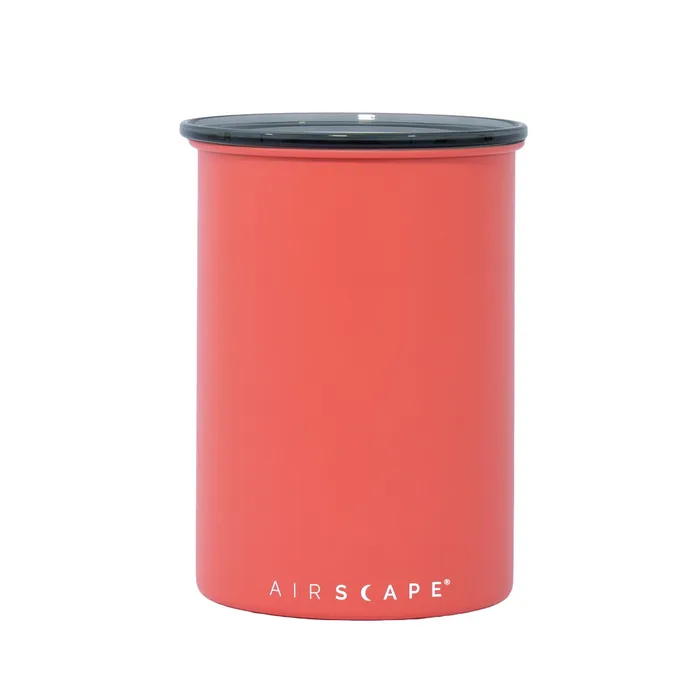
The Airscape Classic from Planetary Design is the one to buy: a patented plunger lid that actively pushes excess oxygen out instead of trapping it, in restaurant-grade stainless steel with a brushed interior, BPA-free and scratch resistant, stackable on a non-slip rubber base, in 250g and 500g sizes with a cotton refill bag included. The Fellow Atmos Vacuum Canister is the runner-up and the more flexible one, removing air by vacuum and then holding that seal, offered in manual and electric versions at 0.4, 0.7 and 1.2 litres in clear glass, matte black or matte white. The Normcore Coffee Bean Cellar Set takes the opposite approach, pre-portioning beans into airtight polycarbonate tubes whose lids carry a one-way valve so freshly roasted beans can degas without letting outside air back in. The Kinto TOTEM canister is the one to skip for coffee: it is precisely specified, handsome and stackable, and nothing on its page claims an airtight seal or any way of dealing with oxygen. Best for: anyone buying whole beans by the bag who finds the last third tastes flat.
Our picks at a glance
- Planetary Design Airscape Classic Coffee Canister - Buy. A plunger lid that pushes the air out, in steel, with nothing to charge or pump.
- Fellow Atmos Vacuum Canister - Buy. A genuine vacuum, in three sizes, with an electric version if you would rather not twist.
- Normcore Coffee Bean Cellar Set - It depends. Single-dose tubes with one-way valves, so only one morning's coffee is ever open.
- KINTO TOTEM canister 800ml - Skip. The most precisely specified jar here, and it says nothing about air.
The verdict in 30 seconds
What mattered most
- Oxygen mechanism
- Degassing valve
- Body material
- Light protection
- Capacities
- Dimensions published
Coffee goes stale because of oxygen, and an airtight container does not remove the oxygen already inside it with the beans. That single fact splits this category into products that solve the problem and products that look like they do. Three of the four here have an actual mechanism: a plunger that pushes air out, a pump that draws a vacuum, and a set of single-dose tubes with one-way valves so most of your coffee stays sealed until the morning you drink it. The fourth is a beautiful glass jar that says nothing about air at all.
A plunger lid that pushes the air out, in steel, with nothing to charge or pump.
Best for: Everyday whole-bean storage, for anyone who wants the mechanism to work without being remembered.
- A patented plunger lid that actively pushes excess oxygen out of the canister, which Planetary Design contrasts directly with airtight containers that simply trap air inside with the coffee.
- Restaurant-grade stainless steel, BPA-free and scratch resistant, with a brushed stainless interior and an opaque body that keeps light off the beans.
- Stackable with a non-slip rubber base, sized at 250g for about half a pound of beans and 500g for about a pound, with an Airscape cotton refill bag included.
- No dimensions or weight are published for either size.
- The opaque steel body means you cannot see how much coffee is left without opening it.
- The inner plunger lid is a second component to clean and dry.
- No warranty terms appear on the product page.
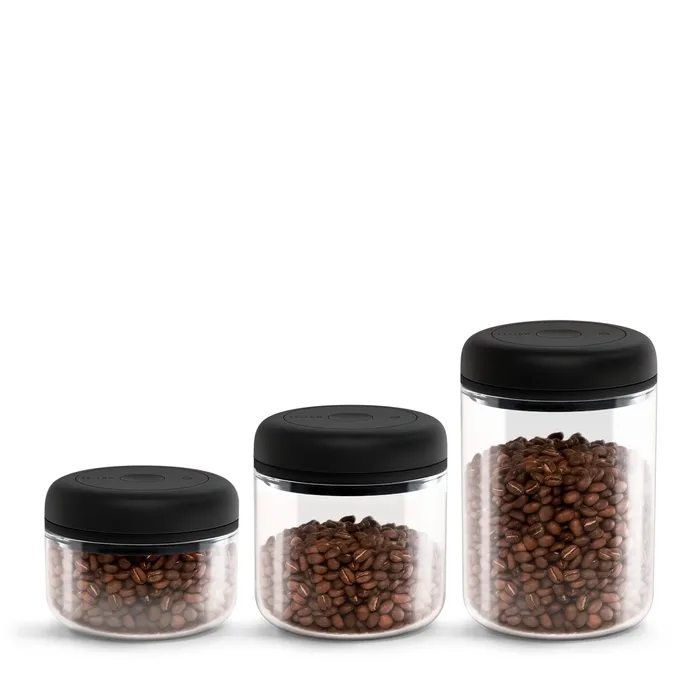
A genuine vacuum, in three sizes, with an electric version if you would rather not twist.
Best for: Anyone who wants a true vacuum and a size that matches the bag they actually buy.
- Removes air to create a sealed space that slows oxidation, and then maintains that seal without needing to be topped up.
- Three capacities at 0.4, 0.7 and 1.2 litres, which is the widest range here and covers everything from a single-origin sample to a large bag.
- A choice of manual or electric versions, and of clear glass, matte black or matte white bodies, so you can pick between seeing your coffee and shielding it from light.
- Fellow publishes no vacuum level, so there is no figure describing how much air is actually removed.
- No dimensions, weight or warranty terms are given on the product page.
- The electric version is another thing to keep charged.
- The clear glass body looks good and exposes the beans to light, which is the second thing after oxygen that ages coffee.
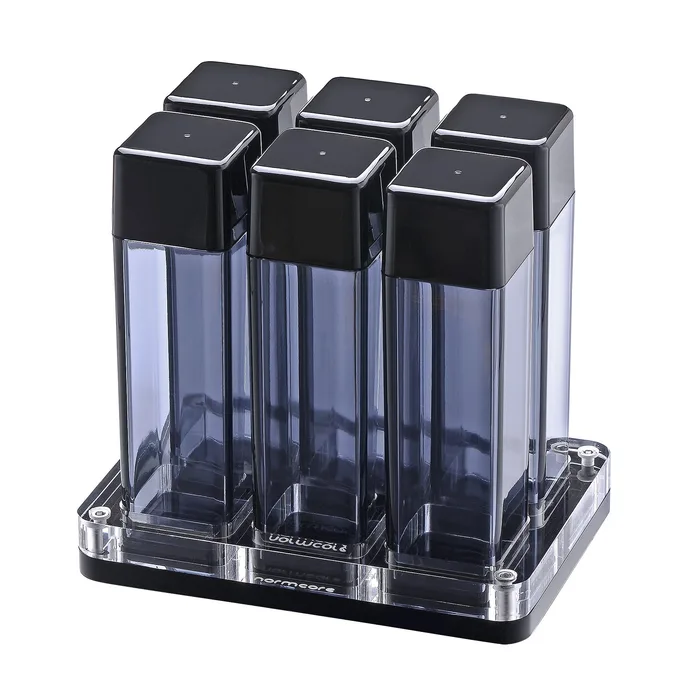
Single-dose tubes with one-way valves, so only one morning's coffee is ever open.
Best for: Espresso drinkers weighing a consistent dose every day who already single-dose their grinder.
- Pre-portioning into individual airtight tubes means each dose stays sealed until you brew it, instead of the whole bag being opened every morning.
- Each lid carries a built-in valve that releases the carbon dioxide freshly roasted beans give off, without letting outside air back in, which is the only degassing feature in this comparison.
- BPA-free polycarbonate with the clarity of glass, a silicone hopper for filling without spills, and a stand to keep the tubes upright, in 6 and 12 tube sets.
- You have to portion an entire bag in one session, which exposes all of it to air at once.
- Normcore's own product page gives no tube capacity in grams; the figure of 25 to 28 grams per tube appears only in its retail listings.
- Polycarbonate rather than glass or steel, and clear, so light reaches the beans.
- Six or twelve doses is less than a typical bag holds, so you will still need somewhere to keep the remainder.
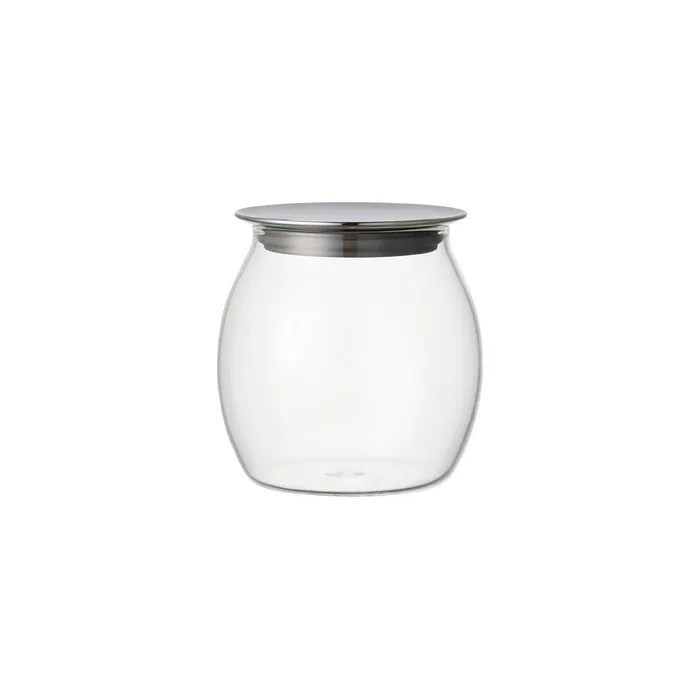
The most precisely specified jar here, and it says nothing about air.
Best for: Displaying tea, sugar or spices, or coffee you will finish within a few days.
- Fully specified: 80mm diameter by 120mm high by 115mm wide, 800ml, with a heat-resistant glass body rated to a 120 degree Celsius temperature differential.
- A stainless steel lid with a hairline finish, and a mostly flat top with slightly lifted edges so canisters stack stably.
- Microwave and dishwasher safe, which none of the mechanical canisters here can claim, and genuinely good looking on a counter.
- Nothing on the page claims an airtight seal, and there is no mechanism for removing or excluding oxygen.
- Clear glass lets light reach the beans, which is the second most common cause of staling after oxygen.
- At 800ml it is sized as a dry goods jar rather than to a standard coffee bag weight.
- KINTO warns that sudden temperature changes may break or shatter it, and it should not be cleaned with abrasives or steel wool.
| Criteria | Airscape Classic Coffee Canister Top pick | Atmos Vacuum Canister | Coffee Bean Cellar Set | TOTEM canister 800ml |
|---|---|---|---|---|
| Verdict | Buy it | Buy it | It depends | Skip it |
| Best for | Everyday whole-bean storage, for anyone who wants the mechanism to work without being remembered. | Anyone who wants a true vacuum and a size that matches the bag they actually buy. | Espresso drinkers weighing a consistent dose every day who already single-dose their grinder. | Displaying tea, sugar or spices, or coffee you will finish within a few days. |
| Price tier | $$ · mid-range | $$ · mid-range | $$ · mid-range | $$ · mid-range |
| Oxygen mechanism | Plunger lid pushes air out | Vacuum pump removes air | Sealed single-dose tubes | None stated |
| Degassing valve | No | No | Yes, one-way in each lid | No |
| Body material | Restaurant-grade stainless steel | Glass or coated steel | BPA-free polycarbonate | Heat-resistant glass |
| Light protection | Opaque | Opaque or clear, your choice | Clear | Clear |
| Capacities | 250 g and 500 g of beans | 0.4 L, 0.7 L, 1.2 L | 6 or 12 tubes | 800 ml |
| Dimensions published | No | No | No | 80 x 120 x 115 mm |
| Power needed | None | None, or electric version | None | None |
| Dishwasher safe | Not stated | Not stated | Not stated | Yes |
| Stackable | Yes, non-slip base | Not stated | Stand included | Yes |
Which one is right for you?
- Everyday whole-bean storage, for anyone who wants the mechanism to work without being remembered. Buy it Planetary Design Airscape Classic Coffee Canister
- Anyone who wants a true vacuum and a size that matches the bag they actually buy. Buy it Fellow Atmos Vacuum Canister
- Espresso drinkers weighing a consistent dose every day who already single-dose their grinder. It depends Normcore Coffee Bean Cellar Set
- Displaying tea, sugar or spices, or coffee you will finish within a few days. Skip it KINTO TOTEM canister 800ml
How we judged the field
The first and largest question is what a container does about the oxygen already inside it. Sealing a jar traps the air in there with the beans, and that air is what stales them, so we treated an active mechanism as the price of entry: a plunger that expels air, a pump that evacuates it, or a design that keeps most of the coffee sealed until it is needed. One of these four has no mechanism at all, and that is what puts it in the skip position despite being the best documented product on the page.
After that, materials and light. Coffee ages faster in light, so an opaque body is a genuine functional advantage over a clear one, which is inconvenient because the clear ones look better on a counter. We also looked at degassing, which matters specifically for beans bought within a week or two of roasting, since carbon dioxide leaving the bean has to go somewhere. Then capacity, and whether it is expressed in a way that maps onto how coffee is actually sold, in grams of beans rather than in litres of volume. And finally the ordinary disclosures: dimensions, dishwasher safety, warranty, which in this category are inconsistent to an unusual degree.
The Airscape Classic is the most elegant solution here because it needs nothing from you beyond pushing a lid down. The patented plunger lid descends onto the surface of the beans and forces the excess oxygen out through a one-way valve, so the space above your coffee shrinks as the coffee does, rather than filling with air. Planetary Design makes the contrast explicit, describing traditional airtight containers as trapping air inside. The body is restaurant-grade stainless steel, BPA-free and scratch resistant with a brushed stainless interior, and being opaque it also keeps light off the beans, which is the second thing that ages them. It is stackable, sits on a non-slip rubber base, and comes in sizes stated the useful way, as 250g for roughly half a pound of beans and 500g for roughly a pound, which maps onto how coffee is actually sold. An Airscape cotton refill bag is included. The gaps are minor: no published dimensions or weight, no warranty terms, a second lid component to keep clean, and no way to see how much coffee is left without opening it.
The Fellow Atmos takes the more direct approach and pulls an actual vacuum. Air is removed to create a sealed space that slows oxidation, and Fellow is specific that the canister then maintains that seal rather than needing constant attention. Where it wins is flexibility. There are three capacities, 0.4, 0.7 and 1.2 litres, which is the broadest range in this comparison and means you can match the canister to the bag rather than decanting into something half empty. There is a choice of manual and electric versions, so you can twist the lid yourself or let a motor do it, and a choice of clear glass, matte black or matte white bodies, which is effectively a choice between seeing your coffee and protecting it from light. What is missing is any number describing the vacuum. Fellow says it removes air without saying how much, which makes it impossible to compare against the Airscape’s mechanical approach on anything but principle. There are also no dimensions, no weights and no warranty terms on the page, and the electric version is one more thing to keep charged.
The Normcore Coffee Bean Cellar Set solves a different version of the problem, and for the right person it solves it better than either canister. Instead of protecting one large container that gets opened every morning, you portion the bag once into individual airtight tubes, and then only the tube you are brewing is ever opened. The rest of the coffee stays sealed at the state it was in when you filled it. Each lid has a built-in valve that lets carbon dioxide out as freshly roasted beans degas without letting outside air back in, which is the only degassing feature in this group and a genuine advantage in the first week or two after a roast date. The tubes are BPA-free polycarbonate with the clarity of glass, there is a silicone hopper so filling does not go everywhere, and a stand keeps them upright, in 6 and 12 tube sets. The reservations are practical. You expose the whole bag at once when you portion it. Normcore’s product page gives no capacity in grams per tube, a figure of 25 to 28 grams that appears only in its retail listings. The tubes are clear, so light gets in. And six or twelve doses is less than most bags hold, so you still need somewhere for the remainder.
The KINTO TOTEM canister is the best documented product in this comparison and the wrong one for coffee. KINTO publishes what almost nobody else does: 80mm diameter by 120mm high by 115mm wide, 800ml, a heat-resistant glass body rated for a 120 degree Celsius temperature differential, a stainless steel lid with a hairline finish, microwave and dishwasher safe, made in China, with a flat lid top and slightly lifted edges so the canisters stack stably. It is a lovely object and it is genuinely useful for tea, sugar, flour or spices. What it does not do is address oxygen. Nothing on the page claims an airtight seal, and there is no plunger, no valve and no pump, so the coffee sits with a jar of air against it and stales at whatever rate that air allows. The glass is clear, which means light reaches the beans as well. KINTO also notes that sudden temperature changes may break or shatter it, and that abrasives and steel wool should be kept away. For coffee you will finish this week, none of that matters. For a bag you are working through over a month, all of it does.
Planetary Design Airscape Classic Coffee Canister vs Fellow Atmos Vacuum Canister: which should you buy?
Airscape against Atmos is a choice between two mechanisms that both work, and the tiebreakers are material and effort. The Airscape’s plunger is mechanically the simplest thing that can possibly solve the problem: you press the inner lid down onto the beans, the air leaves, and the headspace shrinks as the coffee is used. There is nothing to charge, nothing to remember, and the stainless steel body keeps light out as well, which is a functional benefit the glass Atmos does not offer unless you pick a coated finish.
The Atmos pulls a true vacuum rather than merely expelling the headspace, comes in three sizes against two, and offers an electric version that does the work for you, which sounds indulgent until you consider that any storage system only helps if it is used every single time. It is also available in matte finishes, so the light argument can be neutralised. Buy the Airscape if you want the mechanism that cannot be forgotten and the material that protects the beans. Buy the Atmos if you want a real vacuum, a size that matches your bag, or the electric lid that removes the last excuse.
What to look for
- An actual mechanism for removing air: a plunger, a pump or sealed single doses. Airtight on its own traps oxygen in with the coffee.
- Capacity stated in grams of beans: 250g and 500g map onto how coffee is sold; litres do not.
- An opaque body, or a cupboard: light ages coffee alongside oxygen, and the prettiest jars are the ones left on the counter.
- A one-way degassing valve: only relevant for beans within a couple of weeks of roasting, and genuinely useful then.
- How many parts need cleaning: plunger lids and valve assemblies are more to wash and dry than a plain lid.
- Dishwasher safety and temperature limits: glass canisters usually carry warnings about thermal shock that steel ones do not.
Our final take
Coffee storage divides cleanly into products that do something about oxygen and products that look like they do. The Airscape Classic is the one to buy: a plunger lid that expels air every time you close it, in opaque restaurant-grade stainless steel, sized in grams of beans rather than litres, with nothing to charge and nothing to remember. The Fellow Atmos is the better buy if you want a genuine vacuum, a capacity that matches your bag, or an electric lid that removes the excuse not to use it. The Normcore Bean Cellars are the right answer for anyone already single-dosing espresso, and the only product here with a degassing valve. And a beautiful clear glass jar that never once mentions air is a lovely home for sugar.
Questions, answered
Does an airtight container actually keep coffee fresh?
Only partly, and this is the central confusion in the category. Airtight stops new air getting in; it does nothing about the air already sealed inside with the beans, and that oxygen is what stales them. A half-full airtight jar contains half a jar of oxygen sitting against your coffee. That is exactly the distinction Planetary Design draws when it contrasts its plunger lid with traditional airtight containers, and it is why a mechanism that removes air is worth more than a better gasket.
Why do freshly roasted beans need to degas?
Roasting produces carbon dioxide inside the bean, and it escapes over the following days to weeks. That is why roasters put one-way valves in their bags: gas needs to get out without air getting in. If you seal very fresh beans into a rigid vacuum container, the CO2 they release will gradually spoil the vacuum, and in a small sealed tube it will build pressure. Normcore's cellars are the only product here with a valve in the lid, which is a real advantage in the first week after a roast date.
Should I keep coffee in the fridge or freezer?
Not the fridge, where a container is opened into warm humid air, cooled, and condenses moisture onto the beans, and where coffee readily picks up food smells. The freezer is genuinely useful for long-term storage of beans you will not drink soon, provided they are in a properly sealed container and you take out only what you need without letting the rest thaw and refreeze. For the bag you are drinking this fortnight, a sealed container at room temperature away from light and heat is the right answer.
How long does coffee actually stay good?
Whole beans taste best somewhere between a few days and a few weeks after roasting, and the decline after that is gradual rather than sudden. Ground coffee is a different story entirely, losing most of its aroma within minutes to hours because the surface area exposed to oxygen goes up enormously. No canister fixes that, which is why storage advice always comes back to buying whole beans and grinding immediately before brewing. A good container extends the useful window rather than stopping the clock.
Glass or steel?
Steel, if the coffee is going to sit on a counter. Light degrades coffee alongside oxygen, so a clear jar on a sunny worktop is working against you, and the more attractive the jar the more likely it is on display. Glass has the practical advantage that you can see how much is left, and it is generally easier to clean thoroughly. Fellow offers the Atmos both ways, which is the sensible compromise; if you pick clear glass, keep it in a cupboard.
Deciding between the top two? See our head-to-head: Planetary Design Airscape Classic Coffee Canister vs Fellow Atmos Vacuum Canister.
More Home & Kitchen reviews
 The Best Coffee Scales: 4 Compared (and One to Skip)
  The Best Cold Brew Coffee Makers: 4 Compared (and One to Skip)
  The Best Cordless Drills: 4 Compared (and One to Skip)
  The Best Cordless Lawn Mowers: 4 Compared (and One to Skip)
  The Best Cordless Stick Vacuums: We Compared 4 (and One Isn't Worth It)
  The Best Countertop Blenders in 2026 (and the Pretty One to Skip)