

Home & Kitchen
The Best Coffee Scales: 4 Compared (and One to Skip)
We compared four brewing scales on published readability, whether accuracy holds across the whole range, water resistance, battery life and what each maker states in writing.
The short version
The Acaia Pearl is the one to buy if brewing is a serious hobby: readability, repeatability, linearity and minimum weight all published at 0.1 grams, a 2000 gram capacity, a real-time flow rate indicator that shows your pouring speed as you pour, Bluetooth 5.0, a 1100mAh battery good for 30 to 40 hours, USB-C, and a 2-year warranty in the US and EU. The TIMEMORE Basic 3.0 is the value pick and in some ways the better-specified product, with an IPX3 water resistance rating that nobody else here publishes, accuracy stated as 0.1 grams from 0.2 to 500 grams against a 2000 gram capacity, a 1600mAh battery good for 24 hours, and Regular, Pour-Over and Espresso modes. The Fellow Tally Pro has the highest capacity at 2500 grams and a Brew Assist mode that guides you to a target weight from your chosen ratio, on the shortest battery here at 13 hours. The Hario V60 Drip Scale is the one to skip, and it is the only maker honest enough to explain why: its resolution is 0.1 grams only from 2 to 200 grams, then 0.5 grams to 500, then 1 gram above that. Best for: anyone brewing pour-over who has been guessing at ratios with a kitchen scale.
Our picks at a glance
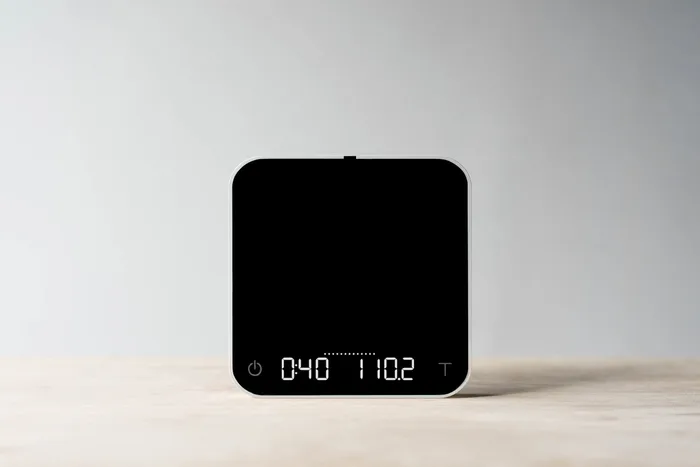
- Acaia Pearl - Buy. A full metrology spec, a flow rate indicator, and the only scale here that tells you its repeatability.
- TIMEMORE Basic 3.0 - Buy. The only one with a published IP rating, the longest battery for the money, and a stated accuracy range.
- Fellow Tally Pro Precision Scale - It depends. The most capacity and the cleverest guidance mode, on the shortest battery here.
- Hario V60 Drip Scale - Skip. The only maker that publishes how its resolution degrades, and the degradation is the problem.
The verdict in 30 seconds
What mattered most
- Readability
- Resolution across range
- Capacity
- Repeatability published
- Water resistance
- Battery
A coffee scale has one job and a hidden catch. The job is telling you the weight to a tenth of a gram while you pour water onto it. The catch is that most scales do not hold that resolution across their whole range, and the number on the box is usually the best case, measured at a low load with nothing moving. Two of the four scales here publish how their resolution changes as the load increases. The other two quote a single figure and leave you to assume it holds at 400 grams of water, which is exactly where you need it.
A full metrology spec, a flow rate indicator, and the only scale here that tells you its repeatability.
Best for: Serious home brewing and cafe use, where flow rate and repeatability actually matter.
- Readability, repeatability and minimum weight all published at 0.1 grams, alongside linearity, which is a genuine specification rather than a single accuracy claim.
- A real-time flow rate indicator that visualises your pouring speed as you pour and suggests thresholds for ideal flow rates, which no other scale here offers.
- A 3.7V 1100mAh lithium-ion battery rated 30 to 40 hours, USB-C charging, Bluetooth 5.0, an adjustable-brightness display, a heat-resistant pad in the box, and a 2-year warranty in the US and EU.
- No water resistance rating is published, and Acaia's own care instruction is a soft cloth with warm water only.
- 2000 grams capacity is the joint lowest here, 500 grams less than the Fellow.
- Acaia states 0.1 gram readability but does not say whether it holds across the full 2000 gram range, where two competitors do.
- It is the most expensive scale in this comparison by a wide margin, and the warranty drops to one year outside the US and EU.
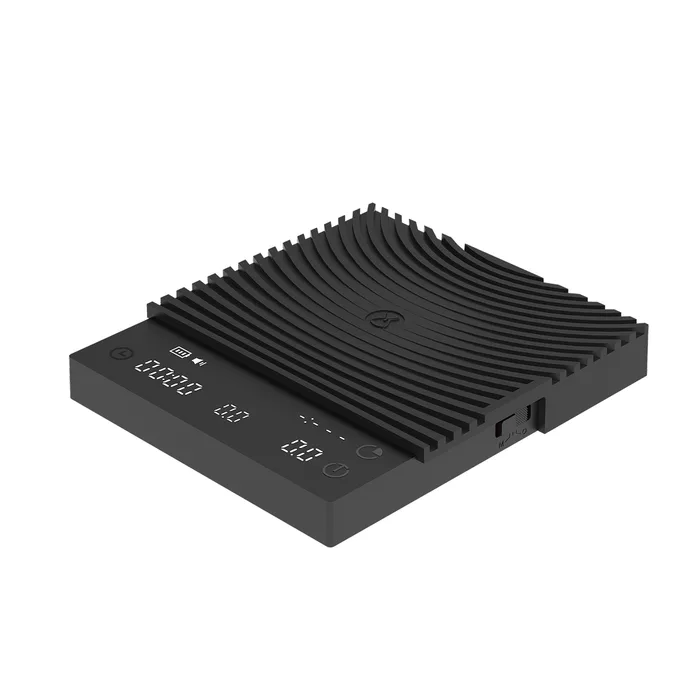
The only one with a published IP rating, the longest battery for the money, and a stated accuracy range.
Best for: A first serious brewing scale, and anyone who splashes water around.
- IPX3 water resistance, the only rating published by any maker here, on a device that lives next to a kettle.
- Accuracy stated as 0.1 grams from 0.2 to 500 grams against a capacity of 0.2 to 2000 grams, so TIMEMORE tells you which part of the range the figure covers.
- A 1600mAh battery good for up to 24 hours of continuous use and a full recharge in 3.5 hours over USB-C, with Regular, Pour-Over and Espresso modes, automatic tare in Espresso mode, a three-second timer lead-in and a coffee-to-water ratio display.
- No Bluetooth and no app, so there is no way to log or export a brew.
- The published accuracy figure covers 0.2 to 500 grams, which means the top three quarters of the capacity is unspecified.
- No warranty terms appear on the product page.
- At 140 by 120mm it is the smallest platform here, which suits a cup better than a wide server.
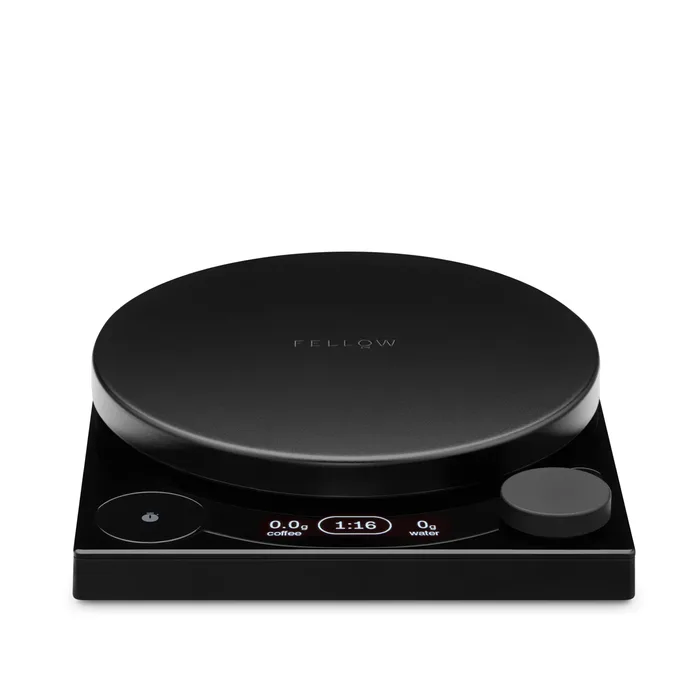
The most capacity and the cleverest guidance mode, on the shortest battery here.
Best for: Brewing into heavy vessels, and anyone who wants the scale to do the ratio maths.
- A 2500 gram maximum load, 500 grams more than anything else here, which matters if you brew into a heavy server or a Chemex.
- Brew Assist mode lets you choose a coffee-to-water ratio and then guides you to the target brew weight, alongside a Timer mode showing weight and time side by side and a Weight mode in grams, ounces, pounds and millilitres.
- Accurate to a tenth of a gram, 177 by 150 by 33mm, USB-C rechargeable, and a 2-year standard warranty with the option to extend.
- Thirteen hours of continuous battery, against 24 on the TIMEMORE and 30 to 40 on the Acaia.
- Water resistant but explicitly not waterproof, with no IP rating published.
- No Bluetooth and no app.
- The largest footprint here at 177 by 150mm, which is a lot of counter for a scale.
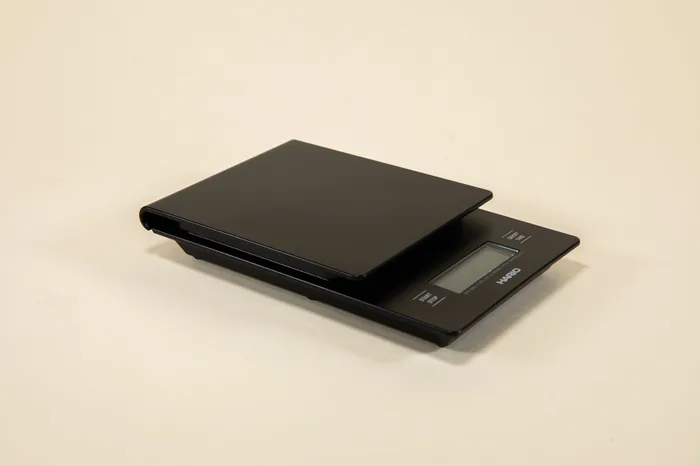
The only maker that publishes how its resolution degrades, and the degradation is the problem.
Best for: Weighing coffee doses, where the 2 to 200 gram range keeps the full 0.1 gram resolution.
- Hario publishes the full scale interval table: 0.1 grams from 2 to 200 grams, 0.5 grams from 200 to 500, and 1 gram from 500 to 2000, which nobody else in this comparison does.
- Complete specification with a product number, VSTN-INT-2000B, dimensions of 120 by 190 by 29mm, materials given as ABS resin for the body and platform, and country of manufacture.
- A narrow 120mm footprint designed to sit under a server, with a built-in timer for following and repeating recipes.
- Resolution drops to 0.5 grams above 200 grams and 1 gram above 500, which covers the entire water weight of a normal pour-over.
- No water resistance rating and no mention of splash protection on a scale sold for pouring water.
- No Bluetooth, no app, no modes beyond weight and timer.
- No warranty terms are published.
| Criteria | Pearl Top pick | Basic 3.0 | Tally Pro Precision Scale | V60 Drip Scale |
|---|---|---|---|---|
| Verdict | Buy it | Buy it | It depends | Skip it |
| Best for | Serious home brewing and cafe use, where flow rate and repeatability actually matter. | A first serious brewing scale, and anyone who splashes water around. | Brewing into heavy vessels, and anyone who wants the scale to do the ratio maths. | Weighing coffee doses, where the 2 to 200 gram range keeps the full 0.1 gram resolution. |
| Price tier | $$$$ · flagship | $ · budget | $$$ · premium | $$ · mid-range |
| Readability | 0.1 g | 0.1 g | 0.1 g | 0.1 g, only 2 to 200 g |
| Resolution across range | Not published | 0.1 g stated for 0.2 to 500 g | Not published | 0.1 / 0.5 / 1 g by load, published |
| Capacity | 2000 g | 2000 g | 2500 g | 2000 g |
| Repeatability published | Yes, 0.1 g | No | No | No |
| Water resistance | Not published | IPX3 | Water resistant, not waterproof | Not published |
| Battery | 1100 mAh, 30 to 40 hours | 1600 mAh, up to 24 hours | 13 hours continuous | Not published |
| Charging | USB-C | USB-C, 3.5 h to full | USB-C, 5 V 1 A | Not published |
| Connectivity | Bluetooth 5.0 | None | None | None |
| Modes | Dual display, auto-start timer, beverage | Regular, pour-over, espresso | Brew Assist, timer, weight | Weight and timer |
| Dimensions | 160 x 160 x 32 mm | 140 x 120 x 20 mm | 177 x 150 x 33 mm | 120 x 190 x 29 mm |
| Warranty | 2 years US and EU, 1 elsewhere | Not published | 2 years, extendable | Not published |
Which one is right for you?
- Serious home brewing and cafe use, where flow rate and repeatability actually matter. Buy it Acaia Pearl
- A first serious brewing scale, and anyone who splashes water around. Buy it TIMEMORE Basic 3.0
- Brewing into heavy vessels, and anyone who wants the scale to do the ratio maths. It depends Fellow Tally Pro Precision Scale
- Weighing coffee doses, where the 2 to 200 gram range keeps the full 0.1 gram resolution. Skip it Hario V60 Drip Scale
How we judged the field
The first thing we looked for was not readability but whether readability is qualified. Every scale here claims 0.1 grams, and that number is meaningless without knowing the load at which it still applies. Hario publishes a full interval table showing the figure degrading twice as the load rises. TIMEMORE states the range the figure covers. Acaia and Fellow give one number and no range. That single distinction told us more than any other line on the four product pages.
After that we looked at capacity, because a heavy server plus water can approach 2000 grams and the limit is a hard one. Then water resistance, which is the most obviously relevant durability question for a device sold to have boiling water poured over it, and which only one maker quantifies. Then battery, in hours of continuous use rather than in vague terms, since a scale left on during a slow pour-over is running for several minutes every session. Finally modes and connectivity, which is where the money goes at the top of the market and where the practical benefit is smallest: a flow rate indicator changes how you pour, and a Bluetooth log does not, unless you are the kind of person who reads the logs.
The Acaia Pearl is the only scale in this comparison that publishes a metrology specification rather than a marketing figure. Readability is 0.1 grams, repeatability is 0.1 grams, minimum weight is 0.1 grams, and linearity is listed alongside them, which is the vocabulary of a weighing instrument rather than a kitchen gadget. Capacity is 2000 grams, the platform is 160 by 160 by 32mm, the battery is a 3.7V 1100mAh lithium-ion rated at 30 to 40 hours, charging is USB-C and connectivity is Bluetooth 5.0. What actually justifies the price is the real-time flow rate indicator, which visualises your pouring speed as you pour and suggests thresholds for an ideal rate. That is the only feature on any of these four scales that changes what you do with your hands, and on a pour-over it is more useful than any amount of logging. There are also multiple brewing modes, a dual display, an auto-start timer and a beverage mode, an adjustable-brightness display for reading in sunlight, a heat-resistant pad in the box and a 2-year warranty in the US and EU. The gaps are a missing water resistance rating on a device whose care instruction is a soft cloth with warm water, and no statement of whether 0.1 grams holds at 1500 grams.
The TIMEMORE Basic 3.0 is the scale that publishes the things that matter and skips the things that do not. It is rated IPX3, the only water resistance rating in this group, which on a device that sits between a kettle and a dripper is the most practically relevant specification anyone here publishes. Accuracy is stated as 0.1 grams from 0.2 to 500 grams against a capacity of 0.2 to 2000 grams, which is a qualified claim rather than a bare number. The battery is 1600mAh, the largest here, good for up to 24 hours of continuous use and roughly 280 five-minute pour-overs, and it charges fully over USB-C in 3.5 hours. It measures 140 by 120 by 20mm and weighs 300 grams, making it both the smallest and the thinnest. The interface is well thought through: Regular, Pour-Over and Espresso modes selected by a multifunction slider, automatic tare when a cup is placed in espresso mode, a three-second timer lead-in that pauses until your first pour so timing starts when you do, and a ratio button that displays coffee to water as you go. There is no Bluetooth, the stated accuracy covers only the lower quarter of the range, and no warranty terms appear on the page.
The Fellow Tally Pro is the best-thought-out interface here and the weakest on endurance. Its headline feature is Brew Assist, which is the sensible version of what a scale should do for a beginner: you choose a coffee-to-water ratio, and the scale guides you to your target brew weight rather than making you do arithmetic mid-pour. Timer mode puts weight and time side by side for people who already know their recipe, and Weight mode handles grams, ounces, pounds and millilitres for everything else in the kitchen. The capacity is 2500 grams, 500 more than anything else here, which is a real advantage if you brew into a heavy glass server. It measures 177 by 150 by 33mm, charges over USB-C at 5V 1A, reads to a tenth of a gram, and carries a 2-year standard warranty with an option to extend, which is the best warranty in this comparison. The problems are the battery and the silence. Thirteen hours of continuous use is a third of the Acaia’s and half the TIMEMORE’s. Fellow describes it as water resistant but explicitly not waterproof, with no IP rating, and warns against the dishwasher and immersion. And it is the largest footprint here by some margin.
The Hario V60 Drip Scale is the most transparently documented product in this comparison and that transparency is what disqualifies it. Hario gives you the product number VSTN-INT-2000B, dimensions of 120 by 190 by 29mm, materials as ABS resin for both body and platform, a 2000 gram capacity, country of manufacture, and then the table nobody else prints: the scale interval is 0.1 grams from 2 to 200 grams, 0.5 grams from 200 to 500 grams, and 1 gram from 500 to 2000 grams. Read that against a normal pour-over. You weigh an 18 gram dose at full 0.1 gram resolution, which is fine. Then you put a dripper and a server on the scale, which on its own may exceed 500 grams, and pour 300 grams of water into it, and for the entire brew the scale is resolving to a whole gram. It still works as a brewing timer and it is genuinely good at weighing doses, but the precision it advertises is not available where brewing happens. Add no water resistance rating, no warranty terms and no modes beyond weight and timer, and there is no reason to choose it over a cheaper scale that holds 0.1 grams to 500 grams.
Acaia Pearl vs TIMEMORE Basic 3.0: which should you buy?
Acaia against TIMEMORE is a choice between a measuring instrument and a well-made tool, and the price gap is large enough that it deserves a straight answer. The Pearl earns its money in two places. The first is the specification: readability, repeatability, minimum weight and linearity all published, which is what you would expect from a laboratory balance and not from a kitchen product, and it is the reason cafes buy them. The second is the real-time flow rate indicator, which shows your pouring speed as you pour and is the only feature in this group that changes technique rather than convenience.
The Basic 3.0 answers with the specifications that describe daily life with the thing. It is IPX3 rated, it runs for 24 hours on a charge and recharges in 3.5, it qualifies its accuracy claim with a range, it is the smallest and thinnest on the counter, and its three modes and three-second timer lead-in are genuinely well designed. For most people, most of the time, that is the better purchase, and the difference in money buys a lot of coffee. Buy the Pearl if you are dialling in brews seriously and want flow rate feedback and a spec sheet you can trust. Buy the Basic 3.0 if you want a scale that works, survives spills and lasts a month between charges.
What to look for
- Readability with a stated range: 0.1 grams means nothing without the load it applies to, and two makers here qualify it while two do not.
- Capacity against your heaviest setup: a glass server plus a dripper plus 500 grams of water adds up faster than you expect.
- A water resistance rating: this device has boiling water poured over it, and IPX3 is the only real number published in this group.
- Battery in hours of continuous use: a pour-over keeps the scale awake for several minutes, so 13 hours and 40 hours are very different experiences.
- A timer with a sensible auto-off: the classic kitchen-scale failure is switching itself off during the bloom.
- Guidance features, if you are learning: a ratio-driven target weight or a flow rate indicator teaches you more than a Bluetooth log ever will.
Our final take
Coffee scales all claim a tenth of a gram and only half of them tell you where that stops being true. The Acaia Pearl is the one to buy if brewing is something you work at, because it publishes a real weighing specification and because its flow rate indicator is the only feature here that changes how you pour. The TIMEMORE Basic 3.0 is the better buy for almost everyone else: a published IPX3 rating, a qualified accuracy figure, 24 hours of battery and three well-designed modes for a fraction of the money. The Fellow Tally Pro has the highest capacity, the best warranty and the friendliest guidance mode, and the shortest battery life by a distance. And the Hario is the only scale here candid enough to publish the table that shows its precision disappears at 200 grams, which is exactly the information you needed and exactly the reason to buy something else.
Questions, answered
Why does 0.1 gram resolution matter for coffee?
For the coffee dose it matters a lot, because a gram either way on an 18 gram dose is a five percent change in your ratio and you will taste it. For the water it matters much less, since a gram in 300 is a third of a percent. The catch is that most scales lose resolution as the load increases, and on the Hario the drop happens at 200 grams, which is below any brew weight. So the useful question is not what resolution a scale claims but at what load it still delivers it.
Do I need Bluetooth or an app?
Only if you want to record brews. An app lets you log weight and time curves, compare them between sessions and share recipes, which is genuinely useful if you are dialling in a new coffee and useless if you brew the same thing every morning. The Acaia Pearl is the only scale here with Bluetooth. Everything that actually affects the cup, resolution, response speed and a timer, works without it, and the other three do the job perfectly well with a button and a display.
What does IPX3 actually protect against?
Water spraying at the device from up to 60 degrees either side of vertical, which in practice means splashes and drips rather than immersion. That is the realistic hazard for a coffee scale: an overshot pour, a dripping dripper lifted off the platform, a spill from a server. It is the only rating published by any maker here. Fellow says its scale is water resistant but not waterproof without a number, and Acaia and Hario say nothing, which for devices sold to have hot water poured over them is a curious silence.
How fast should a scale respond?
Fast enough that the number keeps up with a pour, which is the difference between reacting to your flow and reacting to where it was two seconds ago. Nobody publishes a response time in milliseconds, so it is the one important characteristic you cannot compare on paper. What you can look at is what a maker says around it: Acaia talks about new weighing technology that stabilises faster, and TIMEMORE and Fellow both claim fast stabilisation. A scale intended for espresso is generally the more responsive design.
Can I use a kitchen scale instead?
For the dose, often yes, if it reads to 0.1 grams. For brewing, usually not, for two reasons. Most kitchen scales have no timer, so you end up with a phone propped against the kettle. And many auto-off after 30 or 60 seconds of a stable reading, which on a pour-over means the scale switches itself off during the bloom. A coffee scale is mostly a kitchen scale with a timer, a longer auto-off and a platform sized for a dripper.
Deciding between the top two? See our head-to-head: Acaia Pearl vs TIMEMORE Basic 3.0.
More Home & Kitchen reviews
 The Best Cold Brew Coffee Makers: 4 Compared (and One to Skip)
  The Best Cordless Drills: 4 Compared (and One to Skip)
  The Best Cordless Lawn Mowers: 4 Compared (and One to Skip)
  The Best Cordless Stick Vacuums: We Compared 4 (and One Isn't Worth It)
  The Best Countertop Blenders in 2026 (and the Pretty One to Skip)
  The Best Countertop & Portable Dishwashers: 4 Compared (and One to Skip)