Explained
Stovetop Kettles, Explained
After reading, you'll know whether you need a gooseneck, how to read capacity claims honestly, and which kettles will work on your hob.
In this guide
Two products share the name stovetop kettle. One heats water and signals when it is ready. The other is a pouring instrument that happens to be heatable. Knowing which one you are shopping for makes the rest of the decision straightforward, because the specifications that matter for each are almost entirely different.
The 30-second version
- A gooseneck is for control, not speed, and a conventional spout cannot be made to substitute.
- Practical capacity is what matters, and it is often around two thirds of the nominal figure.
- A lid thermometer removes the biggest guess in home filter brewing, which is water temperature.
- Induction needs a magnetic base, so check for a stated claim or test with a fridge magnet.
- Handle material and balance decide comfort, over a pour that can last three minutes.
The products this guide is about
Our verdict on each, with the full reasoning on the companion review.
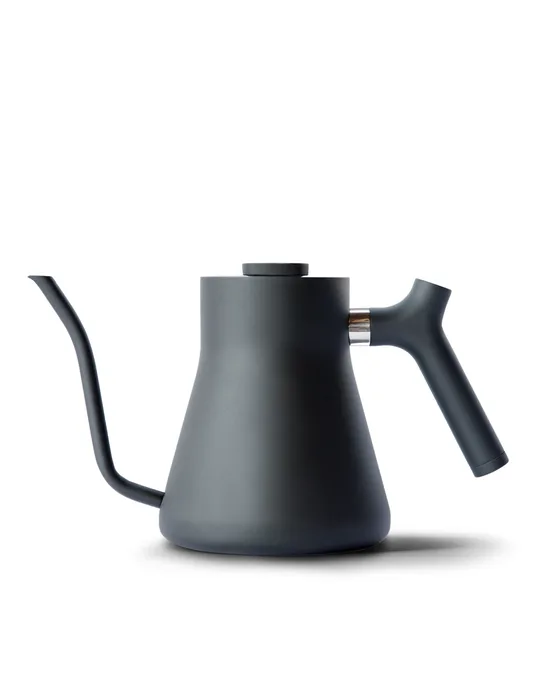
- Buy Fellow Stagg Pour-Over Kettle A thermometer in the lid and a counterbalanced handle, which is the whole argument for a dedicated pour-over kettle.
- Buy Hario V60 Buono Drip Kettle 1.2L The kettle that defined the shape, documented right down to the part number.
- It depends GROSCHE MARRAKESH Gooseneck Pour Over Stovetop Kettle The one that works on every heat source including a campfire, at the lowest price and with the muddiest specification.
- Skip Alessi 9093 Kettle A 1985 Michael Graves design classic that will not tell you how much water it holds.
What actually matters
- Spout geometry - gooseneck spouts are narrow and curved, delivering a thin controllable stream. Conventional spouts are wide and fast, which is right for filling a teapot and wrong for wetting coffee grounds.
- Practical capacity - the volume you can actually fill and pour, as opposed to the vessel's nominal size. The gap can be several hundred millilitres.
- Thermometer - a dial in the lid reading brew range temperatures. It replaces the habit of boiling and then waiting a guessed number of minutes.
- Heat source compatibility - gas, electric coil, ceramic, induction, camping stove or open flame. Induction specifically requires a magnetic base.
- Body material - 18/8 and 18/10 stainless are the common grades, the second with more nickel for corrosion resistance and a deeper shine.
- Handle construction - the material and where the weight sits. A counterbalanced handle keeps the centre of mass near your hand, which steadies a slow pour.
- Base finish - painted and coated bases mark with normal use on a hob, which is worth knowing before choosing a matte colour.
The specs, in plain English
Green flags vs red flags
Green flags
- Practical capacity stated separately from nominal capacity.
- Heat source compatibility listed explicitly, including induction.
- Materials named part by part, including the handle.
- Dimensions and an item number published.
- A thermometer or a clear statement that there is none.
Red flags
- Two different capacities given on the same product page.
- No capacity published at all.
- No mention of which hobs it works on.
- Handle described only as heat proof with no material named.
- Pour control claimed on a conventional wide spout.
Who's who: the brands
- Fellow - American coffee equipment brand known for the Stagg range, which pairs precision spouts with lid thermometers and counterbalanced handles across stovetop and electric models.
- Hario - Japanese glassware and coffee equipment maker, originator of the V60 and the Buono kettle shape, with unusually complete published specifications.
- GROSCHE - Canadian certified B Corp making value-priced kettles, presses and moka pots, funding clean water projects with each product sold.
- Alessi - Italian design house whose kettles, including Michael Graves's 9093, are sold as design objects with minimal technical specification.
- Le Creuset - Best known for enamelled cast iron, and a common choice for traditional whistling stovetop kettles in enamelled steel.
How to read a listing without getting fooled
Decide first whether you are buying a pouring instrument or a boiler, because that determines which specifications you should even read. For a pour-over kettle, look for the word gooseneck and then for anything the maker says about handle balance, since that is where the better designs separate themselves. Find the capacity and then look for a second, smaller number described as practical or usable; if only one number appears, assume the real figure is lower. Check for a thermometer and decide honestly whether you will otherwise buy a probe. Then find the heat source list and make sure your hob is on it, paying particular attention to induction, which needs a magnetic base and which two of the kettles here do not address. Finally read anything the maker says about the base finish, because a kettle used on a hob will mark and the honest brands say so in advance.
How much should you spend?
Stovetop kettles are cheap relative to the coffee equipment around them, and the money buys instrumentation rather than better water. The budget tier gets you a genuine gooseneck in stainless steel that works on every hob including a camping stove, which is enough to transform a pour-over routine and is the right first purchase. Mid-range buys a better-finished kettle with a properly documented spout and materials, typically Japanese, and it is where most people should stop. Premium adds a lid thermometer and a counterbalanced handle, which are real improvements if you are still dialling in your brewing and largely cosmetic if you are not. The flagship tier is design, and a design kettle is a legitimate thing to want, as long as you are not expecting it to pour well. If you brew daily and want temperature held rather than measured, put the money towards an electric gooseneck instead.
Questions, answered
What temperature should the water be for pour-over coffee?
Somewhat below boiling, and the exact figure is less important than being consistent about it. Water straight off a rolling boil tends to over-extract and taste harsh, which is why the usual advice is to let it sit briefly, and why a thermometer in the lid is useful: it converts a guessed pause into a reading. A darker roast generally suits slightly cooler water and a light roast slightly hotter. Pick a temperature, hit it every time, and change one thing at a time from there.
Can I use a gooseneck kettle for tea?
Yes, and it is genuinely nice for delicate teas where you want to pour gently over leaves rather than agitate them. The drawback is speed and capacity: a gooseneck takes a long time to empty and most hold less than a traditional kettle, so filling a large teapot is tedious. If tea is the main use and coffee is occasional, a conventional kettle with a good whistle is the better object and you will not miss the spout.
How do I stop limescale building up inside?
Descale it periodically with a weak acid, which in practice means white vinegar or citric acid diluted in water, left to sit and then rinsed very thoroughly. Hard water areas need this every few weeks, soft water areas rarely. Do not use abrasive pads inside a stainless kettle, and pay attention to the spout, because scale in the narrow bore of a gooseneck restricts flow and is the thing that ruins pour control. Emptying the kettle after use rather than leaving water standing slows the whole process down.
Is a stovetop kettle safe to leave on the hob?
Only while you are there, and this is the practical argument for a whistle. A stovetop kettle has no automatic shutoff, so an unattended one will boil dry and then get very hot indeed, which will damage the base, any resin handle, and possibly the hob. A whistling kettle at least announces itself. With a gooseneck kettle, which usually has no whistle, the discipline is simply not to walk away from it.
Or jump to the head-to-head: Fellow Stagg Pour-Over Kettle vs Hario V60 Buono Drip Kettle 1.2L.