

Home & Kitchen
The Best Stovetop Kettles: 4 Compared (and One to Skip)
We compared four stovetop kettles on spout design and pour control, published capacity against practical capacity, heat source compatibility, handle construction and what each maker states in writing.
The short version
The Fellow Stagg Pour-Over Kettle is the one to buy: a precision pour spout, a brew-range thermometer built into the lid so you can see the temperature without a probe, and a counterbalanced handle that moves the centre of mass back towards your hand so a slow pour stays slow. It holds 1.0 litre and works on gas and electric, though Fellow does not list induction. The Hario V60 Buono 1.2L is the value pick and the best-documented kettle here, published down to its item number, its 274 by 144 by 147mm dimensions, its 800ml practical capacity and its phenol resin handle, made in Japan with a manual online. The GROSCHE Marrakesh is the versatile one, 18/8 stainless with a flat base that works on induction, camping stoves and an open fire, though its own page gives two different capacities. The Alessi 9093 is the one to skip if you are here to brew coffee: it is a Michael Graves design classic with a bird whistle, and Alessi publishes no capacity, no dimensions and no weight for it. Best for: anyone brewing pour-over coffee who has been making do with a saucepan.
Our picks at a glance
- Fellow Stagg Pour-Over Kettle - Buy. A thermometer in the lid and a counterbalanced handle, which is the whole argument for a dedicated pour-over kettle.
- Hario V60 Buono Drip Kettle 1.2L - Buy. The kettle that defined the shape, documented right down to the part number.
- GROSCHE MARRAKESH Gooseneck Pour Over Stovetop Kettle - It depends. The one that works on every heat source including a campfire, at the lowest price and with the muddiest specification.
- Alessi 9093 Kettle - Skip. A 1985 Michael Graves design classic that will not tell you how much water it holds.
The verdict in 30 seconds
What mattered most
- Spout type
- Capacity published
- Thermometer
- Induction
- Body material
- Handle material
A stovetop kettle is a simple object with two fundamentally different jobs hiding inside it. One is boiling water fast and telling you when it is ready, which is what a whistling kettle does. The other is putting a controlled, slow stream of water exactly where you want it, which is what a gooseneck kettle does and why coffee people own one. Almost nothing about the first job predicts performance at the second, and the specifications that matter differ completely: for a whistler it is capacity and how quickly it heats, for a gooseneck it is spout geometry, handle balance and whether there is a thermometer in the lid. We compared three goosenecks and one design icon.
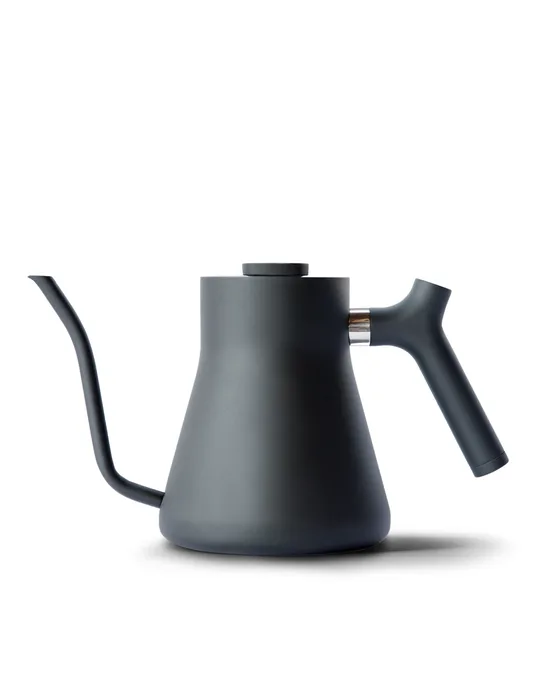
A thermometer in the lid and a counterbalanced handle, which is the whole argument for a dedicated pour-over kettle.
Best for: Pour-over coffee at home, where temperature and pour rate are the variables you are trying to control.
- A brew range thermometer built into the lid, so you can see the water temperature without a separate probe.
- A counterbalanced handle that moves the centre of mass back towards your hand, which makes holding a slow, even pour markedly easier.
- A precision pour spout designed for an intuitive steady stream, with a 1.0 litre boiling capacity, a stainless steel body and a choice of matte white, matte black or polished steel.
- Fellow lists it as gas and electric range compatible and does not mention induction.
- Fellow warns that normal daily use on cooking ranges will damage the finish on the bottom of the kettle, and that copper versions discolour.
- No dimensions, weight or empty-to-boil figures are published.
- The most expensive gooseneck of the three here by a clear margin.
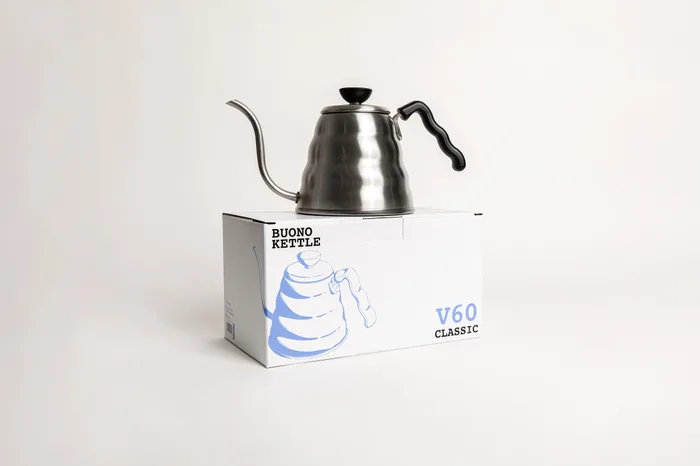
The kettle that defined the shape, documented right down to the part number.
Best for: Anyone who wants proper pour control without paying for a thermometer they may not use.
- Fully specified: item number VKB-120HSV, 274 by 144 by 147mm, practical capacity 800 millilitres, with a product manual published online.
- Materials are named part by part, a stainless steel body and lid with a phenol resin handle and lid knob, and it is made in Japan.
- The slim spout is the original of this shape and gives genuine control over the amount and speed of water poured.
- The 1.2 litre name describes the vessel, not the fill: practical capacity is 800ml, which Hario states but the product title does not.
- No thermometer, so you are brewing by timer or by a separate probe.
- Hario does not publish heat source compatibility on the product page, which is an odd omission given how much else is there.
- No dishwasher guidance is given for a kettle with a resin handle.
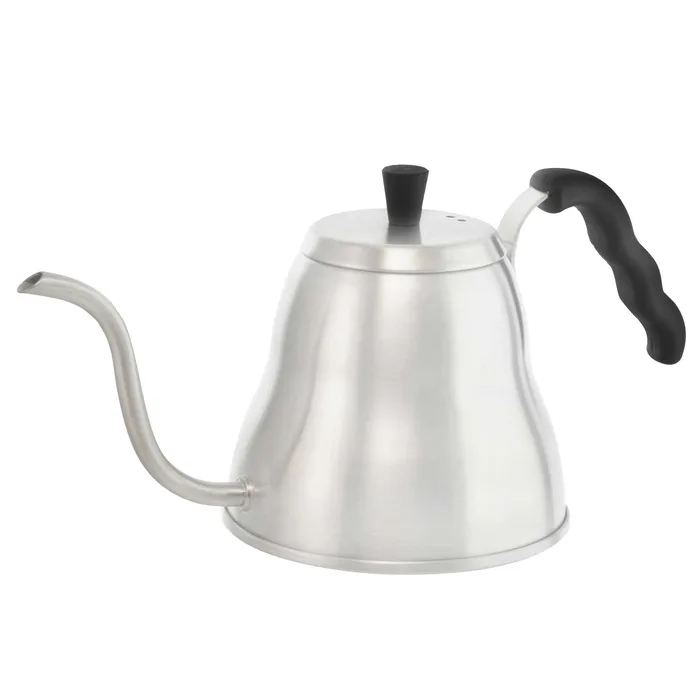
The one that works on every heat source including a campfire, at the lowest price and with the muddiest specification.
Best for: Camping and travel, or a first gooseneck kettle where cost matters more than precision.
- 18/8 stainless steel with a flat base, stated safe on electric coil, induction glass tops, camping propane, gas and over an open fire.
- A long slim spout for flow control and a heat-proof handle, and it is dishwasher safe although GROSCHE recommends hand washing.
- GROSCHE is a certified B Corp and funds safe drinking water through its Safe Water Project for every product sold.
- The page contradicts itself on capacity: the product is titled 34 fl oz / 1000mL while the description says it boils a convenient 700ml.
- No dimensions, no weight and no country of manufacture are published.
- No thermometer and no temperature guidance of any kind.
- 18/8 stainless is a slightly lower grade than the 18/10 used by the Alessi.
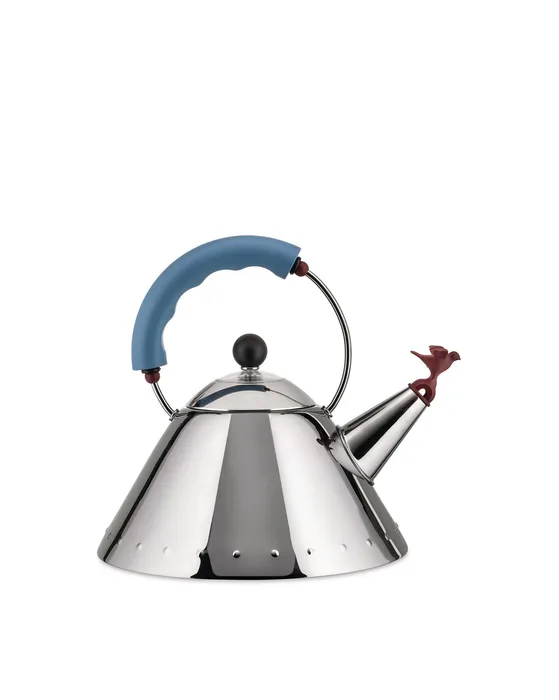
A 1985 Michael Graves design classic that will not tell you how much water it holds.
Best for: Someone buying a design object for the kitchen who happens to want it to boil water.
- 18/10 stainless steel, the highest grade in this comparison, with a magnetic steel bottom explicitly suitable for induction cooking.
- The bird-shaped whistle is a genuine design landmark and one of the best-selling objects Alessi has ever made.
- Offered in light blue, white and black, so it works as an object on a hob rather than something to put away.
- Alessi publishes no capacity, no dimensions and no weight for it anywhere on the product page.
- It is a boiling kettle with a conventional spout, so it gives none of the pour control a gooseneck does.
- Thermoplastic resin is used for the handle and the whistle, on the most expensive kettle here.
- No dishwasher guidance, no heat-up figures and no care instructions are published.
| Criteria | Stagg Pour-Over Kettle Top pick | V60 Buono Drip Kettle 1.2L | MARRAKESH Gooseneck Pour Over Stovetop Kettle | 9093 Kettle |
|---|---|---|---|---|
| Verdict | Buy it | Buy it | It depends | Skip it |
| Best for | Pour-over coffee at home, where temperature and pour rate are the variables you are trying to control. | Anyone who wants proper pour control without paying for a thermometer they may not use. | Camping and travel, or a first gooseneck kettle where cost matters more than precision. | Someone buying a design object for the kitchen who happens to want it to boil water. |
| Price tier | $$$ · premium | $$ · mid-range | $ · budget | $$$$ · flagship |
| Spout type | Gooseneck, precision pour | Gooseneck, slim spout | Gooseneck, long slim spout | Conventional, bird whistle |
| Capacity published | 1.0 L boiling capacity | 800 ml practical, 1.2 L nominal | 1000 ml in title, 700 ml in text | Not published |
| Thermometer | Yes, brew range, in the lid | No | No | No |
| Induction | Not listed, gas and electric only | Not published | Yes, stated | Yes, magnetic steel bottom |
| Body material | Stainless steel | Stainless steel body and lid | 18/8 stainless steel | 18/10 stainless steel |
| Handle material | Counterbalanced, not specified | Phenol resin | Heat proof, not specified | Thermoplastic resin |
| Dimensions published | No | 274 x 144 x 147 mm | No | No |
| Made in | Not published | Japan | Not published | Not published |
| Finishes | Matte white, matte black, polished steel | Silver | Stainless or black | Light blue, white, black |
Which one is right for you?
- Pour-over coffee at home, where temperature and pour rate are the variables you are trying to control. Buy it Fellow Stagg Pour-Over Kettle
- Anyone who wants proper pour control without paying for a thermometer they may not use. Buy it Hario V60 Buono Drip Kettle 1.2L
- Camping and travel, or a first gooseneck kettle where cost matters more than precision. It depends GROSCHE MARRAKESH Gooseneck Pour Over Stovetop Kettle
- Someone buying a design object for the kitchen who happens to want it to boil water. Skip it Alessi 9093 Kettle
How we judged the field
The first question is what the kettle is for, because a gooseneck and a whistler are not competing products. A gooseneck exists to control a stream of water; a whistling kettle exists to boil a lot of water and tell you about it. We judged the three goosenecks against each other on the things that change a cup of coffee, and judged the whistler on whether it could do that job at all.
Within the goosenecks, spout geometry comes first and is largely unmeasurable from a product page, so we looked for what makers say about it and for the design features around it. Handle balance is the second thing, and only one maker here treats it as an engineering problem rather than a shape. Third is a thermometer, which is the cheapest way to remove the biggest uncontrolled variable in home brewing. Fourth is capacity, and specifically the gap between the stated capacity and the practical one, which is larger than most buyers expect and which the makers handle with wildly different degrees of honesty. Fifth is heat source compatibility, which on a stovetop kettle should be the easiest thing in the world to state and which two of these four do not.
The Fellow Stagg is the only kettle here that treats pouring as a design problem with more than one variable. The spout is a precision pour spout shaped for an intuitive, steady stream, which every gooseneck claims. What is less common is the counterbalanced handle, which Fellow explains properly: it moves the centre of mass back towards your hand, and that matters because a slow pour is a sustained act of balance, and a kettle whose weight hangs out in front of your wrist gets shaky by the end of a brew. The third feature is the one that would justify the price on its own, a brew range thermometer built into the lid, which turns temperature from a guess into something you read. Capacity is 1.0 litre, the body is stainless steel, the current version has a stainless steel lid, and there are three finishes. The reservations are worth knowing. Fellow lists gas and electric range compatibility and says nothing about induction. It also warns that normal daily use on cooking ranges will damage the finish on the bottom, which is unusually candid and worth reading before you buy a matte one. And there are no dimensions, no weight and no heat-up figures at all.
The Hario V60 Buono is the kettle that made this shape famous and it is documented like a piece of equipment rather than a lifestyle product. The page gives the item number VKB-120HSV, the dimensions as 274 by 144 by 147mm, the practical capacity as 800 millilitres, the materials broken out as stainless steel for the body and lid and phenol resin for the handle and the lid knob, the country of manufacture as Japan, and a link to the product manual. That is more than any other kettle here publishes and it is the reason to trust it. The slim spout does exactly what it is supposed to, giving control over both the amount and the speed of the pour, and the 1 litre version exists for smaller brews. Three things are missing. There is no thermometer. The 1.2 litre in the name is the vessel and the 800ml is what you can actually pour, a gap the title does not flag. And for a stovetop kettle, Hario does not state on the page which stovetops it is for, which with a resin handle is a question worth answering.
The GROSCHE Marrakesh is the most versatile kettle here and the least precisely described. It is 18/8 stainless steel with a flat base, and GROSCHE is specific that this means it works on electric coil stoves, induction glass tops, camping propane and gas stoves, and directly over a fire, which no other kettle in this group claims. The spout is long and slim for flow control, the handle is described as heat proof, and it is dishwasher safe with hand washing recommended. GROSCHE is also a certified B Corp and funds clean water access through its Safe Water Project on every product sold, which is a real differentiator if that matters to you. The problem is capacity. The product is titled 34 fl oz / 1000mL and the description in the same page says the kettle can boil a convenient 700 ml amount of water. Those are two different numbers about the same object and nothing on the page reconciles them. Add no dimensions, no weight, no country of manufacture and no thermometer, and this becomes the right kettle for camping and the wrong one for anyone who wants to know what they are buying.
The Alessi 9093 is a magnificent object and a poor stovetop kettle for the purpose most people are shopping for. Michael Graves designed it in 1985, it has a bird-shaped whistle that sings when the water boils, and it is one of the best-selling things Alessi has ever made. The specification Alessi gives is two sentences: a kettle in 18/10 stainless steel and thermoplastic resin, with a magnetic steel bottom suitable for induction cooking. That is genuinely the best material grade here and the clearest induction statement. Everything else is absent. There is no capacity, no dimensions, no weight, no care or dishwasher guidance and nothing about heat-up. More to the point, the spout is a conventional pouring spout, so it offers none of the control the other three are built around, which makes it the wrong choice for filter coffee whatever it costs. If you want a kettle that whistles and looks extraordinary on a hob, this is the one. If you are here because your pour-over tastes uneven, it will not help.
Fellow Stagg Pour-Over Kettle vs Hario V60 Buono Drip Kettle 1.2L: which should you buy?
Fellow against Hario is the clearest choice in this comparison, and it is a choice about the thermometer. The Stagg gives you two things the Buono does not: a brew range thermometer in the lid, which removes the guesswork about when boiled water has cooled enough, and a handle deliberately counterbalanced so the kettle stays steady through a slow pour. Both of those directly change the cup, which is more than most upgrade paths in coffee can claim.
The Hario gives you a nearly equal spout, a published dimension list, a named material for every part, a manual and a Japanese factory, for a fraction of the money. If you already own a thermometer, or if you brew by ear and by timer as most people eventually do, the gap narrows to the handle, and that is a real but small advantage. Buy the Stagg if you are still learning the temperature side of brewing and want the feedback in front of you. Buy the Buono if you want the pouring geometry without paying for instrumentation, and spend the difference on better coffee.
What to look for
- A true gooseneck, if you brew coffee: a narrow curved spout is the entire point, and a conventional spout cannot be made to substitute.
- Practical capacity, not the name on the box: the usable figure is often two thirds of the nominal one, and the honest makers say so.
- A thermometer, or a plan without one: it is the cheapest way to fix the biggest uncontrolled variable in filter coffee.
- Handle balance and material: a counterbalanced handle steadies a slow pour, and a named material tells you whether it will survive a dishwasher.
- Stated heat source compatibility: induction needs a magnetic base, and two kettles here will not tell you whether they have one.
- A warning about the finish: a maker that admits the base finish will mark with normal use is telling you something useful about the others that do not.
Our final take
Stovetop kettles look interchangeable and are not. The Fellow Stagg is the one to buy if you are brewing coffee seriously: the thermometer in the lid and the counterbalanced handle are genuine engineering aimed at the two variables you can actually control, and Fellow is honest enough to warn you about the finish on the base. The Hario V60 Buono is the better value and the better-documented product, with everything from its part number to its practical capacity published, and it pours nearly as well. The GROSCHE Marrakesh is the one to take camping, because nothing else here claims to sit on an open fire, provided you can live with a page that gives two different capacities. And the Alessi 9093 is a beautiful object that Alessi will not tell you the volume of, with a spout that cannot do the job the other three exist for.
Questions, answered
Do I actually need a gooseneck kettle?
For pour-over coffee, yes, and for anything else, no. A gooseneck's narrow, curved spout turns the kettle into something closer to a watering can: the stream is thin, slow and goes where you aim it, which is what lets you wet a bed of grounds evenly and keep the water level steady. A conventional spout dumps water in a wide surge that channels through the grounds and pulls the brew unevenly. For tea, for stock, or for filling a hot water bottle, a gooseneck is simply a slower kettle.
Why is the practical capacity lower than the stated capacity?
Because the number on the box is usually the volume of the vessel and the practical capacity is how much you can put in without water reaching the spout or the lid. Hario is straightforward about this, calling its 1.2 litre kettle an 800ml practical capacity. GROSCHE is less clear, titling its kettle at 1000ml while the description says 700ml. Either way, plan around the practical figure: a kettle that takes 800ml comfortably brews two or three cups of pour-over, and you should not expect to fill it to the name on the label.
Does a built-in thermometer matter?
It matters more than most people expect, because brewing temperature is one of the few coffee variables you can control precisely and cheaply. Water off a rolling boil is too hot for most filter coffee, so the usual practice without a thermometer is to boil and then wait a guessed number of minutes, which varies with the kettle, the room and how much water is in it. A brew range thermometer in the lid, as on the Fellow Stagg, removes the guess. If you already own a probe thermometer, it matters much less.
Will a stovetop kettle work on my induction hob?
Only if the base is magnetic, which means it needs to be a ferrous stainless steel or have a magnetic disc bonded to the bottom. GROSCHE states induction glass top compatibility outright and Alessi names a magnetic steel bottom; Fellow lists only gas and electric ranges, and Hario does not address it on the product page. The simple test on a kettle you already own is whether a fridge magnet sticks firmly to the base. If it does not, induction will not heat it.
Stovetop or electric?
Electric gooseneck kettles heat faster, hold a set temperature, and in the better ones let you dial the temperature to the degree, which is why most serious home brewers end up with one. A stovetop kettle costs far less, has nothing electronic to fail, works anywhere there is heat including a camping stove or a fire, and will still be working in twenty years. If you brew every morning and care about hitting a specific temperature, buy electric. If you brew occasionally, travel, or simply prefer objects without a power cord, stovetop is the sensible choice.
Deciding between the top two? See our head-to-head: Fellow Stagg Pour-Over Kettle vs Hario V60 Buono Drip Kettle 1.2L.
More Home & Kitchen reviews
 The Best Cordless String Trimmers: 4 Compared (and One to Skip)
  The Best Tankless Water Heaters: 4 Compared (and One to Skip)
  The Best Toaster Ovens (and Air-Fryer Hybrids) We'd Actually Buy
  The Best Pop-Up Toasters: 4 Compared (and One to Skip)
  The Best Touchless Kitchen Trash Cans: 4 Compared (and One to Skip)
  The Best Tower Fans: 4 Compared (and One to Skip)