Explained
Snowboards, Explained
After reading, you'll understand camber, flex, shape, sizing and base type well enough to read any snowboard spec sheet.
In this guide
Snowboard listings are full of brand terms that sound technical and mean little until you decode them. First-time buyers often pick a board by graphics or by length, then discover it is too stiff, too soft, or the wrong size for their weight. Makers also publish different amounts of detail: some give a numeric flex and weight ranges for every size, others give a label and a minimum. Knowing what each spec does lets you compare boards on equal terms.
The 30-second version
- Size by weight first, then adjust for boot size and riding style, using the maker's own chart.
- A numeric flex is useful, but only compared with other boards from the same maker.
- Twin or directional depends on whether you ride switch or mostly in one direction.
- Sintered bases take wax well, while extruded bases are more basic.
- A beginner label from the maker is worth taking seriously if you are already past that stage.
The products this guide is about
Our verdict on each, with the full reasoning on the companion review.
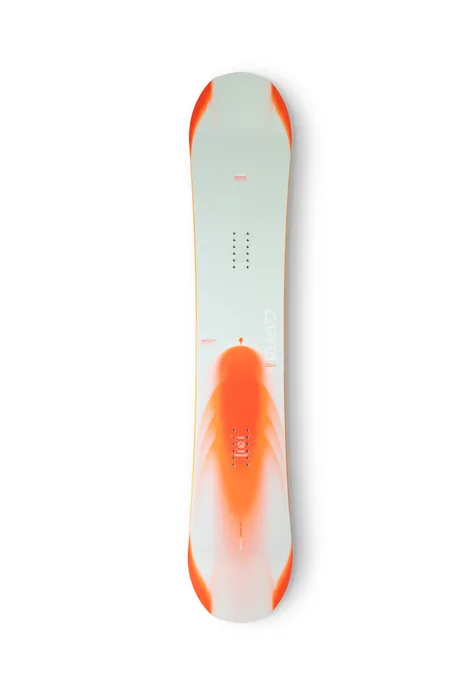
- Buy Capita Mercury A directional all-mountain and freeride board with a numeric 6.5 flex, a sintered base, and weight ranges for every size.
- Buy Burton Process A twin with PurePop Camber and a Happy Medium personality for riders who mix groomers, side hits and some park.
- It depends GNU Money A twin park-leaning board with a C2 hybrid contour and a stated flex of 6 out of 10.
- Skip Burton Instigator PurePop Camber A real, widely sold beginner board that is the wrong purchase for a rider who is already intermediate.
What actually matters
- Camber profile - It describes where the board curves up and down along its length, which shapes edge hold and pop. Makers use their own names, so read the description.
- Flex - It is how easily the board bends. Softer boards are easier to turn and playful, stiffer boards are more stable at speed.
- Shape - A twin is symmetrical, a directional board is built to ride one way. Shape affects switch riding and stability.
- Weight range - Makers list a rider weight range for each size. It is the most reliable starting point for picking a length.
- Waist width - The board's width at the middle. A wider waist helps larger boots avoid dragging in turns.
- Base type - The bottom surface, usually sintered or extruded. It affects glide, durability and how well the board holds wax.
- Core - The wood inside the board. It affects weight, pop and feel, and makers name their cores differently.
The specs, in plain English
Green flags vs red flags
Green flags
- A maker lists weight ranges for every size.
- A numeric flex rating is published.
- The base type is named on the product page.
- The page describes the camber profile in words, not just a brand name.
- The maker states a rider level.
Red flags
- Weight ranges are missing or give only minimums.
- Flex is described only with vague words.
- The base type is not listed.
- The camber profile is named but not explained.
- A beginner label is on a board sold to a rider who is already intermediate.
Who's who: the brands
- Burton - A large mainstream maker with boards from beginner to advanced and consistent weight ranges on product pages.
- Capita - Lists numeric flex and per-size weight ranges on product pages for the boards we checked.
- GNU - Known for playful twins and a numeric flex on a 1 to 10 scale.
- Jones - Focuses on freeride boards and lists terrain scores out of 10 on product pages.
- Ride - Lists response, terrain and ability on product pages, with several models sold through local stores.
How to read a listing without getting fooled
Start with the shape and camber description to understand what the board is built for, then find the flex and see whether it is a number or a label. Go to the size chart and find your weight within the listed ranges, noting whether the ranges give both a minimum and a maximum. Check the base type and the maker's stated skill level, since these quickly separate entry boards from all-mountain boards. If any of those are missing, treat the board as harder to compare, not as a bad board.
How much should you spend?
Snowboards sit in three rough tiers. Budget boards are entry boards, usually with extruded bases and beginner labels. Mid-range boards add sintered bases and better cores and cover most all-mountain riders. Premium boards add refined construction and a clearer sense of purpose, such as a directional freeride shape. Spend more only if you are confident on edges and will use what the extra construction offers. Bindings, wax and a helmet are separate purchases.
Questions, answered
Is a stiffer board better?
Not automatically. A stiffer board is more stable at speed and holds an edge on firm snow, but it takes more effort and is less forgiving of mistakes. A softer board is easier to turn and more playful. Intermediates often do well in the middle of a maker's range. Match flex to how you ride, not to a general idea of quality.
Should I buy a wide board?
Wide sizes exist for riders whose boots could drag in turns, and makers usually give boot size guidance on the product page. If your boots are large, check the maker's wide sizes and their weight ranges. Wide boards are not an upgrade for everyone, since a board that is too wide can be slower to edge. Follow the maker's guidance.
How long should my board be?
Length is chosen mainly by weight, using the maker's size chart, then adjusted for style. Riders who want stability or float may go longer and riders who want a nimbler board may go shorter within their range. Height is a weaker guide than weight. If two sizes both include your weight, the boot size note often decides it.
How often should I wax a board?
There is no single schedule, and it depends on how much you ride and the snow conditions. A dry or whitish look on the base is a common sign that it needs wax. A sintered base absorbs wax well, so it benefits from regular waxing. See our review of snowboard waxes for specific options.
Or jump to the head-to-head: Capita Mercury vs Burton Process.