Explained
All-Mountain Skis, Explained
After reading, you'll understand what a ski's dimensions, radius, rocker profile and construction tell you, and how to match them to the snow you actually ski.
In this guide
All-mountain is the broadest label in skiing, and it covers everything from narrow carving skis to wide freeride skis. First-time buyers often choose by the width they see in ski films rather than by the snow they ski most. Another trip-up is comparing weights or radii without checking which length the maker measured. A few numbers on the spec sheet sort out most of this.
The 30-second version
- Waist width matters most, and the high 80s to mid 90s suits most resort skiing.
- Turn radius sets turn size, with smaller numbers turning tighter.
- Metal makes a ski damp and stable, but also more demanding.
- Check the length behind every number, because makers quote dimensions and weights for one size.
- Bindings are usually separate, so budget for the binding and a shop mount.
The products this guide is about
Our verdict on each, with the full reasoning on the companion review.
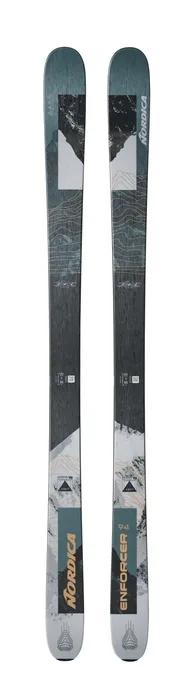
- Buy Nordica Enforcer 94 A 94 mm two-titanal all-mountain ski that Nordica builds for skiers who spend most of their time on trails.
- Buy Fischer Ranger 90 A 90 mm all-mountain ski with a thin titanal layer and a light published weight at a lower price tier.
- It depends Völkl Mantra 88 A precise 88 mm ski with a titanal frame and three-radius sidecut that rewards a strong, active skier.
- Skip Atomic Maverick 105 CTI A wide, heavy, top-priced freeride ski that most resort skiers buy as an everyday ski and should not.
What actually matters
- Waist width - The ski's width underfoot. It decides how quickly the ski switches edges and how well it floats in soft snow.
- Tip and tail width - Together with the waist, these define the sidecut. Wider tips help the ski start turns and float.
- Turn radius - The natural turn size of the ski on edge. Pick shorter for quick turns and longer for speed.
- Rocker profile - How much of the tip and tail rise off the snow. More rocker is easier in soft snow and less grippy on ice.
- Metal and carbon - Titanal adds damping and stability, while carbon saves weight and adds pop. Both change how much effort the ski needs.
- Weight - Lighter skis are easier to steer and carry, and heavier skis tend to feel calmer at speed. Always check the length quoted.
- Intended use - The maker's own tagline and terrain notes. They often tell you more than the category label.
The specs, in plain English
Green flags vs red flags
Green flags
- Dimensions and radius listed for every length.
- A weight that names the length it refers to.
- A clear description of the intended skier and terrain.
- Construction details beyond marketing names.
- A suggested binding and a clear note on mounting.
Red flags
- A 100 mm plus waist sold as an everyday ski for groomer-heavy skiing.
- Weights or dimensions with no length attached.
- No construction details at all.
- A tagline about hard-charging or freeride skiing when you ski mostly groomers.
- Comparing prices without counting the binding.
Who's who: the brands
- Nordica - Known for the Enforcer line of damp, metal-reinforced all-mountain skis.
- Völkl - Known for precise, metal-heavy skis such as the Mantra and detailed per-length spec tables.
- Fischer - Austrian maker known for racing heritage and the Ranger all-mountain and freeride range.
- Atomic - Makes the Maverick range from 80s-width all-mountain skis to wide freeride models.
How to read a listing without getting fooled
Start with the waist width and decide whether it suits the snow you ski most. Then read the tip and tail widths and the turn radius, checking which length they refer to, since most makers quote one size or list a table by length. Next look at construction: core material, how much titanal or carbon, and the rocker profile. Finally read the maker's own description of the intended skier and terrain, and check whether the ski is sold flat or with a binding. A page that leaves out weight or core material is not necessarily a bad ski, but it leaves you comparing on less information.
How much should you spend?
Budget all-mountain skis are often sold as system packages with a binding included and use simpler constructions with little or no metal, which suits newer skiers. Mid-range skis usually add some titanal or carbon and are often sold flat, so the binding is an extra cost. Premium skis bring full titanal sheets, carbon elements and more refined shapes, and the most expensive models are often wider freeride skis rather than better everyday skis. Whatever the tier, count the binding and the shop mount in the total.
Questions, answered
Can one ski really do the whole mountain?
For most resort skiers, yes, if the width and construction match where they ski. A 90 to 95 mm ski handles groomers, bumps and a few inches of fresh. Very deep snow and racing-style carving both have better specialist tools. Most people are better served by one well-chosen all-mountain ski than a ski built for their rarest days.
Should I demo before buying?
If you can, yes. Demo days and shop rentals let you feel how damp, stiff or quick a ski is, which spec sheets only hint at. Try skis in the length you plan to buy and on the snow you ski most. Many shops credit part of a demo fee toward a purchase.
Are women's all-mountain skis different?
Often they share a shape with the men's model but use a lighter construction, different flex or shorter lengths. Some brands sell the same ski in unisex lengths instead. Choose by your weight, height and skiing style, then check which version fits best.
How often do skis need tuning?
It depends on how often you ski and the snow conditions. Edges dull on firm snow and bases dry out without wax. Many skiers wax every few days on snow and have a full shop tune once or twice a season. Our ski tuning kit guide covers what you can do at home.
Or jump to the head-to-head: Nordica Enforcer 94 vs Fischer Ranger 90.