Explained
Avalanche Probes, Explained
After reading, you'll understand how to read a probe listing and what separates a well-documented probe from a thin one.
In this guide
First-time probe buyers tend to focus on weight and price and miss the details that decide how a probe performs in a rescue. Makers describe the same ideas with different words, such as speed-lock, cone or quick-tension, which can make comparison hard. Some pages list a certification and a packed length, and others leave them out. This guide explains the terms so you can read a listing and spot the gaps.
The 30-second version
- Longer probes reach deeper, but they weigh more and cost a little speed.
- Check the maker page for a UIAA statement, and ask if it is not there.
- Readable depth markings matter more than a slightly lower weight.
- Aluminum and carbon both work, and the documentation matters more than the material.
- Practice assembling it with gloves on, because speed in a real search comes from repetition.
The products this guide is about
Our verdict on each, with the full reasoning on the companion review.
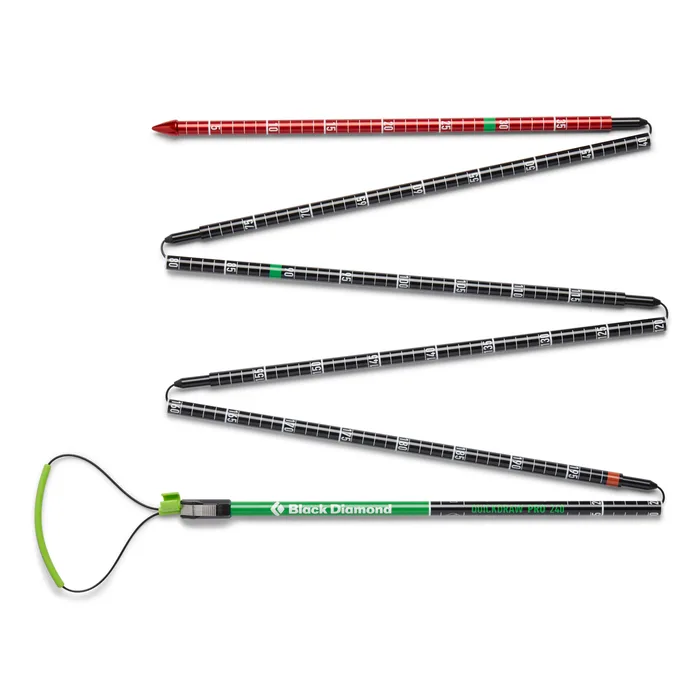
- Buy Black Diamond Quickdraw Pro Probe A documented aluminum probe with a short collapsed length, clear markings and a UIAA certification on the maker page.
- Buy BCA Stealth 300 A 300 cm aluminum probe with laser-etched markings and Quick-Lock hardware, backed by a three-year warranty.
- It depends Pieps Probe Carbon 300 Pro A 300 cm carbon-fiber probe with a centimeter scale, good for gram counters who verify the certification first.
- Skip Ortovox Probe 240 The cheapest and shortest probe in the Ortovox range, with sparse depth marking and no certification listed on its page.
What actually matters
- Length - It sets how deep the probe can reach. Makers list probes from about 240 to 330 cm, and deeper terrain argues for longer.
- Material - Aluminum and carbon are the two choices here. Carbon is lighter, and Black Diamond describes its carbon tubing as lighter and stiffer than aluminum.
- Depth markings - These let you read how deep a burial is. A clear scale beats a single marker.
- Deployment lock - This is how the segments pull tight into a rigid pole. A fast, well-explained lock saves seconds.
- Packed length - This is the collapsed bundle size, which decides whether it fits your pack's pocket.
- Certification - Some makers state a UIAA certification on the page. It is worth checking where it is missing.
- Tip and cable - Makers describe a tip and cable or cord that bears the load. Black Diamond lists an aluminum tip and a stainless-steel cable on its Quickdraw Pro.
The specs, in plain English
Green flags vs red flags
Green flags
- The maker page states a UIAA certification.
- The page lists weight and packed length for the exact length you buy.
- Depth markings are described as high-contrast, laser-etched or a full scale.
- The cable and lock design is explained in the page text.
- The maker offers a warranty and a range of lengths.
Red flags
- No certification is mentioned on the maker page.
- Only a single depth marker is listed.
- The packed length is missing.
- The listing gives a weight without saying for which length.
- The cord or cable is never described.
Who's who: the brands
- Black Diamond - Lists tubing, cable, tip, lock and marking details clearly on its probe pages.
- BCA - Sells the Stealth range in several aluminum and carbon lengths with a three-year warranty.
- Pieps - Offers aluminum and carbon probes, and its pages tend to list diameter and tube count.
- Ortovox - Sells six probes from 240 to 320 cm in aluminum, carbon and steel.
- Mammut - A major avalanche safety brand; we did not verify a current probe page, so none is in this comparison.
How to read a listing without getting fooled
Start with the length and the weight, then confirm both apply to the same size, because some pages list one weight for a range of lengths. Next look for a stated certification, a packed length and a description of the depth markings. If any of these is missing, treat it as unknown rather than assume it is fine. Finally look at how the maker describes the lock and cable, since a clear explanation is a good sign.
How much should you spend?
Probes sit across the budget and mid-range tiers, with aluminum models generally at the lower end and carbon models higher. A budget probe can be a fine choice if its page lists a certification, a full depth scale and a packed length. Spending more on carbon buys weight savings, not a different rescue result, so decide whether grams matter on your tours. Whatever the tier, a probe you can assemble fast and read easily is worth more than a lighter one you cannot.
Questions, answered
Can I use a ski pole as a probe?
Not a good idea. A probe is built to assemble into a rigid pole and carry a depth scale for rescue. Some ski poles are sold with probe-style features, but a separate certified probe is the standard tool for a search.
How often should I replace my probe?
There is no fixed schedule in the maker pages we read. Check the tubes, cable and lock for damage, bends or wear before each season. Replace it if any part is damaged. Ortovox sells a replacement tip, which suggests tips can be swapped.
Do 240 cm probes make sense?
A short probe reaches less, so it suits shallow snowpacks and light kits. In deeper terrain a longer model is the safer reach. Check what the markings and certification look like as well, not just the length.
Where should I store my probe?
Keep it in a dedicated pocket in your pack where you can reach it without removing the pack. Pull it out and reassemble it during practice sessions so storing and deploying become routine.
Or jump to the head-to-head: Black Diamond Quickdraw Pro Probe vs BCA Stealth 300.