

Ski & Snowboard
The Best Avalanche Probes: 4 Compared (and One to Skip)
We compared four current probes from Black Diamond, BCA, Pieps and Ortovox on length, material, deployment lock, depth markings, packed length and listed weight.
The short version
The Black Diamond Quickdraw Pro Probe is our top pick: aluminum, a listed 261 g, a 40 cm collapsed length, high-contrast markings at 30, 90 and 200 cm, and a UIAA certification on the maker page. The BCA Stealth 300 is the value pick, with a 300 cm reach, laser-etched markings and a Quick-Lock hardware design, at a heavier listed 360 g. The Pieps Probe Carbon 300 Pro suits skiers who count grams, but its page lists no certification and no packed length, so confirm both before buying. The Ortovox Probe 240 is the one to skip: it stops at 240 cm and its page lists a single depth marker at 1.5 m and no certification. Pair any probe with a beacon (see our beacon comparison) and practice with it. Best for: backcountry skiers who want a documented, certified probe that deploys fast.
Our picks at a glance
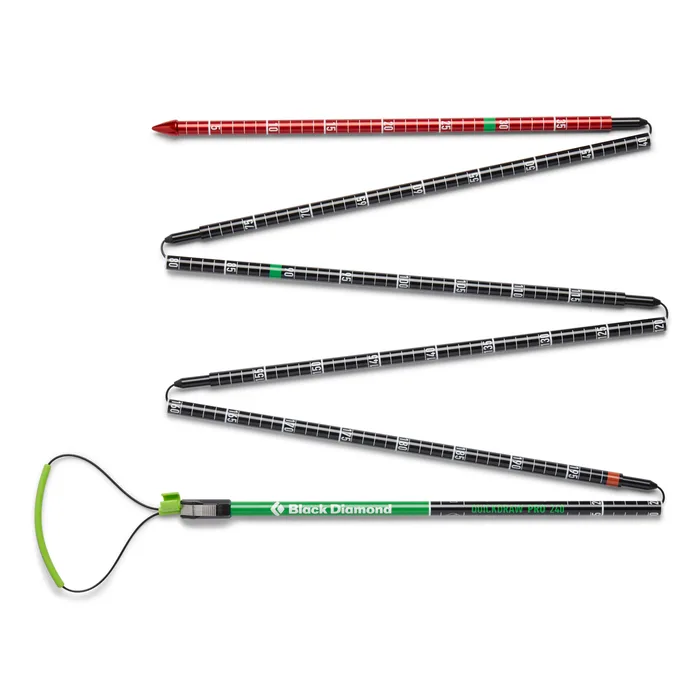
- Black Diamond Quickdraw Pro Probe - Buy. A documented aluminum probe with a short collapsed length, clear markings and a UIAA certification on the maker page.
- BCA Stealth 300 - Buy. A 300 cm aluminum probe with laser-etched markings and Quick-Lock hardware, backed by a three-year warranty.
- Pieps Probe Carbon 300 Pro - It depends. A 300 cm carbon-fiber probe with a centimeter scale, good for gram counters who verify the certification first.
- Ortovox Probe 240 - Skip. The cheapest and shortest probe in the Ortovox range, with sparse depth marking and no certification listed on its page.
The verdict in 30 seconds
What mattered most
- Length options
- Material
- Listed weight
- Packed length
- Depth markings
- Deployment lock
A probe is how a rescuer confirms a burial and reads its depth, so the details that matter are mundane: how long it is, how fast it locks, and whether the markings are legible with cold hands. Every probe here collapses into a short bundle, deploys by pulling a cable, and uses a metal or carbon tube set. They differ in material, listed weight, how clearly the maker documents the depth scale, and whether the maker's page states a UIAA certification. We picked two aluminum probes with fully documented specs, one lighter carbon option with gaps in its paperwork, and one cheap short probe that is hard to recommend.
A documented aluminum probe with a short collapsed length, clear markings and a UIAA certification on the maker page.
Best for: Backcountry skiers who want a certified, well-marked probe in the length that suits their snowpack.
- The maker lists 7075 aluminum tubing, a stainless-steel cable and an aluminum tip, and states UIAA certification updated in 2023.
- High-contrast markings with highlights at 30, 90 and 200 cm, and different graphics on the top and bottom segments, make orientation and depth reads quicker.
- The storage bag integrates with the pull cord, so the probe is ready with one pull, and it is offered in 240, 280 and 320 cm lengths.
- The page lists a single weight of 261 g and a 40 cm collapsed length, and does not break these out by length, so check the exact size you order.
- Aluminum is not the lightest material option.
- The page does not list a tube diameter.
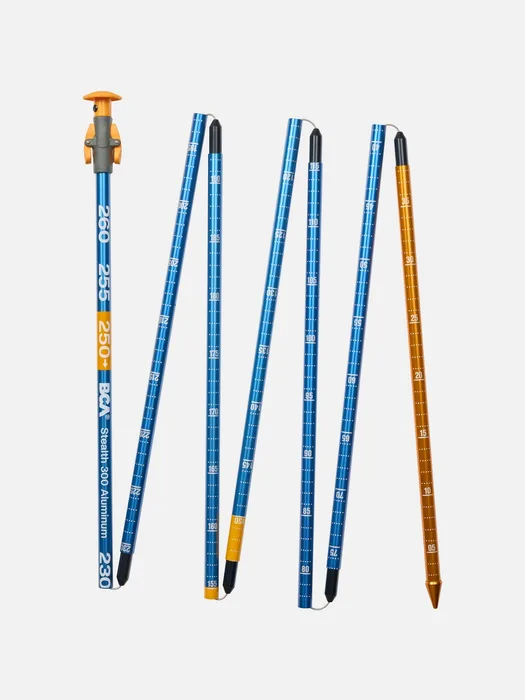
A 300 cm aluminum probe with laser-etched markings and Quick-Lock hardware, backed by a three-year warranty.
Best for: Skiers who want extra reach and a three-year warranty and accept a heavier probe.
- The maker lists a 300 cm extended length, a 1.3 cm diameter and laser-etched depth markings, plus dual-sized markings for reading depth.
- It is certified to the UIAA standard for avalanche probes per the maker page, with a limited three-year warranty.
- The Stealth line also comes in 240, 270 and 330 cm aluminum versions, so you can match length to your terrain.
- The listed weight is 360 g, noticeably heavier than the other probes here.
- The collapsed length is 43 cm, slightly longer than the Black Diamond.
- The page says the Quick-Lock hardware eliminates loose cables but gives no detail on the cord or cable, so how it deploys is less clear.
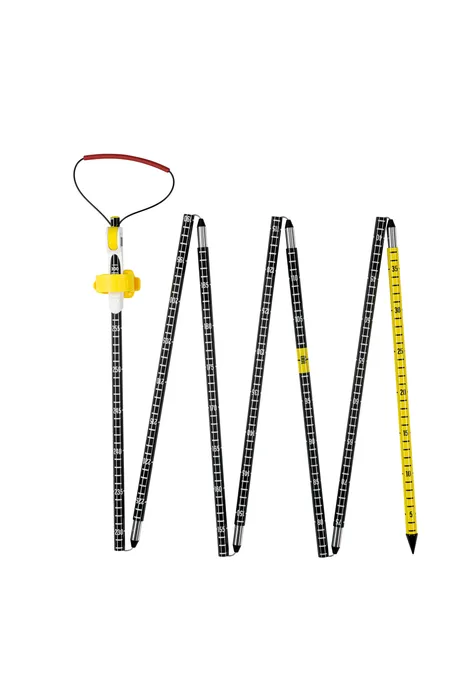
A 300 cm carbon-fiber probe with a centimeter scale, good for gram counters who verify the certification first.
Best for: Ski tourers who count grams and are willing to verify the paperwork themselves.
- The maker lists carbon fiber construction, a 300 cm length and a 315 g weight for a long reach at a low listed weight.
- It has a centimeter scale that reads burial depth and doubles as a measuring tape for snow profiles.
- A quick-tension closure and a Speed-Cone system handle assembly, and an elastic closure buckle keeps the folded bundle compact.
- The page does not mention a certification, so check the UIAA status directly with the maker or retailer before you rely on it.
- The page does not state a packed length, only that it stows in a space-saving way.
- The page does not describe the cord or cable.
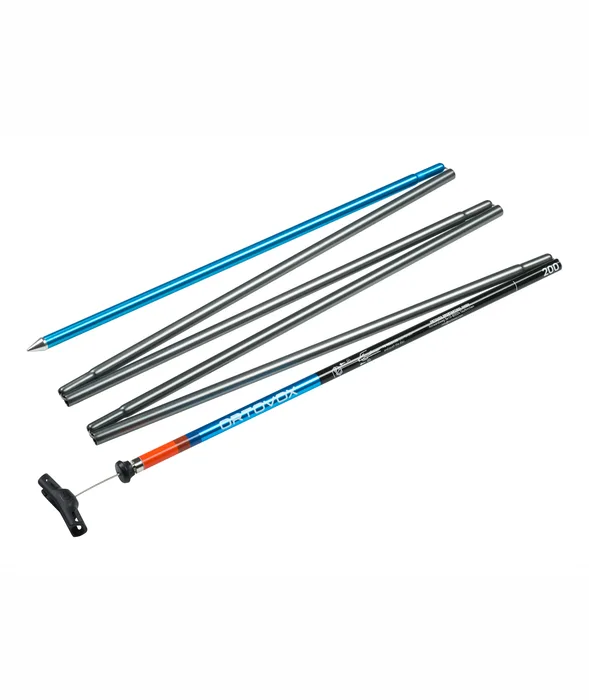
The cheapest and shortest probe in the Ortovox range, with sparse depth marking and no certification listed on its page.
Best for: Almost no one; step up to a longer, fully marked and certified probe instead.
- The maker lists 7075 aluminum T6 at 240 g with a PFA quick-assembly system and a steel cable tensioning system.
- It is the lowest-cost probe in Ortovox's own range.
- Ortovox rates it 5 out of 5 for ski touring and freeride use.
- At 240 cm it is the shortest in the range, so it reaches less in a deep snowpack.
- The page lists only a single depth marker at 1.5 m, which gives rescuers far less to read than the cm scales on competing probes.
- The page lists no certification, while the Ortovox carbon 320+ page does cite a UIAA standard, so the gap is notable.
- The page does not state a packed length.
| Criteria | Black Diamond Quickdraw Pro Probe Top pick | BCA Stealth 300 | Pieps Probe Carbon 300 Pro | Ortovox Probe 240 |
|---|---|---|---|---|
| Verdict | Buy it | Buy it | It depends | Skip it |
| Best for | Backcountry skiers who want a certified, well-marked probe in the length that suits their snowpack. | Skiers who want extra reach and a three-year warranty and accept a heavier probe. | Ski tourers who count grams and are willing to verify the paperwork themselves. | Almost no one; step up to a longer, fully marked and certified probe instead. |
| Price tier | $$ · mid-range | $$ · mid-range | $$ · mid-range | $ · budget |
| Length options | 240, 280 or 320 cm | 240, 270, 300 or 330 cm (aluminum) | 300 cm (this model) | 240 cm |
| Material | 7075 aluminum tubing | Aluminum | Carbon fiber | 7075 aluminum T6 |
| Listed weight | 261 g | 360 g (300 cm) | 315 g | 240 g |
| Packed length | 40 cm | 43 cm | Not listed | Not listed |
| Depth markings | High-contrast, highlights at 30, 90, 200 cm | Laser-etched, dual-sized | Centimeter scale | Single marker at 1.5 m |
| Deployment lock | Cable lock, one-pull bag | Stealth Quick-Lock hardware | Quick-tension closure, Speed-Cone | PFA quick-assembly, steel cable |
| UIAA on maker page | Yes | Yes | Not stated | Not stated |
| Best for | Certified all-rounder | Extra reach, long warranty | Gram counters | Skip |
Which one is right for you?
- Backcountry skiers who want a certified, well-marked probe in the length that suits their snowpack. Buy it Black Diamond Quickdraw Pro Probe
- Skiers who want extra reach and a three-year warranty and accept a heavier probe. Buy it BCA Stealth 300
- Ski tourers who count grams and are willing to verify the paperwork themselves. It depends Pieps Probe Carbon 300 Pro
- Almost no one; step up to a longer, fully marked and certified probe instead. Skip it Ortovox Probe 240
How we judged the field
Five things matter in a probe. Length sets how deep you can reach, so a 240 cm probe covers less ground than a 300 cm one. Deployment decides how fast it goes from a bundle to a rigid pole, which comes down to the cable and lock design. Depth markings decide whether you can read a burial depth at a glance, with gloves on, in poor light. Material and weight trade carrying comfort against cost and the maker’s certification. Packed length decides whether it fits your pack’s dedicated pocket.
The field splits into aluminum probes that are heavier and better documented, and carbon probes that are lighter and often cost more. We picked two aluminum probes whose pages list weight, packed length, markings and a UIAA certification, a carbon probe with real strengths but gaps in its listing, and a very short, sparsely marked probe from a respected brand. Where a maker page did not state a spec, we left it out. This comparison is about probes only, so look to our beacon and shovel guides for the other two parts of the kit.
The Black Diamond Quickdraw Pro Probe is the one we would hand to a first-time buyer. The maker page lists 7075 aluminum tubing, a stainless-steel cable and an aluminum tip, and states a UIAA certification updated in 2023. It collapses to a listed 40 cm at a listed 261 g, and the bag integrates with the pull cord so you pull once to deploy. High-contrast markings with highlights at 30, 90 and 200 cm help you read depth, and different graphics on the top and bottom segments help you orient it quickly. Black Diamond offers it in 240, 280 and 320 cm. The trade-offs are modest: the page does not break weight and packed length out by size, and the tube diameter is not listed. Aluminum is also not the lightest material choice. Buy it if you want a documented, certified, well-marked probe from a maker that explains its design choices.
The BCA Stealth 300 is the value pick for skiers who want reach. The maker lists a 300 cm extended length, a 1.3 cm diameter, a 43 cm collapsed length and laser-etched depth markings, with dual-sized markings called out in the overview. It is certified to the UIAA standard for avalanche probes per the maker page and carries a limited three-year warranty. The Stealth line also comes in 240, 270 and 330 cm aluminum versions, so you can match length to terrain. The downsides are weight, at a listed 360 g, and detail: the page says the Quick-Lock hardware eliminates loose cables but does not describe the cord. Choose it when you want extra reach and a three-year warranty and do not mind carrying a bit more than the lightest option.
The Pieps Probe Carbon 300 Pro is a good fit for ski tourers who count grams. The maker lists carbon fiber construction, a 300 cm length, a 315 g weight, a 13.5 mm diameter and seven tubes. A centimeter scale reads burial depth and doubles as a measuring tape for snow profiles, and a quick-tension closure plus a Speed-Cone system handle assembly. An elastic buckle keeps the folded bundle compact. The page is also where it falls short: it does not mention a certification, does not state a packed length, and does not describe the cord. That leaves you doing homework the Black Diamond and BCA pages already did for you. Buy it if you want a long, lightweight probe and are ready to confirm the certification with the maker or retailer before you rely on it.
The Ortovox Probe 240 is the one we would steer you away from. It is a perfectly real probe: the maker lists 7075 aluminum T6, a 240 g weight, an 11 mm bore diameter, a PFA quick-assembly system and a steel cable tensioning system. The issue is what is missing. At 240 cm it is the shortest in the Ortovox range, so it reaches less in a deep snowpack. The page lists a single depth marker at 1.5 m, which gives rescuers little to read next to the centimeter scales and multi-point markings of rivals. The page also lists no certification and no packed length, while the Ortovox carbon 320+ page cites a UIAA standard. For a tool whose job is to measure depth quickly, that is a lot of unknowns to accept to save money. Step up to a longer, fully marked and certified probe.
Black Diamond Quickdraw Pro Probe vs BCA Stealth 300: which should you buy?
The Black Diamond and BCA are close in kind and different in emphasis. Both are aluminum, both state UIAA certification, and both list laser or high-contrast markings. The Black Diamond is lighter on the page at 261 g versus 360 g and collapses to 40 cm versus 43 cm, while the BCA reaches 300 cm in this model and carries a three-year limited warranty. Black Diamond also describes its cable lock and bag, whereas BCA’s page names the Quick-Lock hardware without describing the cord.
Choose the Black Diamond if weight, pack space and clear documentation matter most, and pick the length that matches your snowpack. Choose the BCA if you want extra reach and the three-year warranty, or if you ski deep, variable terrain where length counts more than the last 100 g. Either is a sensible buy, and your length choice will change the numbers above.
What to look for
- Length: Makers list probes from about 240 to 330 cm, and a longer probe reaches deeper burials, so match it to the snowpack where you ride.
- UIAA certification: Check the maker page for a stated UIAA certification, and ask if it is missing.
- Depth markings: Look for clear, high-contrast or laser-etched markings you can read with gloves on, and avoid probes with only a single marker.
- Deployment lock: Prefer a cable and lock design the maker explains, and practice the pull until it is automatic.
- Material and weight: Aluminum is generally heavier and carbon lighter, so decide how many grams you want to trade for reach.
- Packed length: The collapsed length decides whether it fits your pack’s pocket, so confirm the figure for the length you order.
Our final take
The Black Diamond Quickdraw Pro Probe is the easiest recommendation: a documented aluminum probe with clear markings, a short collapsed length and a stated UIAA certification. The BCA Stealth 300 is the value pick for skiers who want extra reach and a three-year warranty. The Pieps Probe Carbon 300 Pro is for gram counters who will verify the paperwork. Skip the Ortovox Probe 240. A probe only helps if you can assemble and read it fast, so buy one, practice with it, and carry it with a beacon and a shovel.
Questions, answered
How long should an avalanche probe be?
Makers sell probes from about 240 cm to 330 cm, and the right length depends on the snowpack where you ride. A deeper, more variable pack argues for a longer probe, while a shallow pack can make a shorter one workable. Many tourers choose 280 to 300 cm as a middle ground. Remember a longer probe is heavier and takes slightly longer to assemble, so choose for your terrain, not for the biggest number.
Is carbon better than aluminum for a probe?
Carbon is lighter, and Black Diamond describes its carbon tubing as lighter and stiffer than aluminum. Aluminum is typically the more common material and is the choice of the two best-documented probes here. The better test is whether the maker lists a certification, clear markings, a rugged tip and a fast lock, since those decide how the probe performs in a rescue.
What does UIAA certified mean on a probe?
It means the maker states that the probe meets the UIAA standard for avalanche probes. Black Diamond and BCA both say so on their pages. The Pieps and Ortovox 240 pages did not mention it when we read them, so ask the maker or retailer if the certification matters to you. It is worth checking before you buy, not after.
Do I need a probe if I already have a beacon?
Yes. A beacon narrows the search to a spot, but a probe confirms the burial and gives the depth, which tells the shoveler how far to dig. Beacons are covered in our beacon comparison, and the shovel completes the set. All three should be carried and practiced together, ideally in a course taught by a qualified instructor.
How should I carry and practice with my probe?
Carry it inside your pack in a dedicated pocket or sleeve so you can reach it without taking the pack off. Practice assembling it with gloves on until the pull and lock are automatic. Learn to read the depth marks while it is in the snow, because a probe you cannot read quickly slows everyone down.
Deciding between the top two? See our head-to-head: Black Diamond Quickdraw Pro Probe vs BCA Stealth 300.
More Ski & Snowboard reviews
 The Best Avalanche Shovels: 4 Compared (and One to Skip)
  The Best Boot Dryers: 4 Compared (and One to Skip)
  The Best Kids Snowsuits: 4 Compared (and One to Skip)
  The Best Ski Bags: 4 Compared (and One to Skip)
  The Best Ski Boot Bags: 4 Compared (and One to Skip)
  The Best Ski Boot Heaters: 4 Compared (and One to Skip)