Explained
Kids' Snowboards, Explained
After reading, you'll understand how to read a kids' snowboard size chart and what profile, flex and base mean.
In this guide
First-time buyers often size a kids' board by age or height, which is not what makers publish. The size chart ties each length to a rider weight, and sometimes to a boot size. Then there is the jargon: camber, rocker, flat, sintered, extruded. This guide explains each in plain terms so the product page makes sense.
The 30-second version
- Weight decides size, so look for the maker's weight range per length.
- Soft and forgiving beats stiff, for a light child still learning edge control.
- Bindings are usually separate, and need to be fitted to the maker's instructions.
- A printed size chart is a good sign, and a missing one is a reason to ask a shop.
- Do not buy far too big, because the board is sized to the child's weight band.
The products this guide is about
Our verdict on each, with the full reasoning on the companion review.
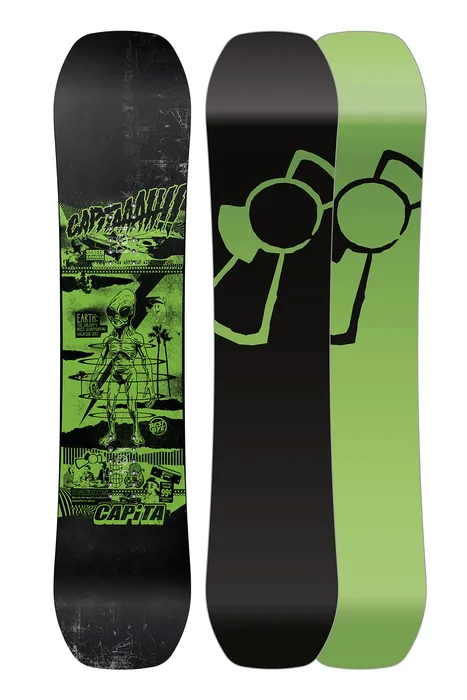
- Buy Capita Youth Brigade Mini A hybrid camber twin in sizes 110 to 130 cm with a suggested weight and boot size printed for every length. Amazon
- Buy Burton Mini Grom Flat Top Burton calls it its most beginner friendly board for the youngest riders, in 80, 90 and 100 cm.
- Buy Salomon Grail Junior A soft, super flat twin with fully detuned edges in five sizes from 110 to 130 cm.
- Buy K2 Lil Kat The widest size range here, 75 to 120 cm, with tip and tail grommets for leash pulls on the smaller sizes. Amazon
- It depends Never Summer Yutes A rocker camber twin with a sintered base and three year warranty, in 120 to 135 cm. Amazon
- Skip Arbor Seedling A parabolic rocker youth twin, but Arbor's own page publishes almost no sizing data. Amazon
What actually matters
- Weight range - the weight a maker suggests for each length. It is the main sizing guide, so follow it.
- Board length - measured in centimeters, it should match the weight band and the child's boot size.
- Profile - the side-on shape of the board, which changes how easily it turns and how likely it is to catch an edge.
- Flex - how easily the board bends. Softer is easier for a light child, and some makers give a number.
- Base - the material under the board. Sintered takes wax well, and extruded is simpler to maintain.
- Waist width - the board's width at the middle, which should suit the boot size so the boot does not drag.
- Inserts - the threaded holes that bindings mount to, commonly a 2x4 pattern on these boards.
The specs, in plain English
Green flags vs red flags
Green flags
- A weight range printed for every size
- A size chart with waist and effective edge
- A stated flex and profile
- Sizes that reach your child's weight
- A named warranty or return policy
Red flags
- No size chart on the maker page
- No weight range anywhere
- A description shared with a different model
- Sizes that jump with no stated weight band
- A size listed as unavailable with no explanation
Who's who: the brands
- Capita - Known for detailed size tables across its youth range.
- Burton - Offers a ladder of kids' boards from toddler sizes up.
- Salomon - Makes a soft, freestyle-leaning junior board.
- K2 - Offers some of the smallest sizes and leash grommets.
- Never Summer - Builds premium boards with sintered bases and a long warranty.
How to read a listing without getting fooled
Open the maker's page and find the size chart first. Look for a suggested rider weight and boot size for each length, then check waist width against the boot size. Next read the profile and flex lines, then the base. If a chart is missing or blank, treat the board as unconfirmed and ask a shop or the maker before buying.
How much should you spend?
Kids' boards sit mostly in the mid-range tier. The premium tier brings a sintered base and a longer warranty, and the budget end is mainly toddler boards. Because children outgrow boards, a mid-range board with a clear size chart is usually the better buy than a premium board bought for the future.
Questions, answered
Should I buy a snowboard a size up for growing room?
No. Makers tie each length to a weight band, and a board far too large is harder for a child to control. Follow the maker's size chart and move up when the child moves into the next band.
Can I mount bindings myself?
Bindings must be mounted and adjusted following the maker's instructions. A shop can do it and check the fit. If you do it yourself, use the correct insert pattern, commonly 2x4 on these boards.
What is a leash grommet?
A small hole at the tip and tail where a leash can attach so a parent can pull a small child. K2 lists them on sizes 100 cm and under, and Burton's Riglet is built for pulling across flat ground.
Is a sintered base worth it for a kid?
It takes wax better but needs more care. Many makers use an extruded base on kids' boards because it is durable and low maintenance. Choose by how much tuning you will do.
Or jump to the head-to-head: Capita Youth Brigade Mini vs Burton Mini Grom Flat Top.