Explained
Ski Boot Heaters, Explained
After reading, you'll understand the main ways to heat feet in ski boots, how to read run-time claims, and which option fits how you ski.
In this guide
Cold feet in ski boots have several possible fixes, and they are easy to confuse. Battery heaters, heated insoles, heated socks and disposable warmers all look like the same solution on a shelf. Their run times, installation and behavior inside a closed boot are very different. A few terms make the choice clear.
The 30-second version
- Battery heaters sit on your insole, so they stay in the boot and work with any socks.
- Heated socks carry the heat with you, which suits rental boots but adds charging and washing.
- Disposable warmers need air, and a closed ski boot supplies little of it.
- Run-time claims are for the lowest setting, so higher heat means much shorter days.
- Boot fit comes first, since a tight boot causes cold toes on its own.
The products this guide is about
Our verdict on each, with the full reasoning on the companion review.
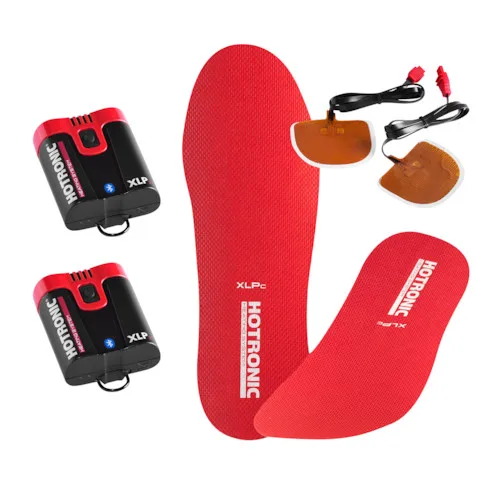
- Buy Hotronic XLP 2C BT Custom A battery boot heater with long run times and app control that fits on your existing insoles.
- Buy Therm-ic Heat Kit + C-Pack 1700B A DIY kit that turns any insole into a heated one, with Bluetooth batteries and up to 17 hours of warmth.
- It depends Therm-ic Powersocks Heat Fusion Uni + S-Pack 1200 Heated ski socks that warm the toes without touching your insoles, powered by cuff batteries.
- Skip HotHands Toe Warmers Cheap single-use toe warmers that need air to work, which a closed ski boot does not supply well.
What actually matters
- Heating method - Elements on insoles, heated socks and chemical packs each work differently in a boot. The method decides reliability.
- Run time - Rated hours depend on the heat setting. Check what you get on the setting you will actually use.
- Heat control - Several settings prevent overheating. Sweaty feet get cold later in the day.
- Battery size and weight - Bigger batteries run longer but weigh more on the boot or sock cuff.
- Installation - Some systems need a boot fitter, some are DIY, some need nothing.
- Compatibility - Insole heaters stay with your boots; socks move between boots.
- Ongoing cost - Disposable warmers cost little each but add up over a season.
The specs, in plain English
Green flags vs red flags
Green flags
- Run times listed for each heat setting
- Several heat settings, not just on and off
- Thin elements that fit under the toes
- Clear installation instructions
- Replaceable or spare batteries available
Red flags
- A single run-time number with no setting
- Bulky packs that crowd the toe box
- No way to adjust heat
- Disposable warmers sold as an everyday ski solution
- Batteries that only one outdated charger supports
Who's who: the brands
- Hotronic - Known for XLP battery boot heaters that fit on standard or custom insoles.
- Therm-ic - Makes heated insole kits, heated ski socks and matching battery packs.
- HotHands - Best known for disposable air-activated hand, foot and toe warmers.
- BOOTDOC - Hotronic's sister brand, focused on ski boot footbeds and fitting.
How to read a listing without getting fooled
Look first for how the heat reaches your feet: an element on the insole, a heated sock or a disposable pack. Then find the run time and check which heat setting it refers to, since makers usually quote the lowest. Note the battery capacity, weight and where the battery sits. Finally, check what installation involves and whether it suits boots you own or rent.
How much should you spend?
Disposable warmers are budget per pair but add up over a season. Heated socks and DIY insole kits sit in the mid-range. Premium battery boot heaters with large batteries and app control cost the most, which buys longer run times and a system that stays in your boots.
Questions, answered
Will a boot heater make my feet sweat?
It can if you run it too hot. Start on a low setting and use boost only briefly. Moisture-wicking socks help keep feet dry.
Can I use boot heaters in snowboard boots?
Many boot heater systems fit any boot with a removable insole, including snowboard boots. Check the element size against your insole. Heated socks work in any boot.
How do I charge heated socks or boot heaters?
Most use USB or a dedicated charger for the battery packs. Charge them fully the night before. Some chargers are sold separately, so check what is included.
Are disposable toe warmers safe?
Follow the packet directions and do not place them directly on bare skin. Remove them if they feel too hot. People with circulation problems or diabetes should ask a doctor before using any foot warmer.
Or jump to the head-to-head: Hotronic XLP 2C BT Custom vs Therm-ic Heat Kit + C-Pack 1700B.