Explained
Ski Boots, Explained
After reading, you'll understand what last width, flex, shell plastic and sole standards tell you, and how to use them to shortlist boots before a fitting.
In this guide
Ski boots are the piece of gear first-time buyers most often get wrong. The usual mistake is choosing the boot that feels most comfortable in the shop, which is often a size too big or a last too wide. The second is treating the flex number as a skill badge rather than a stiffness rating that varies between brands. Spec sheets help, once you know which lines matter.
The 30-second version
- Last width decides fit, and makers such as Tecnica publish ranges like LV 93 to 98 mm, MV 99 to 100 mm and HV 103 mm.
- Flex is a stiffness rating, not a standard, so compare it within one brand.
- Shell plastic matters, with PU and TPU common in performance boots and softer polyolefin in entry boots.
- Customization is the real value, because heat-moldable liners and punchable shells let a fitter solve hot spots.
- Check the sole standard, since GripWalk soles need compatible bindings.
The products this guide is about
Our verdict on each, with the full reasoning on the companion review.
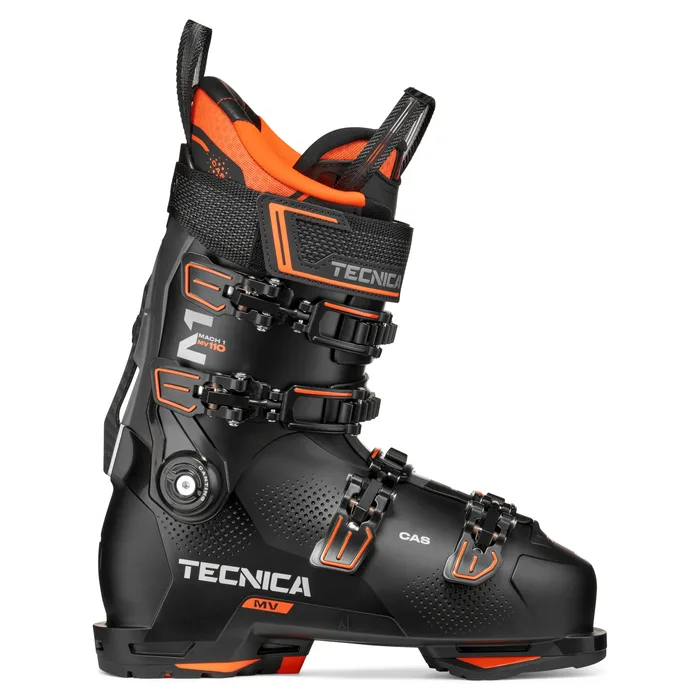
- Buy Tecnica Mach1 MV 110 A mid-volume 110 flex buckle boot with the most fully documented fitting options in this group.
- Buy Fischer RC4 110 MV A 110 flex, mid-volume buckle boot with an adjustable Vacuum Fit shell at a lower price tier.
- It depends K2 Recon 110 Zonal BOA A 110 flex all-mountain boot that closes with BOA dials on the shell and cuff instead of buckles.
- Skip Rossignol Speed 80 HV+ A wide, soft comfort boot with a polyolefin shell and cuff that an improving skier will outgrow quickly.
What actually matters
- Last width - The width of the boot's shell at the forefoot, in millimetres. It is the starting point for fit, and too wide is as bad as too narrow.
- Flex - A number for how stiff the boot is when you lean forward. Higher means stiffer, but numbers are not consistent between brands.
- Shell plastic - PU, TPU, PP or polyolefin. The material changes how consistent the flex is in the cold and how well the shell holds a fitted shape.
- Liner - The removable inner boot. Heat-moldable liners can be shaped to your foot at a shop.
- Shell customization - Punching, grinding or a brand process that reshapes the shell. It is how a fitter makes a good boot fit a specific foot.
- Closure - Buckles or BOA dials. They spread pressure differently and change how easy fine adjustments are.
- Sole standard - Alpine ISO 5355 or GripWalk ISO 23223. It decides which bindings the boot works with.
The specs, in plain English
Green flags vs red flags
Green flags
- A published last width in millimetres, not just a fit adjective.
- A heat-moldable liner with stated heating instructions.
- A shell the maker says can be punched, ground or molded.
- GripWalk or a clearly stated sole standard.
- A published weight and shell material.
Red flags
- No published weight or shell customization options.
- A very wide last chosen only because it felt comfortable in the shop.
- Polyolefin shells on a boot you expect to grow into.
- Walking soles listed as compatible but sold separately.
- Buying online without knowing your size in that exact model.
Who's who: the brands
- Tecnica - Known for its C.A.S. customizable shells and liners and the long-running Mach1 line.
- Fischer - Known for its Vacuum Fit adjustable shells and the RC4 range.
- K2 - Has moved its alpine boot range heavily toward BOA dial closures.
- Rossignol - Sells everything from wide comfort boots like the Speed 80 HV+ to BOA-closure Alltrack and Hi-Speed boots.
- Atomic - Known for its Hawx range across several last widths and Memory Fit heat molding.
How to read a listing without getting fooled
Start with the last width and volume label, because they tell you whether the boot is even a candidate for your foot. Next read the flex and the ability level the maker assigns, remembering that flex numbers differ between brands. Then check shell and cuff materials, the liner name and whether it is heat-moldable, and any shell customization the maker describes. Finish with the sole standard, closure type, weight and listed size range. If a page leaves out flex, weight or materials, treat that as a reason to ask a shop rather than a detail to ignore.
How much should you spend?
Budget boots are mostly soft, wide entry models with simpler plastics and comfort liners, and they suit renters upgrading for a season or two more than improving skiers. Mid-range boots usually bring 100 to 110 flex options, PU or TPU shells, heat-moldable liners and GripWalk soles, which is where most intermediate skiers get the best return. Premium boots add more documented shell customization, lighter or stiffer constructions and refinements such as linkage systems between shell and cuff. Whatever the tier, set aside money for a fitting, because it often does more for comfort than moving up a tier.
Questions, answered
How tight should a new ski boot feel?
Snug everywhere with your toes lightly touching the front when you stand straight, then pulling back slightly when you flex forward. Your heel should not lift when you lean into the cuff. A new liner will settle, so a boot that feels roomy in the shop will feel looser after a few days. A fitter can check shell fit by removing the liner and measuring the gap behind your heel.
How long do ski boots last?
It depends on how often you ski and how the liner holds up. Liners compress over time and lose some hold before the shell wears out. Replaceable parts such as GripWalk soles, buckles and straps can extend a boot's life. If your heel starts lifting where it did not before, the liner is usually the first thing to look at.
Can I use new boots with my old bindings?
Only if the binding accepts the boot's sole standard. GripWalk soles need GripWalk-compatible or multi-norm bindings, and touring soles need their own compatible bindings. A shop should adjust and test the release settings whenever you change boots.
Are women's ski boots different?
Usually yes. Women's boots often have lower cuffs, more calf room and softer flex numbers for the same model family. Tecnica's scale, for example, places women's 85 to 75 in its medium band. Fit your foot and calf shape first, whatever the label says.
Or jump to the head-to-head: Tecnica Mach1 MV 110 vs Fischer RC4 110 MV.