Explained
Ski Locks, Explained
After reading, you'll understand how much protection a pocket ski lock gives, which specs matter, and how to lock skis or a board to a rack properly.
In this guide
First-time buyers often expect a ski lock to make gear theft-proof, and no pocket cable does that. The real job is deterrence: making your skis harder to grab than the next pair. The confusing part is that listings mix up cable length, locking length and combination types, and many skip key specs entirely. Knowing what to look for keeps you from paying more for a weaker lock.
The 30-second version
- A ski lock is a deterrent, meant for lunch breaks and short stops, not overnight storage.
- Four digits beat three, because 10,000 possible codes take far longer to work through than 1,000.
- Reach decides usefulness, and about 90 cm of cable covers skis, poles and a rack upright.
- Carry it or it does nothing, so weight and pocket size matter more than heft.
- Lock technique matters, so run the cable through both skis and around the rack, not just between the skis.
The products this guide is about
Our verdict on each, with the full reasoning on the companion review.
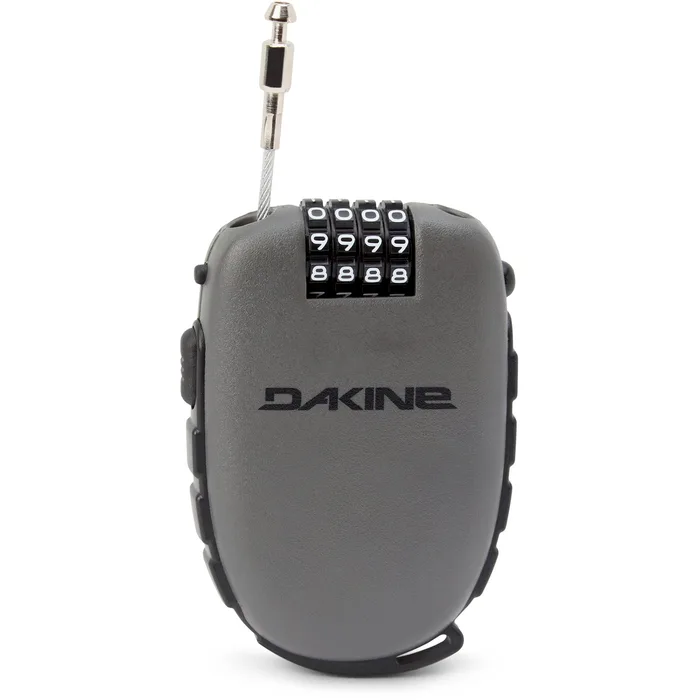
- Buy Dakine Cool Lock A four-digit retractable cable lock with a 37-inch reach, built by a ski brand for resort racks and roof racks. Amazon
- Buy Kryptonite R2 Retractable Lock A lock specialist's four-digit retractable cable with a 90 cm reach, sold for accessory lock-ups. Amazon
- It depends Hiplok Z LOK COMBO A steel-core security tie with a three-digit code that Hiplok lists as a ski lock, but with only a 45 cm loop. Amazon
- Skip Burton Cable Lock A pocket steel cable lock from snowboarding's best-known brand, with a three-number code and a 30-inch cable.
What actually matters
- Cable length - This is how far the cable extends from the body. Too short and you can only lock one ski to itself, which a thief can carry off.
- Locking length - On a strap or tie lock, this is the usable loop size. It is usually smaller than the overall length of the strap.
- Combination digits - Each extra dial multiplies the possible codes by ten. Four digits give 10,000 codes and three digits give 1,000.
- Cable diameter - Thicker cable takes longer to cut. Pocket locks use thin cable, so treat any of them as a deterrent.
- Weight and size - A lock you leave in the car protects nothing. Pocket locks generally weigh around a tenth of a kilo.
- Resettable code - Being able to set your own code helps you remember it. Follow the maker's reset steps exactly, since a forgotten code may not be recoverable.
- Stated use - Some locks are designed for ski and roof racks; others are bike accessory locks. The maker's description tells you whether skis were in mind.
The specs, in plain English
Green flags vs red flags
Green flags
- A four-digit combination you can set yourself.
- A published cable length of around 90 cm.
- A listed weight and dimensions that confirm pocket size.
- A maker that names ski racks or roof racks as an intended use.
- Clear reset instructions from the maker.
Red flags
- Claims that a thin cable is cut proof or theft proof.
- A three-digit dial priced like a four-digit lock.
- No cable length or weight anywhere on the listing.
- A cable too short to reach both skis and a rack.
- Unbranded listings with no maker page or instructions.
Who's who: the brands
- Dakine - Snow and surf accessory brand that sells three- and four-digit retractable cable locks for ski racks and roof racks.
- Kryptonite - Long-running lock maker, best known for bike U-locks, that also makes small retractable accessory locks.
- Hiplok - UK bike lock brand known for wearable chains and the Z LOK security tie.
- Burton - Major snowboard brand that sells a pocket cable lock alongside its boards and bindings.
How to read a listing without getting fooled
Start with three numbers: cable or locking length, number of combination digits, and weight. Length tells you what you can loop together, digits tell you how many codes a thief would face, and weight tells you whether it will ride in your pocket. Then check what the maker says the lock is for, and whether it lists cable diameter and materials. Be suspicious of a listing that leaves out length or digits, and read any security language closely: if a maker does not claim cut resistance, assume there is none.
How much should you spend?
Pocket ski locks sit almost entirely in the budget tier, and the better four-digit retractables cost about the same as weaker three-digit ones. A mid-range price for a pocket lock usually reflects a brand name rather than a longer cable or more digits. Spending more only gets you real extra security when you step up to a thick braided cable or chain, which no longer fits in a pocket and is better suited to a car or a home rack.
Questions, answered
Why not just use a bike lock on my skis?
A heavy U-lock or chain is more secure but too bulky to ski with, and U-locks rarely fit around skis and a rack. Small bike accessory locks, like retractable cables and tie locks, work fine on skis. The best one is the lock you will actually carry on the hill.
What happens if I forget my combination?
It depends on the maker, and some resettable locks cannot be reset without the current code. Write your code somewhere safe away from the lock, and some makers let you register a combination. Avoid obvious codes like birthdays or 0000.
Does cold weather affect a combination lock?
Snow and ice can pack into the dials and the cable opening. Brush the lock off and keep it in a pocket between uses so it stays dry. If dials stick, warm the lock in your hand rather than forcing them.
Should I lock skis together or to the rack?
To the rack. Skis locked only to each other can be carried away as a pair. Run the cable through both skis and around a fixed rack upright so the gear stays put.
Or jump to the head-to-head: Dakine Cool Lock vs Kryptonite R2 Retractable Lock.