Explained
Ski Tuning Kits, Explained
After reading, you'll understand how to read a tuning kit listing and know which parts you really need.
In this guide
First-time buyers see the word kit and assume it means a full tune, but a kit can be a single guide with one file or a box of stones. Angles are the next trap, since a bigger number is a flatter, duller edge. Base repair is a separate job from edges, and wax is a third. This guide explains the terms so you can tell what a listing includes and what it leaves out.
The 30-second version
- Smaller angles are sharper, so 85 degrees is more aggressive than 88 degrees and needs more upkeep.
- Side edge and base bevel are separate settings, and many guides cover only the side edge.
- A kit is whatever the contents line says, so read that line instead of trusting the name.
- Base repair does nothing for edges, and edge tools do nothing for base scratches.
- Snowboard fit is a listing detail, so do not assume a ski tool works on a board.
The products this guide is about
Our verdict on each, with the full reasoning on the companion review.
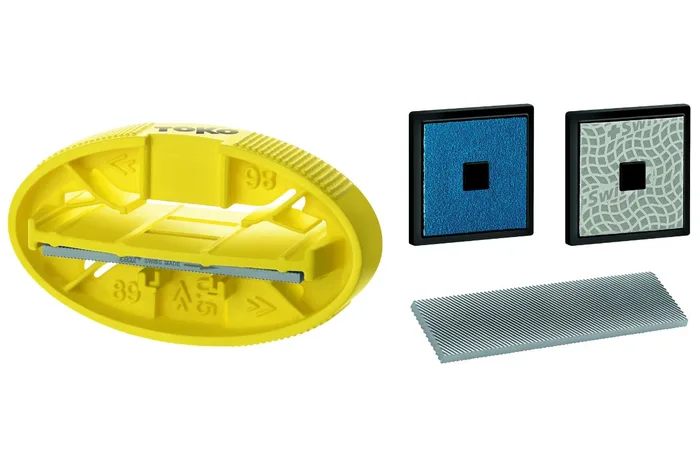
- Buy Toko Ergo Race Kit A guided edge sharpener listing side edge and base bevel angles, sold with three files.
- Buy Swix TA3008 Sharpener, rollers, 85-90 An adjustable file guide with ball bearings, an 80 mm file, and an 85 to 90 degree side edge range for skis and snowboards.
- It depends Toko Ski Base Repair Kit A two-bottle base repair kit of base powder and base adhesive, with no edge tools at all.
- Skip Swix Pocket Edger Kit A pocket-format kit with a 40 mm file, two stones and brake retainers, fixed to 87 or 88 degree side edges.
What actually matters
- Side edge angle - This is the angle between the ski base and the side of the edge, and it sets how hard the edge bites. Lower numbers bite harder and dull faster.
- Base bevel - A small angle ground into the base side of the edge, often 0.5 or 1 degree, which makes the ski less grabby. Many guides cannot set it at all.
- File length - Longer files, such as 80 mm, cover more edge per stroke. Short pocket files work but take longer on a full ski.
- Stone and abrasive type - Coarse stones remove burrs and hardened steel, while diamond or fine stones polish. The maker's wording matters because grit numbers are often not listed.
- Angle guide - The body that holds the file at a fixed or adjustable angle against the ski. Ball bearings on some guides help it ride steadily on the base.
- Base repair - Filling scratches in the base with powder and adhesive or with P-tex. It is a different job from sharpening.
- Ski brake retainers - Small clips that hold the brakes up while you work. A pocket kit may list them as a feature, but they do not do any tuning.
The specs, in plain English
Green flags vs red flags
Green flags
- The listing states side edge angles clearly.
- A base bevel setting is listed, such as 0.5 and 1 degree.
- The contents line names each item, including file length.
- The page says whether it works on skis, snowboards or both.
- Spare files and stones are sold by the maker.
Red flags
- Everything you need with no contents list.
- Only one fixed angle and no way to change it.
- A tiny file marketed as a full tune.
- No maker page, only a retailer description.
- Claims of professional results with no angle or file details.
Who's who: the brands
- Toko - Swiss maker whose US site lists edge tuning tools, base repair and starter kits.
- Swix - Lists a wide tools range, including guides, files, stones and P-tex sticks.
- Holmenkol - Lists Edger guides covering 85 to 90 degree side angles.
- Hertel - Known for ski wax, and its US shop lists wax and wax remover rather than edge tools.
How to read a listing without getting fooled
Start with the angle line and write down what it supports for the side edge and the base bevel. Then read the contents line item by item, noting file length and whether stones are named. Check whether the page says skis, snowboards or both. If the specifications box is empty, as on several Swix pages, treat the description text as the only source and be cautious. Finally decide whether you need base repair and wax separately, since these are rarely part of an edge kit.
How much should you spend?
Simple guides and pocket kits sit in the budget tier, and a guide with several files and a base bevel option sits in the mid-range. The premium tier is machines and workshop tools, which most home tuners do not need. Spend where the angles and file length are, not on extras. Spare files and stones are usually cheaper to replace than buying a larger kit.
Questions, answered
How often should I sharpen my edges?
There is no single number, since it depends on snow, rocks and how hard you ski. A common approach is to feel the edge with a thumbnail and touch up when it skates instead of biting. Pocket stones are made for quick passes between full tunes.
Can I change my ski's factory angle?
You can, but it is easier to go sharper than to go flatter. Check what the ski maker recommends before changing it. A guide with a range such as 85 to 90 degrees gives you room to adjust.
Do I need a vise?
A stable ski helps a lot, and Swix lists vises as a separate tool category. A kit's brake retainers hold brakes up but do not hold the ski. Plan for a way to keep the ski still.
Is base repair the same as waxing?
No. Repair fills damage in the base, while wax adds glide. Our snowboard wax review covers the wax side, and you would normally repair a scratch before waxing over it.
Or jump to the head-to-head: Toko Ergo Race Kit vs Swix TA3008 Sharpener, rollers, 85-90.