Explained
Snowboard Boots, Explained
After reading, you'll understand how lacing, flex, liner, and sizing differ, and what a snowboard boot spec sheet does and does not tell you.
In this guide
Snowboard boots come with a lot of jargon, and the spec sheets do not always agree on what is measured. First-time buyers often assume a number like flex means the same thing across brands, or that every boot works with every binding. Neither is safe. Knowing which details a maker actually states makes it much easier to compare boots honestly.
The 30-second version
- Lacing is about fit tuning, and dual-zone systems let you adjust the foot and the cuff separately.
- Flex ratings are brand-specific, so a 6 from one maker is not a 6 from another.
- Heat-moldable liners help fit, but only count them when the maker says so.
- Size by Mondopoint, because the centimeter measurement is more precise than a US size.
- Step On is a closed system, so check binding compatibility before buying either piece.
The products this guide is about
Our verdict on each, with the full reasoning on the companion review.
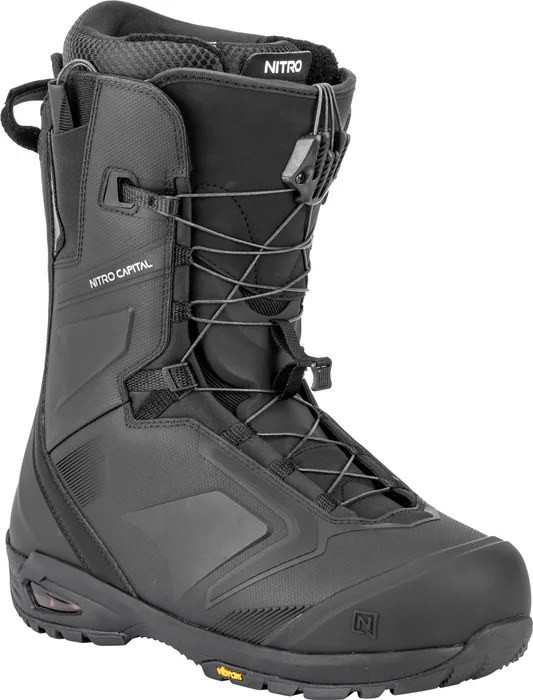
- Buy Nitro Capital TLS+ Boots A high-performance all-mountain boot with dual-zone speed lacing, a pre-molded heat-moldable liner, and a Vibram Icetrek outsole.
- Buy ThirtyTwo Lashed Db Fava A double-Boa boot rated 6 out of 10 for flex, with a plush foam midsole and a performance rubber outsole.
- It depends Nitro Team Step On TLS Boots An all-mountain boot with TLS two-zone lacing and a Boa-controlled heel lock, built to work with Step On bindings.
- Skip ThirtyTwo Recruit A soft, traditional-lace boot rated 4 out of 10, positioned as friendly and playful.
What actually matters
- Lacing system - It controls how quickly you get a snug fit and how well it holds through the day. Traditional laces, speed lacing, and Boa each trade cost against convenience.
- Number of zones - A dual-zone system tightens the foot and the cuff independently. That helps with heel lift and pressure on the shin.
- Flex rating - It tells you how much the boot resists forward bend. Softer boots forgive mistakes, and stiffer boots give response at speed.
- Liner - The liner is the inner boot that wraps your foot. Its material and shape decide comfort, warmth, and how well it holds your heel.
- Heat-moldability - A moldable liner can be shaped to your foot with heat. Makers state it only on some models, so check the page.
- Sizing range - The sizes offered decide whether you can buy the boot at all. Check whether the range covers your Mondopoint measurement.
- Binding compatibility - Step On boots only work with Step On bindings. Strap-binding boots are usually fine across brands, but makers rarely state it.
The specs, in plain English
Green flags vs red flags
Green flags
- The maker states flex with a number on its own scale.
- The product page says the liner is heat-moldable.
- Dual-zone lacing is listed.
- A full size range is shown, with Mondopoint sizes.
- Binding compatibility is stated clearly.
Red flags
- The page says nothing about the liner or heat-molding.
- There is no flex information at all.
- Size range stops short of common sizes.
- Binding compatibility is vague for a Step On boot.
- Claims of a perfect fit with no sizing guidance.
Who's who: the brands
- Nitro - Known for TLS speed lacing and Thermacell liners that the maker says can be heat molded.
- ThirtyTwo - Prints a 1 to 10 style flex rating on its boot pages and sells both Boa and lace models.
- K2 - Offers Boa, Conda, and lace boots with Intuition liners that it describes as heat-moldable.
- DC - Sells Boa, hybrid-lace, and Step On boots, including models built with Burton's Step On interface.
- Burton - Developed the Step On system that several brands now build boots around.
How to read a listing without getting fooled
Start with lacing and the number of zones, then look for a flex rating on the maker's own scale. Next check the liner name and whether the page says it can be heat molded, since that determines how well the boot adapts. Look at the size chart for Mondopoint and the range offered, and read the outsole and footbed notes for comfort and grip. Finally, look for a binding compatibility line. If a detail is missing, treat it as unknown rather than assuming it is included.
How much should you spend?
Snowboard boots sit in rough tiers. Budget boots use traditional laces and soft flex with little spec detail. Mid-range boots add Boa or two-zone lacing and often a cushioned footbed. Premium boots add moldable liners, tunable stiffeners, and better outsoles. Spend the extra when you need the fit tuning, and save when a simple soft boot matches how you ride.
Questions, answered
How long do snowboard boot liners last?
Liners pack out as you ride, and how fast depends on foam, riding days, and how you lace. Many riders find the boot feels looser after a season of regular use. A moldable liner can sometimes be re-molded, and aftermarket liners exist for some boots.
Should I size up or down?
Start from your Mondopoint measurement rather than your street shoe size. Snowboard boots should feel snug with toes lightly touching, and they tend to loosen with use. Try them with the socks you will ride in.
Do snowboard boots work with ski bindings?
No, they are made for snowboard bindings, and ski boots are a different system. Check the binding maker's compatibility page for the specific pairing you want. Step On is a special case with its own boot and binding requirements.
How do I keep my boots dry?
Pull the liners out after a day and let them air dry, or use a gentle boot dryer. Avoid high heat, which can damage liners. Dry boots stay warmer and last longer.
Or jump to the head-to-head: Nitro Capital TLS+ Boots vs ThirtyTwo Lashed Db Fava.