Explained
Ski Poles, Explained
After reading, you'll understand how to read a ski pole spec sheet and which features suit your kind of skiing.
In this guide
Ski poles look the same until you read the listing. Names like piste, all-mountain, freeride and touring describe different poles. Terms like HTS, 2K and SQS sound technical but mean simple things. First-time buyers often pick on color and price, then find the length is wrong or the basket is made for another kind of snow.
The 30-second version
- Fixed poles are simpler, and adjustable poles trade a few extra joints for flexibility.
- Carbon is light, while aluminum is the tougher everyday choice.
- The strap matters for safety, so look for a design that releases under tension or a deliberate glove connection.
- Basket size follows snow, with 60 mm a standard piste size and larger baskets for soft snow.
- Length comes first, because a wrong size cannot be fixed by a better pole.
The products this guide is about
Our verdict on each, with the full reasoning on the companion review.
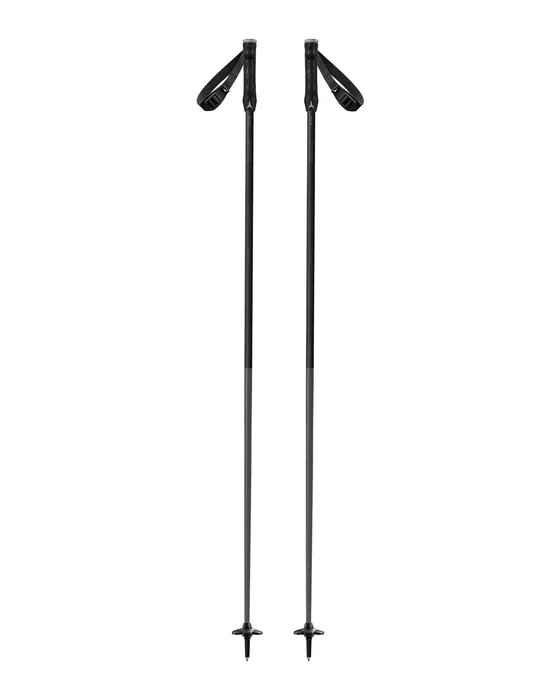
- Buy Atomic Revent Carbon A fixed-length carbon all-mountain pole with a padded strap and a carbide tip.
- Buy Atomic Redster A sturdy fixed-length aluminum piste pole with a size-adjustable strap that releases under tension.
- It depends Leki Detect S Vario A length-adjustable aluminum pole with a trigger grip system and a swappable basket.
- Skip K2 Swift Stick A four-piece collapsible, adjustable touring pole that is the wrong shape for resort skiing.
What actually matters
- Length - Poles are sized in centimeters, usually in 5 cm steps. The right length lets your forearm sit roughly level with the ground when you hold the pole upside down under the basket.
- Fixed or adjustable - A fixed pole is one piece. An adjustable one has a clamp or lock that changes length, which helps shared poles but adds a part that can slip.
- Shaft material - Aluminum is common and tends to bend. Carbon is lighter, and it can fail more suddenly in a hard impact.
- Shaft diameter - Thicker shafts feel stiffer and are often aluminum. Some brands do not list diameter, so compare weight and feel when you can.
- Strap - The strap holds the pole to your wrist. Release designs let go under tension, which is the safer behavior in a fall.
- Grip - Grips come in rubber, foam and molded plastic. Size and shape matter if your hands are small or you wear thick gloves.
- Basket - The basket is the disc near the tip. A 60 mm basket is common on piste, and a larger one helps in soft snow.
The specs, in plain English
Green flags vs red flags
Green flags
- The maker lists the length range, shaft material and basket size clearly.
- A strap that releases under tension, or a described glove system.
- A grip with more than one size for different hands.
- A basket size that matches your snow, such as 60 mm for piste.
- A size chart or length guide on the maker page.
Red flags
- No shaft material listed.
- A touring pole being sold for resort use without saying so.
- Many joints on a pole you plant hard every turn.
- A strap that stays fixed with no release or system described.
- A listing with no maker page or spec sheet at all.
Who's who: the brands
- Atomic - A ski maker with a range of fixed piste and all-mountain poles at several tiers.
- Leki - A pole specialist known for its Trigger glove system and adjustable Vario poles.
- K2 - Sells piste, freeride and touring poles, including adjustable and collapsible models.
- Black Diamond - Focuses on touring and backcountry poles, including folding and adjustable types.
How to read a listing without getting fooled
Start with the category label, then check length range, shaft material and basket size. A listing that says touring or backcountry is describing a different pole than piste. Look for the strap and grip names, because they tell you how the pole behaves in a fall. If weight and diameter are missing, do not assume them, and compare with a model that lists them.
How much should you spend?
Budget poles are usually aluminum, fixed length, with a basic strap and a small basket. Mid-range poles add carbon, a padded or better-designed strap, a better tip or an adjustment clamp. Premium poles move to race-focused carbon, specialist grips and strap systems. For most resort skiers the mid-range is the sweet spot, and a budget aluminum pole is a fine choice if you ski a few days a year.
Questions, answered
Can I use trekking poles for skiing?
Trekking poles and ski poles share a purpose, but the grips, straps and baskets differ. Ski poles tend to have straps made for gloves and baskets made for snow. Our trekking poles review covers the summer side. For downhill days, a ski pole is the safer choice.
What does a basket do?
It stops the pole from sinking in. On groomed snow a small basket, such as 60 mm, is enough and avoids snagging. In soft snow a larger basket gives more float, and some poles let you swap it.
Are kids' poles different?
Yes, they come shorter and often with smaller grips, and Leki lists junior poles in the 90 to 120 cm range. Some adult poles also offer small grip sizes, like Atomic's S-Fit for 115 cm and under. Check the length chart before buying.
How do I care for my poles?
Rinse and dry them after a salty or wet day, and store them out of heat. Check adjustable poles for slipping before each trip. Replace baskets or tips that are worn or cracked.
Or jump to the head-to-head: Atomic Revent Carbon vs Atomic Redster.