

Ski & Snowboard
The Best Ski Poles: 4 Compared (and One to Skip)
We compared four current downhill and all-mountain ski poles on fixed versus adjustable length, grip and strap design, shaft material, basket size, and how easy they are to size.
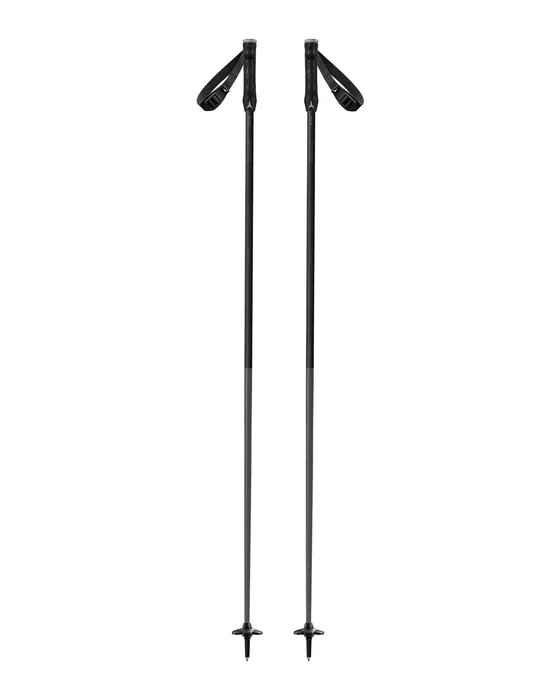
The short version
The Atomic Revent Carbon is the pole most resort skiers should buy: carbon shaft, a padded strap that releases under load, and a standard 60 mm piste basket. The Atomic Redster is the value pick, a fixed-length aluminum piste pole with the same release strap idea at a much lower tier. The Leki Detect S Vario suits skiers who want one pole to cover several users or both groomers and soft snow, because the length adjusts and the basket can be swapped. It costs more and adds a clamp that fixed poles do not have. Skip the K2 Swift Stick for resort days: it is a four-piece collapsible touring pole with a big powder basket and a foam grip, built for a different job. Best for: resort and all-mountain skiers who want a light, simple fixed pole with a safe strap.
Our picks at a glance
- Atomic Revent Carbon - Buy. A fixed-length carbon all-mountain pole with a padded strap and a carbide tip.
- Atomic Redster - Buy. A sturdy fixed-length aluminum piste pole with a size-adjustable strap that releases under tension.
- Leki Detect S Vario - It depends. A length-adjustable aluminum pole with a trigger grip system and a swappable basket.
- K2 Swift Stick - Skip. A four-piece collapsible, adjustable touring pole that is the wrong shape for resort skiing.
The verdict in 30 seconds
What mattered most
- Length
- Shaft material
- Shaft diameter
- Weight
- Grip
- Strap
A ski pole looks like the simplest thing in your bag, but the grip, the strap and the basket change how it feels on every turn and how it behaves in a fall. The big split in the category is fixed length versus adjustable, and then carbon versus aluminum underneath that. We built the field from Atomic, Leki and K2 pages that list the poles as current: a carbon all-mountain pole, a plain aluminum piste pole, a length-adjustable freeride pole, and a touring-style collapsible pole that most resort skiers should leave on the shelf. For gloves that pair with these straps, see our ski gloves review, and for getting poles through an airport, see our ski bags review. If you also hike in summer, the trekking poles review covers that side.
A fixed-length carbon all-mountain pole with a padded strap and a carbide tip.
Best for: A resort skier who wants a light, simple pole with a strap that releases in a fall.
- The carbon shaft cuts weight, and Atomic describes the feel as direct and responsive.
- The Pro strap is pre-shaped and padded and uses the Safety Quick Release System, which lets the strap release under tension.
- A 60 mm piste basket and a carbide tip suit groomers, ice and rocky edges.
- Fixed length means you cannot fine-tune the size after you buy, and a wrong length is a return.
- Carbon can fail suddenly if it is hit hard or bent in a crash, unlike aluminum that tends to bend.
- Atomic does not list shaft diameter or weight on the product page, so you cannot compare those numbers directly.
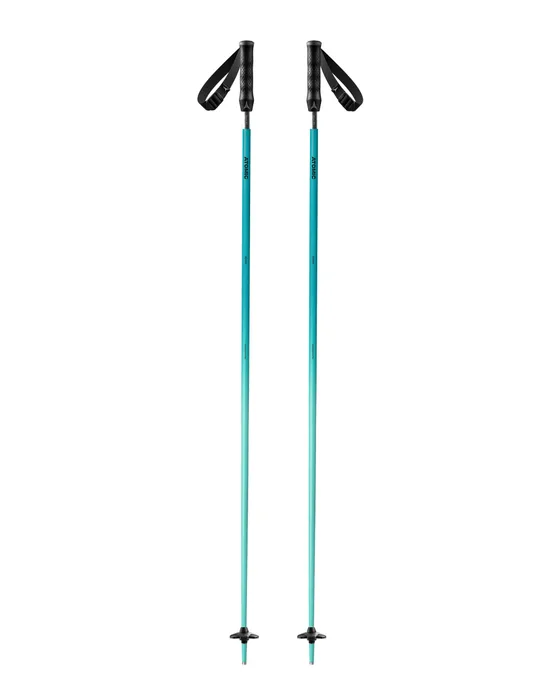
A sturdy fixed-length aluminum piste pole with a size-adjustable strap that releases under tension.
Best for: A skier who sticks to groomed runs and wants a durable pole without paying for carbon.
- The aluminum 6k shaft is the tougher choice if a pole gets stepped on or bent in a lift line.
- The Essential strap is size-adjustable and carries the same Safety Quick Release System idea as the carbon model.
- The grip comes in two diameters, M-Fit for 120 cm and up and S-Fit for 115 cm and under, so smaller hands get a better fit.
- It is built for piste, and the 60 mm basket will sink in deep soft snow.
- The strap is a basic design without the padding of a Pro strap.
- Atomic does not list weight or shaft diameter, and some lengths were shown as unavailable on the page.

A length-adjustable aluminum pole with a trigger grip system and a swappable basket.
Best for: A skier who wants adjustable length and a powder basket option and will accept the clamp.
- The length adjusts from 110 to 140 cm, which suits shared poles or skiers who want to shorten them for steep terrain.
- The Speed Lock Plus external clamp is described as holding firmly and easy to work with thick gloves.
- The Cobra Alpin basket ships for piste, and a Big Mountain basket is listed as a swap-in for deep powder.
- The adjustment clamp adds a joint and moving parts that a one-piece fixed pole does not have.
- At 264 g it is heavier than Leki's fixed Detect S at 251 g.
- The Trigger System connects glove and pole directly, so it takes some learning and you should check it works with your gloves.
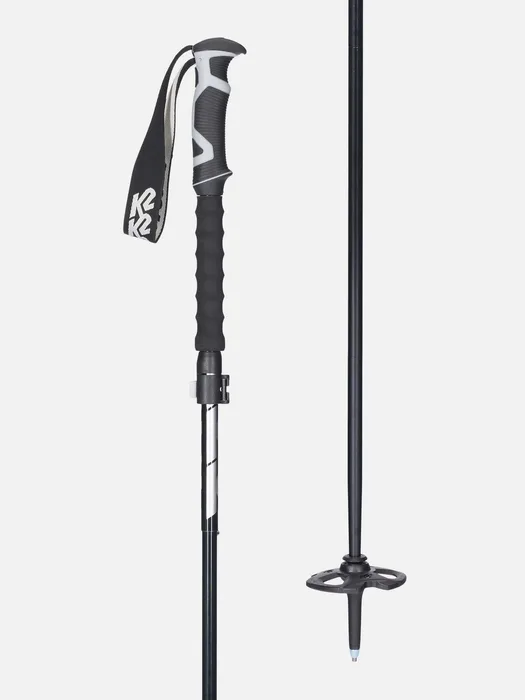
A four-piece collapsible, adjustable touring pole that is the wrong shape for resort skiing.
Best for: A ski tourer or hiker who wants a pole that packs down, not a resort skier.
- It collapses small, which is useful for a skin track, a summer hike or a pack.
- The 7075 aluminum shaft and carbide tip are sensible materials for a touring pole.
- A bubble inclinometer is built in for checking slope angle.
- Four pieces and a FlipJaw telescoping mechanism mean more joints that can slip or loosen than a one-piece resort pole.
- The adjustment range is 110 to 130 cm, narrower than the 110 to 140 cm of the Leki Detect S Vario.
- The 95 mm articulating powder basket and Freetour EVA foam grip are touring choices, and K2 lists the strap as not shown on the page.
- K2 lists it as best for touring and the page says it is not available on the website, so you have to find a local store.
| Criteria | Atomic Revent Carbon Top pick | Atomic Redster | Leki Detect S Vario | K2 Swift Stick |
|---|---|---|---|---|
| Verdict | Buy it | Buy it | It depends | Skip it |
| Best for | A resort skier who wants a light, simple pole with a strap that releases in a fall. | A skier who sticks to groomed runs and wants a durable pole without paying for carbon. | A skier who wants adjustable length and a powder basket option and will accept the clamp. | A ski tourer or hiker who wants a pole that packs down, not a resort skier. |
| Price tier | $$ · mid-range | $ · budget | $$ · mid-range | $$ · mid-range |
| Length | Fixed, 105 to 135 cm | Fixed, 110 to 135 cm | Adjustable, 110 to 140 cm | Adjustable, 110 to 130 cm |
| Shaft material | Carbon | Aluminum 6k | Aluminum HTS 6.0 | 7075 aluminum |
| Shaft diameter | Not listed | Not listed | 16 mm and 14 mm segments | Not listed |
| Weight | Not listed | Not listed | 264 g | Not listed |
| Grip | Ergonomic 2K grip with ridges | Ergonomic 2K grip, M-Fit and S-Fit | Trigger S Pro G, 2K Supersoft | Freetour EVA foam |
| Strap | Pro strap, padded, quick release | Essential strap, quick release | Trigger Mesh Strap | Not listed |
| Basket | 60 mm piste | 60 mm piste | Cobra Alpin, powder swap optional | 95 mm powder, articulating |
| Best use | All-mountain | Piste | Piste and freeride | Touring |
Which one is right for you?
- A resort skier who wants a light, simple pole with a strap that releases in a fall. Buy it Atomic Revent Carbon
- A skier who sticks to groomed runs and wants a durable pole without paying for carbon. Buy it Atomic Redster
- A skier who wants adjustable length and a powder basket option and will accept the clamp. It depends Leki Detect S Vario
- A ski tourer or hiker who wants a pole that packs down, not a resort skier. Skip it K2 Swift Stick
How we judged the field
Five things matter in a downhill pole. Length: a pole that is wrong for your height changes your posture, and adjustable length removes that risk. Grip and strap: this is the part you touch every turn, and a strap that releases under tension is a real safety feature in a fall. Shaft material and diameter: carbon is light but can fail suddenly, while aluminum tends to bend and costs less. Basket size: 60 mm is a standard piste size, and bigger baskets help in soft snow but are a nuisance on hardpack. Weight and swing feel: lighter poles are easier on long days, though maker pages do not always list weight.
The field splits into fixed piste and all-mountain poles, adjustable poles for freeride or shared use, and collapsible touring poles. We picked a carbon and an aluminum fixed pole from Atomic to show the material trade directly, a Leki adjustable pole as the specialist, and a K2 touring pole as the one to skip because it is built for a different kind of skiing. Every spec here comes from the maker page. Where a page leaves out weight or diameter, the table says so.
The Atomic Revent Carbon is the most useful all-rounder here because it fixes the three things that annoy skiers on a long day: weight, a hard strap, and a basket that is wrong for the snow. The shaft is carbon, which Atomic says gives a direct, responsive feel. The Pro strap is pre-shaped and padded and carries the Safety Quick Release System, so it releases under tension instead of holding your wrist in a fall. The 60 mm piste basket and carbide tip fit groomers, ice and rocky edges. The grip is an ergonomic 2K design with ridges for control. The catch is that it is fixed length, so you need the right size when you buy, and carbon can fail if it takes a hard hit. The page does not list diameter or weight, so you are trusting the carbon claim rather than a number. Buy it if you ski resorts most days and want a pole you stop thinking about.
The Atomic Redster is the pole to buy when you want sound design without paying for carbon. The shaft is aluminum 6k, a material that tends to bend rather than snap, which helps if you drop poles in lift lines or ski a bit of park. It is a fixed-length piste pole, built for what Atomic calls fast, tight turns, with a 60 mm basket and a steel tip. The grip is a 2K ergonomic design with ridges, and it comes in two diameters: M-Fit for 120 cm and up, and S-Fit for 115 cm and under, which helps smaller hands. The Essential strap is size-adjustable and has the Safety Quick Release System. It does not have the padding of the Pro strap, and the small basket will sink in deep snow. Some lengths showed as unavailable on the page. It is a good first pole and a good spare for anyone.
The Leki Detect S Vario is the specialist, and it is worth it only if you will use the adjustment. The aluminum HTS 6.0 shaft is 16 mm and 14 mm in two segments, and the length runs from 110 to 140 cm. The Speed Lock Plus is an external clamp that Leki describes as easy to work and firm, including with thick gloves. The Trigger S Pro G grip and Trigger Mesh Strap connect glove and pole directly. The Cobra Alpin basket is made for piste, and a Big Mountain basket is a swap-in for deep snow. At 264 g it weighs more than the fixed Detect S at 251 g, and the clamp is an extra joint. If you share poles with a partner, ski steeps where you shorten the pole, or want the powder-basket option, it makes sense. If you ski groomers and know your length, a fixed pole is simpler.
The K2 Swift Stick is a good touring pole that people may buy by mistake for resort use. K2 calls it a four-piece, collapsible, adjustable touring pole for summer and winter. The shaft is 7075 aluminum, the tip is carbide, and the adjustment is a FlipJaw telescoping mechanism with a range of 110 to 130 cm. It also has a bubble inclinometer. For a resort skier those features count against it. Four pieces mean more joints, the 95 mm articulating powder basket is oversized for groomers, and the Freetour EVA foam grip is a touring grip. K2 does not show a strap on the page, and lists the pole as not available on its site. Buy it for a skin track or a hike. For lifts and groomers, a one-piece pole like the Redster is the better tool.
Atomic Revent Carbon vs Atomic Redster: which should you buy?
The Revent Carbon and the Redster share a layout: fixed length, a 60 mm piste basket, a ridged 2K grip and the same quick-release strap idea. The difference is the shaft and the strap. Carbon is lighter, the Pro strap is padded, and the tip is carbide. Aluminum is tougher, the strap is simpler, and the tier is lower.
Choose the Revent Carbon if you ski a lot and notice weight over a long day. Choose the Redster if you ski a few days a year, ski with kids, or tend to bend and lose poles. If neither length feels right, look at the Leki Detect S Vario, which adjusts, and remember that gloves and bags matter too: our ski gloves review covers hands, and our ski bags review covers how poles travel.
What to look for
- Fixed or adjustable length: Fixed poles are simpler and have fewer parts to loosen, while adjustable poles help with shared use and travel.
- Shaft material: Carbon is lighter but can fail suddenly, and aluminum tends to bend, which many skiers prefer for rough use.
- Strap design: Look for a strap that releases under tension, like Atomic’s Safety Quick Release System, or a deliberate system like Leki’s Trigger.
- Basket size: A 60 mm piste basket fits groomers, and a larger basket is only worth it if you ski soft snow.
- Grip shape and size: A ridged 2K grip or foam grip changes feel, and a small-diameter option helps smaller hands.
- Length for your height: Use the upside-down pole check or the maker’s size chart, and buy a size you can return if it feels off.
Our final take
For most resort and all-mountain skiers, the Atomic Revent Carbon is the one to buy: light, simple, and with a strap that releases under load. If you want to spend less, the Atomic Redster delivers the same basic layout in tougher aluminum. The Leki Detect S Vario is the pick when adjustable length or a powder basket matters to you more than saving weight. Pass on the K2 Swift Stick unless you tour, since it is built for a different job. Whatever you choose, get the length right and look at how the strap lets go.
Questions, answered
Should I buy adjustable or fixed-length ski poles?
For most resort skiers, fixed is simpler and has fewer parts to fail. Adjustable poles earn their place when a pole is shared between people, when you want to shorten the pole for steep terrain, or when you travel and need it shorter. The Leki Detect S Vario shows the trade: 110 to 140 cm of range and a clamp built for thick gloves, at 264 g against 251 g for the fixed Detect S. If you ski mostly groomers and know your size, a fixed pole is the easier buy.
Is a carbon ski pole worth it?
Carbon lowers weight, and Atomic says the Revent Carbon gives a direct, responsive feel. The trade is that carbon can fail suddenly under a hard impact, while aluminum is more likely to bend. If you ski park, ride lifts with pole tangles, or are rough on gear, the aluminum Redster is the safer value. If you ski a lot and want a light swing, carbon is a reasonable upgrade.
What basket size do I need?
A 60 mm piste basket, as on both Atomic poles here, is a standard size for groomed snow. Deep or soft snow calls for a bigger basket so the pole does not sink. The Leki Detect S Vario ships with a Cobra Alpin basket for piste and lists a Big Mountain basket as a swap for powder. K2's Swift Stick uses a 95 mm powder basket, which is more than most piste skiers need.
How do I pick the right length?
The usual shop method is to flip the pole upside down, grip the shaft just under the basket, and check that your forearm is roughly level with the ground. Brand size charts exist too, and Leki links a pole length finder from its skiing page. If you are between sizes, many skiers pick the shorter one for groomers and a little longer for flat touring. An adjustable pole removes the guess.
Why does the strap release matter?
A strap that stays on your wrist in a fall can twist your thumb or shoulder when the pole catches. Atomic's Safety Quick Release System is a strap that releases under tension, and both the Revent Carbon and the Redster list it. Leki's Trigger System takes a different approach, connecting glove and pole directly. Whichever you pick, check how the strap behaves before you ride a chair with it.
Deciding between the top two? See our head-to-head: Atomic Revent Carbon vs Atomic Redster.
More Ski & Snowboard reviews
 The Best Ski Socks: 4 Compared (and One to Skip)
  The Best Ski Tuning Kits: 4 Compared (and One to Skip)
  The Best Snowboard Bindings: 4 Compared (and One to Skip)
  The Best Snowboard Boots: 4 Compared (and One to Skip)
  The Best Ski and Snowboard Waxes: 4 Compared (and One to Skip)
  The Best All-Mountain Snowboards: 4 Compared (and One to Skip)