Ski & Snowboard
The Best Snowboard Bindings: 4 Compared (and One to Skip)
We compared four snowboard bindings on flex, baseplate and heelcup materials, entry system, board compatibility and warranty.
The short version
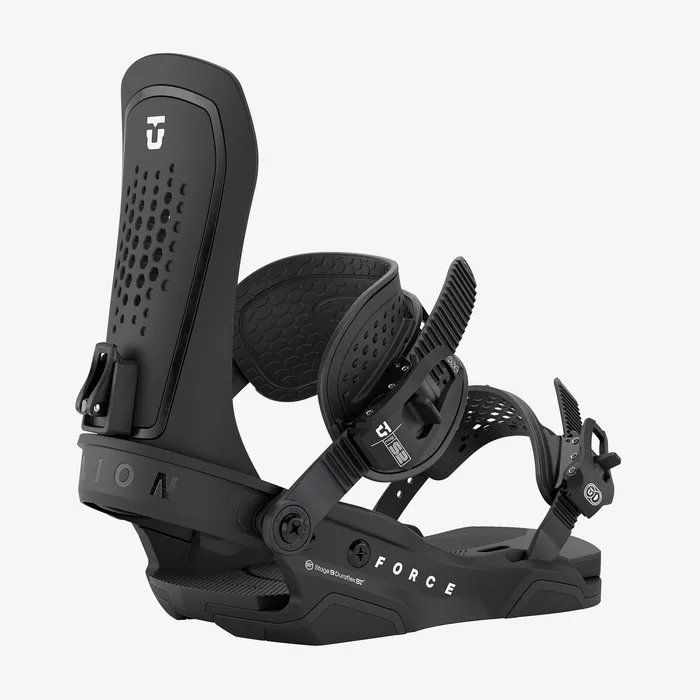
The Union Force is the pick: a stiff-enough 7 of 10 flex, an extruded aluminum heelcup, magnesium ratchets, a published 2.20 kg pair weight and a lifetime warranty on the baseplate and heelcup. The Rome Trace AW is the value buy, a mellow, medium-flexing two-strap binding with a forged aluminum heelhoop and Rome's AsymWrap chassis at a mid-range price, with a 2-year warranty. The Flow NX2 suits riders who hate sitting down to strap in: a reclining highback, a fused strap and an aluminum baseplate rated 4 of 5 for flex, but rear entry takes careful setup and it starts at size M. Skip the Burton Step On Re:Flex unless you are buying into the system: it works only with Step On boots, so your current boots won't fit it. Best for: resort riders choosing their next pair of bindings.
Our picks at a glance
- Union Force - Buy. A durable, responsive all-mountain two-strap binding with a lifetime warranty on its key parts.
- Rome Trace AW Snowboard Bindings - Buy. A forgiving, medium-flex two-strap binding with Rome's AsymWrap chassis at a mid-range price.
- Flow NX2 - It depends. A stiff, rear-entry binding that saves time strapping in, if you take the time to set it up.
- Burton Step On Re:Flex Snowboard Bindings - Skip. A convenient step-in binding that only works if you also buy Step On boots.
The verdict in 30 seconds
What mattered most
- Entry
- Flex (maker's scale)
- Baseplate
- Heelcup / highback
- Boot compatibility
- Mounting
Bindings connect your boots to the board, so they decide how quickly the board responds and how comfortable a long day feels. The market now splits three ways: classic two-strap bindings, rear-entry bindings with a reclining highback, and strapless step-in systems. We compared a best-selling two-strap all-mountain binding, a mellow two-strap value pick, a rear-entry binding and a step-in system, using each maker's published specs.
A durable, responsive all-mountain two-strap binding with a lifetime warranty on its key parts.
Best for: Intermediate and advanced riders who want one binding for the whole mountain.
- Union rates the flex 7 of 10, a responsive all-mountain feel that still suits park and freeride.
- Extruded 3D aluminum heelcup, Stage 9 Duraflex ST baseplate and magnesium S2 ratchets.
- Lifetime warranty on the baseplate and heelcup; a published 2.20 kg for a medium pair with disks and hardware.
- The most expensive two-strap binding here.
- Everything other than the baseplate and heelcup carries a 1-year warranty.
- Stiffer than a beginner needs for learning turns.
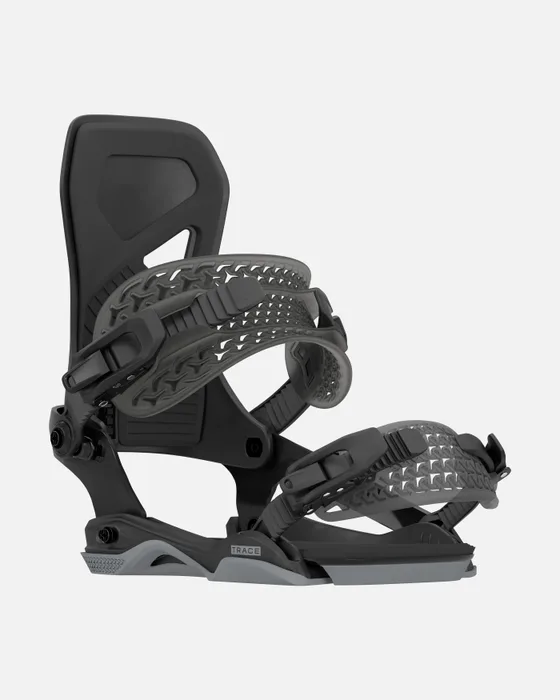
A forgiving, medium-flex two-strap binding with Rome's AsymWrap chassis at a mid-range price.
Best for: Beginners and progressing riders who want a forgiving, comfortable binding without paying premium prices.
- Mellow, medium-flexing G baseplate (15% glass) and a 100% nylon N highback for a smooth, forgiving ride.
- Forged aluminum heelhoop on Rome's AsymWrap platform with three connection points to the base.
- ProFlex ankle and ProGrip toe straps using Rome's AuxTech pattern for even pressure.
- 2-year warranty, shorter than Union's or Burton's lifetime baseplate coverage.
- Rome publishes no weight.
- Rome recommends upsizing if in doubt and checking fit with an adjusted binding, so sizing takes care.
- Softer flex will feel loose at high speed for aggressive riders.
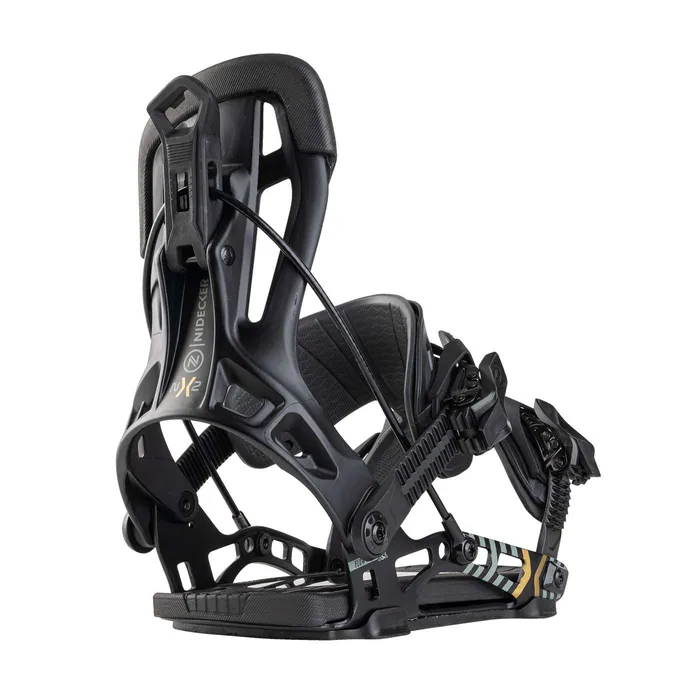
A stiff, rear-entry binding that saves time strapping in, if you take the time to set it up.
Best for: Strong riders who value quick entry at the top of every lift and will spend time on setup.
- Reclining highback with Active Strap tech lifts the Fusion strap so you slide in from behind.
- Aircraft-grade aluminum baseplate, flex rated 4 of 5, for direct edge control.
- Ships with aluminum offset Multi-Disks for 4x4, 4x2, 3HP and M6 Channel boards.
- Rear entry only works well once strap tension and fit are dialed in; owners on Flow's own page describe adjusting to get their heel in.
- No size S; sizes start at M.
- The fused toe and ankle strap gives less independent adjustment than two separate straps.
- The most expensive binding in this comparison.
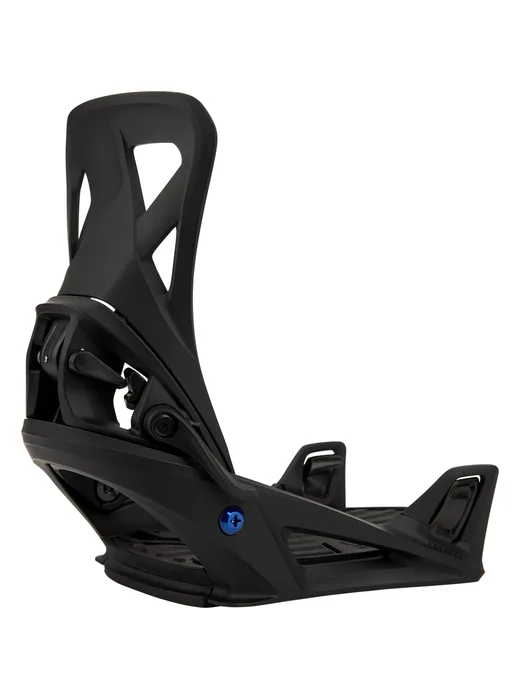
A convenient step-in binding that only works if you also buy Step On boots.
Best for: Riders who are replacing boots anyway and want strapless entry.
- Three connection points, two at the toe and one at the heel, lock the boot in without straps.
- Re:Flex mounting works with all current board mounting systems.
- Lifetime warranty on the baseplate; FullBED cushioning underfoot.
- Burton states it is only compatible with Step On boots, so your current boots will not work.
- Straps and hi-backs are covered for one year.
- Forward lean adjusts with a #2 screwdriver rather than by hand.
- The 3D Hinge Disc needed for older Burton 3D boards is not included.
| Criteria | Force Top pick | Trace AW Snowboard Bindings | NX2 | Step On Re:Flex Snowboard Bindings |
|---|---|---|---|---|
| Verdict | Buy it | Buy it | It depends | Skip it |
| Best for | Intermediate and advanced riders who want one binding for the whole mountain. | Beginners and progressing riders who want a forgiving, comfortable binding without paying premium prices. | Strong riders who value quick entry at the top of every lift and will spend time on setup. | Riders who are replacing boots anyway and want strapless entry. |
| Price tier | $$$ · premium | $$ · mid-range | $$$ · premium | $$$ · premium |
| Entry | Two straps | Two straps | Rear entry, fused strap | Step-in, strapless |
| Flex (maker's scale) | 7 of 10 | 5, medium | 4 of 5 | Not rated on page |
| Baseplate | Stage 9 Duraflex ST | G baseplate, 15% glass | Aluminum alloy | 30% short-glass/nylon |
| Heelcup / highback | Extruded aluminum heelcup | Forged aluminum heelhoop | Nylon+ FX Uniback | Step On hi-back |
| Boot compatibility | Any snowboard boot | Any snowboard boot | Any snowboard boot | Step On boots only |
| Mounting | Standard disks | Standard disks | 4x4, 4x2, 3HP, Channel | Re:Flex, all current systems |
| Warranty | Lifetime baseplate/heelcup, 1 yr rest | 2 years | Not stated on page | Lifetime baseplate, 1 yr straps/hi-back |
| Sizes | S to XL | S, M/L, L/XL | M to XL | S to XL |
Which one is right for you?
- Intermediate and advanced riders who want one binding for the whole mountain. Buy it Union Force
- Beginners and progressing riders who want a forgiving, comfortable binding without paying premium prices. Buy it Rome Trace AW Snowboard Bindings
- Strong riders who value quick entry at the top of every lift and will spend time on setup. It depends Flow NX2
- Riders who are replacing boots anyway and want strapless entry. Skip it Burton Step On Re:Flex Snowboard Bindings
How we judged the field
Five things decide how a binding rides and how long it lasts. Flex decides responsiveness and forgiveness, and it should match your boots and riding. The baseplate and heelcup take the load, so their materials matter for durability. The entry system, strap, rear entry or step-in, changes how quickly you get going and how much you can adjust. Compatibility decides whether it fits your board and your boots. And the warranty tells you what the maker expects to break.
We picked one binding from each approach plus a value option: the Union Force, one of the best-known two-strap all-mountain bindings; the Rome Trace AW, a softer two-strap binding at a lower price; the Flow NX2, a rear-entry binding from Nidecker’s Flow line; and the Burton Step On Re:Flex, a strapless step-in system. Every spec below comes from the maker’s own product page.
The Union Force is the pick because it gets the fundamentals right and backs them with the strongest warranty here. Union rates its flex 7 of 10, which is responsive enough for carving and fast groomers while still workable in the park. The load-bearing parts are built to last: a Stage 9 Duraflex ST baseplate, an extruded 3D aluminum heelcup, an S19 Duraflex ST highback, an Exoframe 6.0 ankle strap with a PU core, a TS 5.0 UltraGrip toe strap and magnesium S2 ratchets with an enclosed spring. Union publishes a weight of 2.20 kg for a medium pair including disks and hardware, and offers sizes from S to XL. The baseplate and heelcup carry a lifetime warranty; everything else is covered for a year. It is the most expensive strap binding here and stiffer than a first-week beginner needs. For intermediate and advanced riders who want one binding for everything, it is the one to buy.
The Rome Trace AW is the value pick for riders who want comfort and forgiveness more than raw response. Rome builds it on its AsymWrap platform, where a forged aluminum heelhoop connects to the base at three points for a surfy ride and plenty of board feel. The G baseplate uses 15% glass for what Rome calls a mellow, medium-flexing feel, paired with a 100% nylon N highback and a zero-degree footbed. The ProFlex ankle strap and ProGrip toe strap use Rome’s AuxTech pattern, a hinged design meant to spread pressure evenly. Rome rates it 5 on its flex scale and backs it with a 2-year warranty, shorter than Union’s lifetime baseplate cover. There is no published weight, and Rome recommends upsizing when in doubt and checking fit with an adjusted binding. The softer flex will feel loose to aggressive riders at speed. For beginners and progressing riders, it is a comfortable binding at a fair price.
The Flow NX2 is built for riders who want to skip sitting in the snow at the top of every lift. Its highback reclines, and Flow’s Active Strap tech lifts the one-piece Fusion strap at the same time, so you slide your boot in from behind and flip the highback up to lock in. The NX2 is also a serious performance binding: an aircraft-grade aluminum baseplate, a Nylon+ FX Uniback with 30% glass fiber, LSR 2.0 ratchets and a flex rating of 4 of 5. It ships with aluminum offset Multi-Disks for 4x4, 4x2, 3HP and M6 Channel boards. The catch is setup. Rear entry works when the strap tension matches your boot, and several owners on Flow’s own page describe adjusting to get their heel in. The fused strap offers less independent adjustment than two straps, sizes start at M, and it is the most expensive binding here. For strong riders who will take the time to dial it in, it is a great binding; for anyone who wants to adjust on the fly, it isn’t.
The Burton Step On Re:Flex is the most convenient binding here to get into, and the least flexible choice. Instead of straps, it uses three connection points, two at the toe and one at the heel, that lock onto matching hardware on the boot. Re:Flex mounting fits all current board systems, FullBED cushioning adds comfort underfoot, and the baseplate carries a lifetime warranty. The problem is stated plainly by Burton: Step On bindings are only compatible with Step On boots. If you own boots you like, they will not work, and choosing Step On means your next boot purchase is tied to the system too. Straps and hi-backs are covered for one year, forward lean adjusts with a #2 screwdriver, and the 3D Hinge Disc for older Burton boards is sold separately. For riders already replacing boots who want fast entry, it can make sense. For most riders shopping for bindings, a strap binding that fits the boots they already own is the better buy.
Union Force vs Rome Trace AW Snowboard Bindings: which should you buy?
The Union Force and the Rome Trace AW are both two-strap bindings, but they ride differently. The Force is stiffer, rated 7 of 10 by Union, with an extruded aluminum heelcup and magnesium ratchets, so it responds quickly and holds an edge at speed. The Trace AW has a mellow, medium-flexing baseplate and a forged aluminum heelhoop on a three-point AsymWrap chassis, so it feels looser and more forgiving. The Force also carries the stronger warranty, with lifetime coverage on the baseplate and heelcup against Rome’s two years.
Choose the Union Force if you ride fast, carve hard, or want one binding to grow into for years. Choose the Rome Trace AW if you are still learning to link turns, ride mostly groomers and park at moderate speeds, or want to spend less. Both fit standard boots and boards.
What to look for
- Flex that matches your boots: a stiff binding on a soft boot, or the reverse, gives a mismatched ride.
- Durable heelcup: aluminum heelcups and heelhoops tend to outlast plastic under load.
- Warranty on the baseplate: lifetime baseplate coverage shows the maker’s confidence in the part that carries the load.
- Board compatibility: check that the disk or mounting system fits your board’s insert pattern.
- Boot compatibility: step-in systems need matching boots; strap and rear-entry bindings fit standard boots.
- Correct size: use the maker’s chart and check that the boot sits centered with little toe or heel overhang.
Our final take
For most riders, the Union Force is the binding to buy: a proven all-mountain flex, aluminum and magnesium hardware and a lifetime warranty on its baseplate and heelcup. If you are newer to snowboarding or want to spend less, the Rome Trace AW offers a softer, forgiving ride on a solid chassis. The Flow NX2 is a strong choice for riders who want rear-entry speed and will spend time on setup. The Burton Step On works well, but because it needs Step On boots, it only makes sense for riders buying boots too.
Questions, answered
What binding flex should I get?
Match it to your riding. Softer bindings are easier to control and more forgiving for beginners and park riders. Stiffer bindings respond faster and hold an edge better at speed. Mid-flex bindings like the Union Force suit riders who do a bit of everything. Try to match binding flex to your boot flex, since a stiff binding on a soft boot wastes the stiffness.
Will these bindings fit my board?
Most current bindings fit most current boards. The Flow NX2 ships with disks for 4x4, 4x2, 3HP and Burton's Channel, and Burton's Re:Flex mounting works with all current systems. Very old Burton boards with the 3D pattern need a separate 3D disc. Check your board's insert pattern before buying.
Are rear-entry bindings good?
They can be very fast to get into once they are set up, since you slide your boot in from behind and flip the highback up. The setup is the catch: strap tension has to match your boot closely, and some riders need several days to dial it in. Riders who ride with their bindings very tight may find two-strap bindings easier to adjust on the fly.
Do Step On bindings work with any boots?
No. Burton says Step On bindings are only compatible with Step On boots, which have the matching toe and heel connection hardware. If you buy Step On bindings, plan to buy compatible boots too. Your existing boots will only work in strap bindings.
How do I pick a binding size?
Binding sizes follow boot size, so use the maker's chart for your boot size and brand. Boots vary in outer size between brands, which is why Rome recommends checking the boot-to-binding fit with an adjusted binding. The toe and heel of the boot should sit centered, with little overhang.
Deciding between the top two? See our head-to-head: Union Force vs Rome Trace AW Snowboard Bindings.