Explained
Ski Helmet Audio, Explained
After reading, you'll understand the difference between helmet speakers and intercoms, how to read battery and cold ratings, and which specs actually change your day on the hill.
In this guide
Most first-time buyers compare helmet audio on sound and price, then find the battery quits early in the cold or the group intercom only links a few people. The other surprise is fit: drop-in speakers need audio-ready ear pockets, and not every helmet has them. Spec sheets mix tested ratings with marketing lines, and the numbers are not always consistent on the same page. Knowing a few terms makes it much easier to tell which system suits how you ski.
The 30-second version
- Speakers and intercoms are different products, and only an intercom lets your group talk without a phone.
- Read the cold rating in the spec table, because the operating temperature tells you how the battery is rated in real ski weather.
- An IP rating beats a description, so IP54 or IP67 is more useful than sweat and water resistant.
- Talk time and playtime are not the same, and running an intercom usually drains a battery faster than music alone.
- Check your helmet has audio pockets, or budget for a liner that adds them.
The products this guide is about
Our verdict on each, with the full reasoning on the companion review.
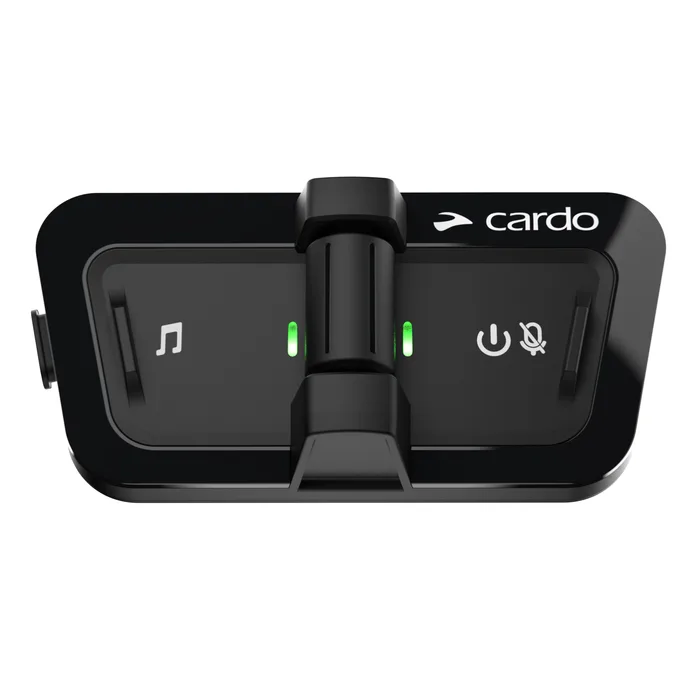
- Buy Cardo Packtalk Outdoor A mesh intercom with JBL speakers that Cardo says connects up to 15 people on the mountain without a phone signal. Amazon
- Buy Aleck Snow Series Core A slim 14 mm drop-in speaker set with a stated 12 hours of playtime, IP54 and a -20°C operating rating. Amazon
- It depends Outdoor Tech Chips PRO The longest-playing speaker-only set here, with Bluetooth 5.3, app EQ and a noise-cancelling mic, but a thin cold and water spec.
- Skip Sena Snowtalk 2 A Bluetooth helmet intercom with a short stated talk time and an operating range that stops at -10°C. Amazon
What actually matters
- Intercom or speakers only - Speaker sets play music and take calls through your phone. Intercoms add rider-to-rider talk that works without a cell signal.
- Battery life - Makers quote playtime for music and talk time for intercom use. Intercom use is the harder test, so compare talk time if you plan to chat all day.
- Operating temperature - Lithium batteries lose capacity in the cold. A unit rated to -20°C is specified for colder conditions than one rated to -10°C.
- Water resistance - Snow melts into helmet pockets and sweat builds up on warm days. A stated IP rating tells you the unit was tested against water and dust.
- Intercom range and group size - Range is quoted in open terrain, and trees or ridges cut it down. Group size decides whether the whole family can join.
- Bluetooth version - Newer versions such as 5.2 and 5.3 are designed for steadier, more efficient connections to your phone. Some makers do not list the version at all.
- Controls - You will press these with gloves on, on a moving chairlift. Big, well-spaced buttons beat touch controls and app-only settings.
The specs, in plain English
Green flags vs red flags
Green flags
- A stated battery figure with a cold temperature attached.
- A named IP rating for water and dust.
- Glove-friendly physical buttons.
- A clear list of which helmets or pockets the speakers fit.
- A stated warranty length on the product page.
Red flags
- Water resistance described in words only, with no IP rating.
- An operating temperature that stops at -10°C or warmer.
- Different numbers for the same spec in the description and the spec table.
- Intercom range quoted with no mention of open terrain or group size.
- Talk time far shorter than a full ski day.
Who's who: the brands
- Cardo - Best known for motorcycle intercoms, Cardo brings its mesh communication system to skiing with the Packtalk Outdoor.
- Sena - Another motorcycle intercom maker that sells Bluetooth and mesh headsets for snow, cycling and outdoor use.
- Aleck - Focused on helmet audio for snow and bike riders, with drop-in speakers and an Off Grid radio for long-range push-to-talk.
- Outdoor Tech - Known for its Chips drop-in helmet speakers and audio liners that add speaker pockets to helmets.
How to read a listing without getting fooled
Start with the type: does the listing say speakers or intercom, and if intercom, how many riders and what range in open terrain. Then find the battery figure and check whether it is playtime or talk time, and whether a temperature is attached. Look for the operating temperature in the spec table rather than the description, and note when the two disagree. Look for a named IP rating instead of words like water resistant. Finally, check the Bluetooth version, the speaker size and what is in the box, including mounts, cases and cables, and confirm your helmet has audio-ready ear pockets.
How much should you spend?
Budget speaker sets cover music and calls and are the right place to start if you ski alone or your group uses phones. Mid-range sets add things like app EQ, newer Bluetooth versions and better microphones, but read the cold and water ratings closely because a higher price does not always mean better ones. Premium systems add mesh group intercom, which is the main reason to spend more, and they only pay off if the people you ski with buy compatible units too.
Questions, answered
Can I move my helmet speakers to a new helmet?
Usually yes, if the new helmet has audio-ready ear pockets. Drop-in speakers are not attached to the helmet, so they lift out of one set of pads and into another. Check the speaker size and thickness against the pocket before you buy a new helmet.
Can I use helmet audio for biking too?
Some systems are sold for several sports, but a bike helmet rarely has ear pockets. Outdoor Tech sells an eBike helmet audio kit with a liner, and Aleck sells strap-mounted open-face speakers. Check the maker's page for the specific helmet type.
Do intercoms from different brands talk to each other?
Usually only within a brand's own system, especially for mesh. Check the maker's compatibility list before buying units for a mixed group. The simplest route is for everyone to buy the same system.
How should I store helmet audio over the summer?
Charge the battery partway, store it somewhere cool and dry, and top it up every few months. Take the speakers out of a damp helmet so moisture does not sit on the contacts. Follow the storage temperature on the maker's spec sheet where one is given.
Or jump to the head-to-head: Cardo Packtalk Outdoor vs Aleck Snow Series Core.