Explained
Ski Bindings, Explained
After reading, you'll understand how to read a binding's release range, boot compatibility and brake sizing, and what to leave to a certified shop.
In this guide
First-time binding buyers often fix on the biggest number on the binding, the maximum DIN, and assume higher is better. In practice the important question is whether the value a shop calculates for you sits inside the range. The second trap is boot compatibility, because Alpine, GripWalk and touring soles are different shapes. The third is brake width, which has to match your skis.
The 30-second version
- The release value is not yours to choose, a certified shop calculates it from your weight, height, age, skier type and boot sole length, and sets and tests it.
- A higher maximum DIN is not better, and on some models the minimum goes up too, which can leave lighter skiers out of range.
- Your boot sole decides what fits, so match Alpine, GripWalk or touring soles to a binding listed for that standard.
- Brakes come in sizes, so choose one at least as wide as your ski's waist.
- Hybrid touring bindings are for people who tour, because their touring mode needs boots with tech inserts and they cost more.
The products this guide is about
Our verdict on each, with the full reasoning on the companion review.
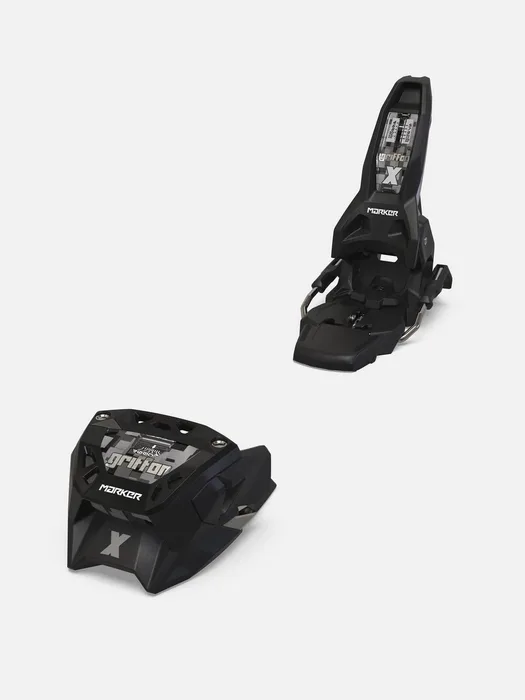
- Buy Marker Griffon X 13 A freeride-style alpine binding with a DIN 4 to 13 range, a 14 mm stand height and Alpine plus GripWalk sole compatibility. Amazon
- Buy Tyrolia Attack 14 GW The lowest-priced Attack, with a DIN 4 to 14 range, a three-piece heel and brakes from 85 to 150 mm. Amazon
- It depends Atomic Shift² 13 MN A TÜV-certified hybrid that skis as an alpine binding and switches to pin-tech touring mode, if your boots have tech inserts. Amazon
- Skip Look Pivot 2.0 18 GW A heavy-duty freeride binding whose DIN 8 to 18 range is wrong for most adult resort skiers. Amazon
What actually matters
- Release range (DIN/ISO) - This is the span of release values a binding can be set to. Your shop-calculated value should fall inside it, ideally away from the ends.
- Boot sole standard - Alpine (ISO 5355), GripWalk (ISO 23223) and touring (ISO 9523) soles differ in shape. A binding must be listed for your sole, and some need height adjustment.
- Brake width - The brake arms stop a released ski from sliding away. They should be at least as wide as the ski waist, not far wider.
- Stand height - This is how high the binding lifts your boot above the ski. Makers say lower heights give more direct power transfer.
- Weight - Bindings add noticeable weight to every carry and lift ride. Makers list it differently, per binding, per half pair or without a unit, so read the label.
- Flat versus system skis - Some skis come with a plate that takes only a matching system binding. Flat skis need a screw-on binding drilled and mounted by a shop.
- Touring capability - Hybrid bindings add a walk mode for skinning uphill. That mode needs tech-insert boots and adds cost and complexity a resort-only skier does not need.
The specs, in plain English
Green flags vs red flags
Green flags
- A release range where your shop-calculated value sits comfortably in the middle.
- Clear listing of the boot sole standards the binding accepts.
- A brake size available at or just above your ski's waist width.
- Published stand height and weight with clear units.
- A maker's user manual and dealer setup information available online.
Red flags
- A minimum DIN above the value your shop calculates for you.
- No mention of GripWalk or ISO 23223 when you own GripWalk boots.
- A hybrid touring binding bought for resort-only skiing.
- Old used bindings with no current user manual or dealer support from the maker.
- Any seller suggesting you set the release value yourself.
Who's who: the brands
- Marker - Known for its Royal Family line (Griffon, Jester, Duke PT) and the low stand height X Series.
- Look - Known for the Pivot turntable heel, which Look says gives 28 mm of elastic travel.
- Tyrolia - Known for the Attack freeski bindings and the Protector piste and all-mountain range.
- Atomic - Known for the Shift hybrid touring binding alongside its Strive and Icon alpine lines.
How to read a listing without getting fooled
Start with the release range and check that it comfortably includes typical values for someone your size and ability; your shop will give you the exact figure. Next, read the boot standard line: it should list ISO 5355 for Alpine soles, ISO 23223 for GripWalk, and ISO 9523 only if it accepts touring soles. Then check the brake options against your ski's waist width, which is printed on the ski or the maker's spec sheet. Finally, look at weight and stand height, and note the unit, because makers list weight per binding, per half pair or without a unit at all.
How much should you spend?
Budget alpine bindings cover most recreational skiers well, with modest release ranges and fewer brake sizes. Mid-range bindings add tougher toes and heels, wider release ranges and more brake options, and this is where most adult resort skiers get the best value. Premium bindings include high-DIN freeride models and hybrid touring bindings; they make sense for heavy, aggressive skiers or people who tour, and add cost without benefit for everyone else. Budget for shop mounting and adjustment on top of the binding itself.
Questions, answered
Can I move bindings from my old skis to new ones?
Sometimes, but it is a shop decision. The binding has to be compatible with the new ski's mounting style, whether flat or a system plate, and its brake has to fit the new waist width. Older bindings may also no longer be supported by the maker. Ask a certified shop to check before you plan around it.
Why does my shop need my boots to mount bindings?
The binding is adjusted to your boot sole length, and some models need a sole height adjustment too. Tyrolia, for example, says Attack models need the sole height checked with a tester. Without your boots the shop cannot set or test the system properly.
Do I need new bindings if I buy GripWalk boots?
Only if your current bindings are not listed as GripWalk (ISO 23223) compatible. Many current bindings accept both Alpine and GripWalk soles. A shop can check your bindings' markings and test the fit.
Are demo or rental bindings different?
Demo and rental bindings are built to adjust quickly to many boot lengths, which suits shared skis. For skis you own, a fixed-mount binding is the usual choice. In both cases the release value is set by trained staff.
Or jump to the head-to-head: Marker Griffon X 13 vs Tyrolia Attack 14 GW.