Explained
Rock Tumblers, Explained
After reading, you will understand what grit stages, barrel capacity and run times mean, and how to read a maker's age and safety wording before you buy.
In this guide
Rock tumbler listings mix toy language with hobby jargon, and the numbers rarely line up. One maker quotes a barrel size, another a total load, and another a rock weight, and a few publish nothing at all. First-time buyers also underestimate how long the process takes, because the full run can be several weeks. The sections below cover the terms that matter and the warnings that are easy to miss.
The 30-second version
- The process takes weeks, so look for a maker that publishes days per stage.
- Capacity is quoted three ways, so compare barrel size, total load and rock weight separately.
- More grit stages means a smoother finish, and four stages from coarse to polish is the common pattern.
- Age wording differs by maker, and some publish none, so read the exact words.
- Grit must not go down the drain, so plan a bucket and a garbage bag.
The products this guide is about
Our verdict on each, with the full reasoning on the companion review.
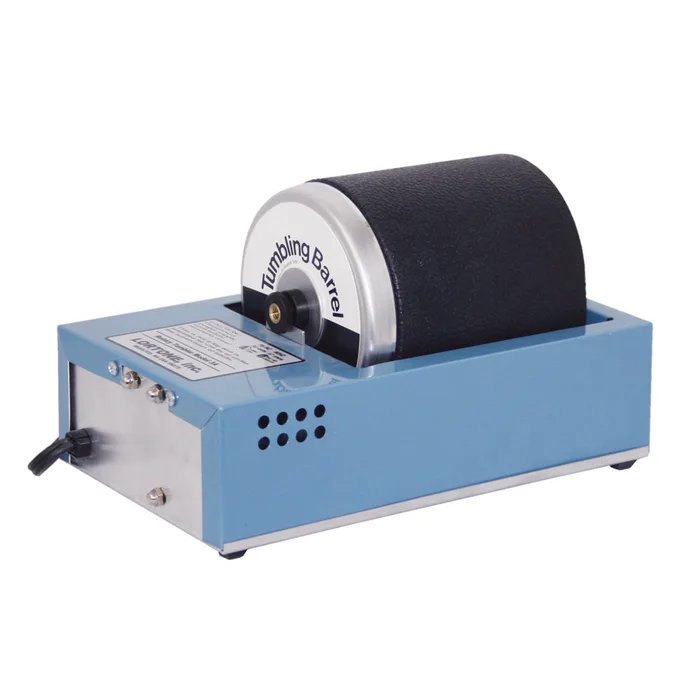
- Buy Lortone 3A Rotary Tumbler A plain hobby-grade tumbler with a single 3 lb all-rubber barrel that Lortone says suits stones up to 1-1/4 inches.
- Buy Thames & Kosmos Rock Tumbler A kid-oriented kit with a built-in timer of up to seven days, four grit packets and a USB-C power supply, rated by the maker for ages 8 and up. Amazon
- Buy National Geographic Hobby Rock Tumbler Kit A boxed kit with an automatic shutoff timer, four levels of grit, half a pound of rough stones and jewelry fastenings.
- It depends Thumler's Tumbler A-R2 Rotary Rock Tumbler A two-barrel American-made hobby machine with a continuous-duty, fan-cooled, overload-protected motor and two 3 lb rubber barrels. Amazon
- It depends Raytech TV-5 Rock Polishing Starter Kit A vibratory Tumble-Vibe bowl with two bowls and four grit steps, aimed at finishing stones rather than rounding rough rock.
- Skip Smithsonian Rock Tumbler A yellow toy-style tumbler whose own listing publishes few specs and gives two different age ratings.
What actually matters
- Barrel capacity - the size of the barrel limits batch size. Makers advise filling it to one-half or two-thirds, so a 1 lb barrel holds less rock than the number suggests.
- Grit stages - each stage uses a finer abrasive, from coarse silicon carbide to a polish. Skipping or rushing a stage leaves scratches, so check how many are in the box.
- Run time - each stage runs for days. Thames & Kosmos suggests 4, 7, 7 and 7 days, and Lortone's booklet says to check after 2 to 3 days.
- Rotary or vibratory - a rotary barrel rounds rough rock, while Raytech says its vibratory bowl suits finishing where the shape should not change much.
- Power source - a mains motor and a USB-C DC 5V supply are different, and Thames & Kosmos says its adapter is not included.
- Age and supervision wording - the maker's own wording matters most for kids. Thames & Kosmos says over 8, and Raytech says not recommended for children.
- Contamination - Lortone and Raytech both say to wash stones and parts between steps, because coarse grit left behind scratches the polish.
The specs, in plain English
Green flags vs red flags
Green flags
- The page lists barrel capacity and how full to fill it.
- A published days-per-stage table.
- Grit listed by size for every stage.
- Age and supervision wording that matches between page and box.
- A listed power rating and a built-in timer.
Red flags
- The page and the box give different age ratings.
- No capacity, run time or power rating anywhere.
- Only two or three grit bags in a kit that promises a polish.
- No age or safety wording on an electrical product.
- A kit with no rinse or drain guidance.
Who's who: the brands
- Lortone - A Washington-state lapidary maker whose rubber-barrel tumblers and booklets are written for hobbyists.
- Thumler's Tumbler - A made-in-USA brand of rotary and vibratory tumblers sold through Tru-Square Metal Products.
- Raytech - A Connecticut maker of Tumble-Vibe vibratory tumblers for metal finishing and stone polishing.
- Thames & Kosmos - A science-kit maker whose rock tumbler comes with a detailed manual and an age warning.
- National Geographic - A licensed toy line from Blue Marble that sells boxed tumbler kits with GemFoam and jewelry fittings.
How to read a listing without getting fooled
Start with the barrel or bowl capacity and whether the maker means total load or rock weight, then check that the box lists a grit for every stage. Next, look for days per stage, because a page with no run times is hiding most of the weeks you will spend. Read the age and supervision wording exactly, and check that the page and the box agree. Last, check the power rating or adapter, and whether a timer is built in.
How much should you spend?
The budget tier covers kid-oriented kits like the Thames & Kosmos and National Geographic sets, which include grit and stones. The mid-range tier covers the Lortone 3A and the Raytech starter kit, which are sturdier machines or bundles with more grit steps. The premium tier covers two-barrel hobby machines like the Thumler's A-R2. Higher tiers buy durability and capacity, but check what is in the box, since the hobby machines often ship without grit or stones.
Questions, answered
Why do rocks need four stages?
Each stage uses a finer grit than the last, so the scratches from the previous stage are smoothed away. Thames & Kosmos lists 60, 220, 500 and 1200 grit, and Lortone lists two silicon carbide stages and two aluminum oxide stages. Cutting a stage tends to leave a duller finish. Most makers say to wash the rocks and barrel between stages.
How full should the barrel be?
Thames & Kosmos says to fill its barrel to one-half to two-thirds of capacity, and Lortone's booklet says the same. Overfilling leaves too little room for stones to tumble against each other, and Thames & Kosmos says the motor may stop if the barrel is too heavy. Mixed sizes of stone are recommended by Lortone for best results.
Can I tumble anything other than rocks?
Some makers mention other uses. Thames & Kosmos says you can try rocks, glass, wood and other materials once the included rocks are done, and Thumler's lists polishing brass and cartridges for some models. Raytech says stones of mixed hardness usually do not finish well in the same batch. Check the maker's list before trying anything unusual.
Is it safe to leave a tumbler running overnight?
Only follow what the maker states. Lortone says its tumblers can operate 24 hours a day for years with proper care. Raytech warns not to cover the machine, to use a grounded outlet and to keep it away from combustible materials. Thames & Kosmos says to unplug when unused and to inspect the cable and adapter regularly.
Or jump to the head-to-head: Lortone 3A Rotary Tumbler vs Thames & Kosmos Rock Tumbler.