Explained
Stroller Organizers, Explained
After reading this you will know whether a given organizer will actually grip your handlebar, hold your drink, and stay within the weight your stroller can safely carry.
In this guide
A stroller organizer is a caddy that straps to your handlebar to hold drinks, a phone, keys and snacks. Every listing looks the same in photos, so most people buy on pocket count and then discover the straps slip on their bar or the cup wells will not take the tumbler they actually carry. Two things decide whether the caddy stays on the stroller: how it attaches, and how much weight you end up hanging behind the rear axle.
The 30-second version
- Weight on the handlebar is the tip-over risk. Anything hung on the bar sits behind and above the rear axle, so it acts as a lever that lifts the front wheels, which is why loaded strollers tip backward the moment a child is lifted out.
- Universal fit is a claim about strap length, not grip. Universal caddies fail most often on curved one-piece handlebars, where a stiff shell only touches at two points, and on slick telescoping or leather-wrapped bars where straps creep down over a long walk.
- Insulated cup holders cost you capacity. Padded sleeves are thick and usually fixed in place, so an insulated caddy has meaningfully less room for a change of clothes than an uninsulated one of the same outside size.
- Cup well size matters more than cup count. Most modern drinks are tall handled tumblers, and a caddy advertising four holders is useless if none of the wells is deep or wide enough for the one you carry every day.
- One zipped pocket beats four open ones. Many organizers in this category have an open top, so a phone, keys and cards need a closure, and everything else can live loose.
The products this guide is about
Our verdict on each, with the full reasoning on the companion review.
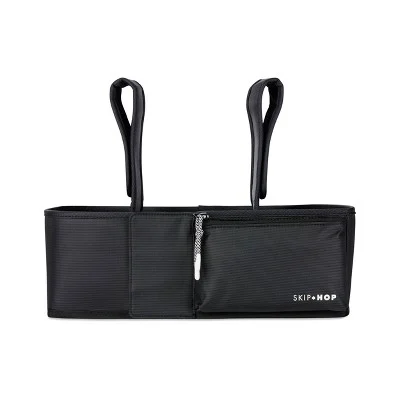
- Buy Skip Hop Ultimate Stroller Organizer The rare organizer that swallows a tall handled tumbler without turning your handlebar into a counterweight. Amazon
- Buy Itzy Ritzy Stroller Caddy A structured, wipe-clean caddy that holds its shape when it is half empty and does not look like baby gear. Amazon
- It depends Valco Baby Universal Stroller Organizer & Stroller Caddy The only one here that lets you pick insulated drinks or maximum capacity, because the insulated liner lifts out.
- Skip UPPAbaby Carry-All Parent Organizer It matches your stroller, costs the most here, and owners still report it sliding down the bar. Amazon
What actually matters
- Strap design. Long, flexible hook-and-loop bands wrap a thick, curved or telescoping bar and grip along their whole length. Short elastic loops only pinch at two points and are the single most common reason an organizer slides.
- Handlebar weight limit. Your stroller manual gives a limit for the handlebar or parent console, and it is lower than most people assume. Exceeding it is what turns a full caddy into a tipping hazard, so heavy items belong in the under-seat basket.
- Cup well dimensions. Check the stated depth and diameter of the drink pockets against the tumbler you actually use. A magnetic or open side flap that lets a cup handle sit outside the sleeve solves a problem fixed holes cannot.
- Insulation versus volume. Decide before you buy whether you want cold drinks or room for spare clothes. A removable insulated liner is the only design that lets you run it both ways.
- Depth and how far it hangs. A deep caddy sits further out from the bar, which increases leverage on the frame and lets liquids slop when the stroller tilts on a curb.
- Clearance around the fold. An organizer parked over the fold trigger or frame release turns every collapse into a fight. This is a common complaint about consoles that mount flush.
- Cleanability. Wipe-clean coated or vegan leather shells recover from a burst pouch in seconds. Woven nylon absorbs the spill and holds the smell.
The specs, in plain English
Green flags vs red flags
Green flags
- Straps described as long, adjustable hook-and-loop bands rather than elastic loops, with owner reports naming curved or telescoping bars specifically
- Stated cup well depth and width, or photos showing a tall handled tumbler actually sitting in the well
- A magnetic or open side flap that lets a cup handle clear the sleeve instead of forcing it through a fixed hole
- Light empty weight, so almost all of the load you add to the bar is the contents rather than the bag
- At least one zipped compartment for phone, keys and cards, positioned away from the drink wells
- A wipe-clean exterior, coated nylon or vegan leather, rather than untreated woven fabric
Red flags
- A universal fit claim with no strap length, no bar diameter range and no photos of it on a curved bar
- Owner reports clustering on the phrase slides down the handlebar, which no amount of cinching fixes on a slick bar
- Deep, heavy shells sold on pocket count, since depth increases leverage on the frame and weight is the tip-over risk
- Shallow compartments where drinks are visible above the rim, a sign contents will slop when the frame tilts
- Insulated sleeves that are sewn in permanently on a caddy you mostly use for short trips
- Any design that sits over the fold trigger or frame release, which owners usually discover after the return window
Who's who: the brands
- Skip Hop - The mainstream baby gear name in this category, known for long flexible straps and cup wells sized for the tall handled tumblers most caddies choke on.
- Itzy Ritzy - Design-led baby accessories, best known here for wipe-clean caddies with a structured shape and do not read as baby gear.
- Valco Baby - Stroller maker whose caddy has a removable thermal bag, letting the same shell run insulated or high capacity.
- UPPAbaby - Premium stroller brand whose first-party organizer mounts flush on its own frames, though owner reports on handlebar grip are unusually mixed for a brand-matched accessory.
- Diono - Car seat and travel gear brand offering budget-friendly nylon caddies that cover the basics without the finish or the cup well sizing of the pricier options.
- Munchkin - High-volume baby goods maker with widely stocked, inexpensive organizers, generally simpler straps and shallower wells than the specialist options.
How to read a listing without getting fooled
Listings in this category sell the photo, so read past it. Start with attachment: look for the words long, adjustable and hook-and-loop, and for a stated bar diameter range. If the copy just says universal and shows the caddy on a straight aluminium tube, assume nothing about your curved or telescoping bar. Next, hunt for actual dimensions on the drink wells, not the number of them, and compare against the tumbler on your counter right now. Treat pocket count as noise. Then check empty weight and depth, because a deep heavy shell hangs further from the bar and pulls harder on the frame regardless of what you put in it. Read owner reports with a filter: recurring complaints about sliding, about a caddy blocking the fold, or about drinks slopping tell you far more than a general average. Finally, confirm whether any insulation is removable, since a sewn-in liner is a permanent decision made for you.
How much should you spend?
This is a small purchase where the entry level genuinely under-delivers and the top end mostly buys finish. Cheap nylon caddies tend to cut costs exactly where it hurts, with short elastic straps and shallow wells, so the very bottom of the market is a false economy if your handlebar is curved or your drink is tall. The value sweet spot sits in the middle, where you get long hook-and-loop straps, properly sized drink pockets and a wipeable shell, which is the whole job. Paying up buys three things: a premium exterior finish, a removable insulated liner, or a brand-matched shape. The finish is a taste call and reasonable if cleanability and looks matter to you. The removable liner is worth a premium only if you regularly walk long enough for drink temperature to change. The brand-matched shape is the weakest reason to spend more, since matching your stroller does not guarantee better grip and locks you to one frame family. Judge straps and well dimensions, then buy the cheapest option that clears both.
Questions, answered
How much weight can I safely hang on the stroller handlebar?
Less than most people assume, and the limit is in your stroller manual under handlebar or parent console. The reason it is low is physics: weight on the bar sits behind and above the rear axle, so it works as a lever that lifts the front wheels. That is why strollers tip backward the moment a child is lifted out while a loaded organizer stays put. Keep the heavy items in the under-seat basket, never hang a diaper bag from the handles on top of a full caddy, and treat any organizer as a place for drinks, a phone and snacks rather than the bulk of your load.
Will a universal organizer actually fit my stroller?
Usually, but universal describes strap length, not grip. Failures cluster on two shapes. Curved one-piece handlebars leave a stiff caddy touching at only two points, so it rocks and works loose. Telescoping or leather-wrapped bars are slick and taper, giving the straps a downhill slope to creep along. Before buying, measure your bar diameter and check the straps are long, flexible hook-and-loop bands rather than short elastic loops. On a double stroller with two separate handles, check the stated width can bridge the gap.
Are insulated cup holders worth paying extra for?
Only if you drink on outings that run longer than about an hour. Insulation is a direct trade against capacity: the padded sleeves are thick, usually sewn in, and they take exactly the space a folded change of clothes would use. If your typical load is a bottle, snacks and a phone, an uninsulated caddy with more open volume is the better buy. A removable liner is the compromise, since you can run insulated on a long day out and pull it for a park trip.
Should I buy the organizer made by my stroller brand?
Not automatically. Brand-matched consoles usually mount flush and look tidier, but they are typically the priciest option and they lock you to one stroller family. The mounting is not always better either, since many use the same hook-and-loop straps as universal caddies and draw the same slipping complaints. Judge the strap design, the well dimensions and the compartment depth, not the logo.
Can I leave the organizer attached when I fold the stroller?
On most folds yes, but empty the open compartments first. Almost everything in this category has an open top, so folding tips drinks and loose items straight out. Before you buy, check the organizer will not sit over the fold trigger or frame release, which is a recurring complaint about caddies that mount flush against the bar.
My organizer keeps sliding down the bar. Can I fix it?
Sometimes. Re-cinching helps on a straight bar and rarely lasts on a tapered one. Practical fixes are moving the caddy to the flattest section of the bar, adding a strip of grip tape or a thin rubber sleeve under the straps to raise friction, and reducing the load so there is less weight dragging it down. If it still creeps, the caddy is wrong for your bar shape and a design with longer, more flexible straps is the real answer.
Or jump to the head-to-head: Skip Hop Ultimate Stroller Organizer vs Itzy Ritzy Stroller Caddy.