Explained
Toddler Plates, Explained
After reading, you'll understand what each material claim on a toddler plate actually certifies, why bamboo composite plates are a plastic, and which suction designs a toddler can beat.
In this guide
First-time buyers get tripped up by two things. The first is the word non-toxic, which appears on almost every listing and certifies nothing at all, while the words that do mean something, like platinum cured, LFGB and FDA-grade, appear far less often. The second is bamboo, which most shoppers read as wood and which is usually a plastic with plant filler in it. Underneath both is the only functional question that matters, which is whether the suction is part of the plate or an accessory attached to it.
The 30-second version
- Suction is the product, so an integral moulded base beats a removable ring, and every base needs a smooth non-porous surface to work on.
- Non-toxic is not a certification, while FDA food-contact compliance, LFGB testing and platinum curing are all specific and checkable.
- Bamboo plates are usually melamine plastic, with ground bamboo used as a filler, which is why they carry heat limits that a wooden bowl would not.
- Melamine tableware is for serving, not heating, because FDA states food should not be heated on it in a microwave and migration rises with hot acidic food.
- Stainless steel sidesteps the melamine question, but it cannot suction by itself, and the stainless plate reviewed here says not to use it in a microwave or oven.
The products this guide is about
Our verdict on each, with the full reasoning on the companion review.
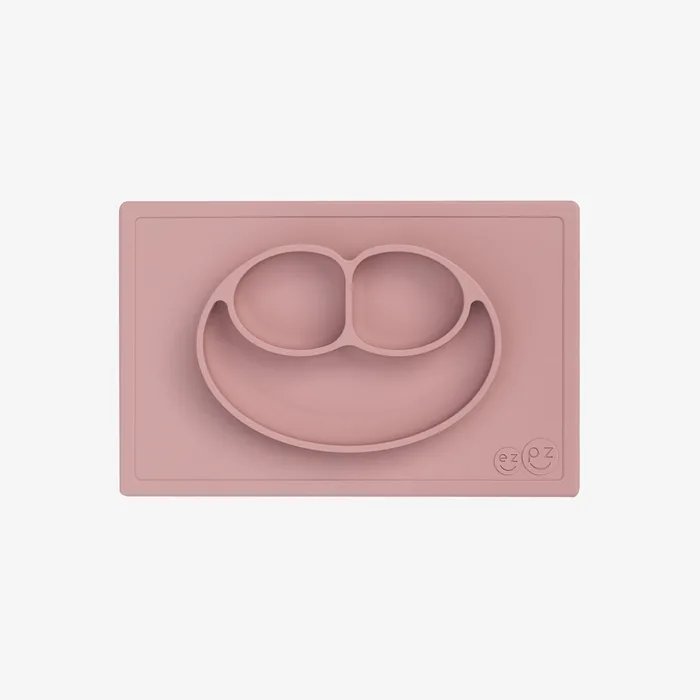
- Buy ezpz Happy Mat An all-in-one silicone placemat and plate whose suction is the whole underside, not a cup glued to the bottom. Amazon
- Buy Bumkins Silicone Grip Dish A one-piece divided silicone plate sized for a highchair tray, from the only brand here that publishes its curing method. Amazon
- It depends Avanchy Baby Round Divided Plate, Stainless Steel & Silicone An 18/8 stainless plate on a removable silicone suction ring, for parents who want no polymer under the food. Amazon
- Skip WeeSprout Bamboo Divided Plates, Set of 4 Sold as the natural option, but it is bamboo fibre bound with melamine resin and it does not stick to anything. Amazon
What actually matters
- Integral versus removable suction - A base moulded into the plate has no join, cannot be twisted off, and dries in one piece. A separate ring is easier for a child to remove and creates a seam where water and food sit between washes.
- The surface you own - Suction needs a smooth, non-porous, clean surface. ezpz names wood, laminate, stone and glass as surfaces that work and warns that pitted, fractured or divoted ones will not hold, which is the honest version of what every parent finds out.
- Curing method - Silicone is cured to set its shape, and platinum curing leaves no by-products while peroxide curing leaves residues that must be baked off. Bumkins states it uses platinum curing; most brands in this category say nothing either way.
- FDA grade versus LFGB grade - Both are real food-contact standards and both are passable. LFGB testing is often described as broader, with sensory checks for odour and taste transfer.
- What the bamboo is bound with - If the listing says bamboo fibre, bamboo powder or melamine finish, the plate is a melamine-formaldehyde thermoset with plant filler. That is a plastic with heat limits, not a natural material with none.
- Stated heat limits - A number you can check, like oven safe to 400 degrees F or 204 C, tells you the maker tested something. Vague heat resistance language tells you nothing and cannot be held against them.
- Fit against your tray - Suction only works if the whole base contacts a flat surface. A plate that overhangs a highchair tray edge will not seal, no matter how good the base is.
The specs, in plain English
Green flags vs red flags
Green flags
- The maker names the surfaces the suction works on and admits which ones it does not.
- The curing method is stated in writing, not implied by the word premium.
- Heat guidance comes with an actual temperature and unit rather than a vague claim.
- The plate is described as one moulded piece with no separate ring or insert.
- The material standard is given per product, so you can tell FDA grade from LFGB grade on the item you are buying.
Red flags
- Non-toxic, eco-friendly or natural used as though they were certifications, with no standard named anywhere.
- A bamboo or wheat straw plate that never says what the fibre is bound with.
- A suction claim with no mention of surface requirements, which usually means it was only ever tested on glass.
- Microwave-safe claimed on a bamboo composite or melamine plate.
- A suction ring sold as a separate replaceable accessory, which suggests it may come off.
Who's who: the brands
- ezpz - Built the category around the all-in-one silicone mat and plate, and is unusually specific in its own FAQ about which surfaces its seal works on.
- Bumkins - The clearest material disclosure of the mainstream brands, publishing its platinum curing process and telling buyers to check FDA versus LFGB grade per product.
- Avanchy - Stainless steel feeding gear with removable silicone suction bases sold as a grow-with-me feature.
- Munchkin - A mass-market baby brand with suction bowls; check the maker's page for current heat and care limits.
- Miniware - Plant-based tableware brand; check the maker's page for what its composite is bound with.
How to read a listing without getting fooled
Read a toddler plate listing from the bottom up. Skip the headline and the adjectives and find the specification block, which is where the checkable claims live. You want four things: the material named precisely, the curing method or food-contact standard, a heat limit with a number and a unit, and a description of how the suction is attached. If the listing says bamboo, look for the binder; if it says silicone, look for platinum cured or a named standard; if it says suction, look for whether the base is moulded in or clipped on. Anything a maker states in a specification block is something you can hold them to and something a retailer has to honour. Anything in the marketing paragraph above it, particularly the words non-toxic, natural and eco-friendly, is not a claim about safety testing and should not be read as one.
How much should you spend?
Toddler plates cover a narrow range, and the spread has more to do with size and material than quality. Budget buys you a small one-piece silicone divided plate sized for a highchair tray, or a multipack of bamboo composite plates, and at this tier the silicone option is the better product by some distance. Mid-range buys the large all-in-one silicone mat and plate, which is where the suction problem is actually solved rather than mitigated, and is the tier most parents should aim at. Premium is almost entirely stainless steel, where you are paying for a stainless body and a removable silicone ring rather than better suction. There is no tier at which a bamboo composite plate becomes the right choice for a toddler, because the missing feature is suction and no amount of spend adds it.
Questions, answered
What is the difference between a suction plate and a suction mat?
A suction plate is a normal plate shape with a gripping base underneath, so the sealed area is roughly the size of the plate's foot. A suction mat, like the ezpz design, is a placemat and plate moulded as one piece, so the sealed area is the entire mat. The larger footprint is harder to lift and also catches the food that misses the plate. The trade-off is that mats are too big for most highchair trays.
Does silicone hold onto smells and stains?
It can, and the usual cause is dish soap rather than food. ezpz recommends unscented, non-oily detergents and warns that soaps containing essential oils, antibacterial agents or moisturisers stick to silicone and leave an aftertaste. Its own fix for a lingering smell is a soak in white vinegar and baking soda, or baking the mat at 275 degrees for about 45 minutes. Strongly coloured foods like tomato and curry can tint lighter silicone without affecting how it performs.
Is a wheat straw or rice husk plate any different from bamboo?
In principle no. These are all ground plant fillers used inside a plastic matrix, and the European Commission's enforcement position covers bamboo and other unauthorised plant-based additives together rather than singling bamboo out. The Commission's stated concern is that most of these fillers have never been safety assessed for use in plastics and that they can accelerate the plastic's degradation. Treat any plant-fibre-in-plastic plate the same way, and check what the binder is.
Can my child use a suction plate on a wooden table?
Sometimes, and it depends on the finish rather than the wood. ezpz explicitly lists wood among the surfaces its mats seal to, alongside laminate, stone and glass, but adds that a wooden or tiled surface with holes, divots or fractures will not hold as well. A smooth sealed or lacquered table usually works; a reclaimed, oiled, waxed or heavily grained one usually does not, because air can get under the edge. Wiping both the table and the base dry before you press it down makes a real difference.
Or jump to the head-to-head: ezpz Happy Mat vs Bumkins Silicone Grip Dish.