

Explained
Robot Lawn Mowers, Explained
After reading this, you'll be able to read any robot-mower listing and know whether it can navigate, climb, and cover your specific yard - or whether it will wander, stall, and leave you finishing by hand.
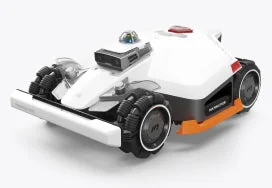
In this guide
Robot mowers have quietly crossed a line: the best ones now map your lawn with satellite positioning or onboard cameras instead of the buried wire that used to make setup a weekend project. But the category stretches from machines that glide across half an acre and climb steep banks down to clever concepts whose software can't quite deliver, and the spec sheets make them all sound equally capable. The two things buyers misjudge most are how the mower knows where the lawn ends, and whether it has the traction and capacity to actually finish your yard.
The 30-second version
- Navigation type is the biggest decision. Wire-free RTK-GPS or camera systems skip the buried boundary wire, but they need a clear view of the sky; a wire is more setup work yet immune to tree cover and signal dropouts.
- Match the mower to your yard's size and shape, not the marketing photo - every model has a recommended maximum area, and buying too small means it can never finish in a cycle.
- Slopes need all-wheel drive. If your lawn has real hills, banks, or damp low spots, a two-wheel-drive mower will slip and get stuck where an all-wheel-drive one keeps climbing.
- The badge 'wire-free' doesn't guarantee reliability. A cheap camera-only mower that wanders, misses patches, or stalls in glare is worse value than a dependable one that costs more.
- These machines live outdoors unattended, so a rain sensor, GPS anti-theft, a PIN lock, and safe blade design aren't luxuries - they're the difference between set-and-forget and constant babysitting.
What actually matters
- Navigation and setup effort - the clearest dividing line in the category. Wire-free RTK-GPS or vision mowers let you 'draw' the lawn by walking the perimeter once in an app; boundary-wire models need a wire buried or pinned around every edge and island, which is real work but never loses signal under trees.
- Reliable coverage, not just a wire-free claim - a mower is only useful if it actually mows the whole lawn evenly. Owner reports, not spec sheets, reveal which systems drift off course, skip strips, or stall in shadow, glare, or dry, patchy grass.
- Drive type and slope rating - all-wheel drive matters the moment you have hills, banks, or soft damp ground. Manufacturers publish a maximum incline (as a percentage or degrees); check yours against your steepest slope before buying.
- Lawn-size capacity - each model lists a recommended maximum area. Buy too small and it can't finish in a mowing cycle; buy far too big and you overpay. Match the rating to your actual lot, with a margin for thick or fast-growing grass.
- Multi-zone and passage handling - if your property has a front and back lawn joined by a narrow gate or path, you need a mower that can store multiple zones and navigate 'passages' between them without getting lost or stuck.
- Obstacle avoidance and safety - camera- and sensor-based systems that slow for and steer around people, pets, hoses, and toys are worth prioritizing in a busy yard. Blades should be small, shielded, and stop quickly when the mower is lifted or tilted.
- Anti-theft and weather protection - GPS tracking, a PIN lock, an alarm, and a working rain sensor are the practical safety net for a machine that spends its life outside on its own.
The specs, in plain English
Green flags vs red flags
Green flags
- Wire-free RTK-GPS (often paired with a camera) with a clearly stated way to mount the reference station where it can see the sky
- All-wheel drive with a published incline rating that comfortably clears your steepest slope
- A recommended maximum area that matches your lawn with room to spare for thick or fast-growing grass
- Support for multiple zones and automatic passage navigation if your property is split
- GPS tracking, a PIN lock, an alarm, and a rain sensor all included as standard
- Small, shielded blades that stop quickly on lift or tilt, plus obstacle sensing that slows for people and pets
Red flags
- A 'wire-free' badge with no mention of how the mower actually navigates, or owner reports of it wandering, missing patches, or stalling in shadow and glare
- Camera-only navigation marketed for large, sloped, or cluttered yards it clearly can't manage reliably
- No slope rating listed, or a two-wheel-drive machine sold as suitable for 'any lawn'
- A maximum-area figure that only just matches your lawn, leaving no margin for growth
- Anti-theft down to a PIN alone, with no GPS tracking on a mower that lives outdoors
- Vague setup claims that hide a heavy boundary-wire install, or an RTK system with no realistic place to mount the base station in a shaded yard
Who's who: the brands
- Mammotion - Wire-free specialist known for all-wheel-drive RTK-GPS mowers that tackle slopes and large, awkward yards other robots won't touch.
- Segway (Navimow) - Makes some of the easiest wire-free mowers to live with, pairing RTK positioning with camera-based virtual fencing for typical suburban lawns.
- Husqvarna - Long-established mower maker with a bulletproof, all-weather reputation; flagship models are superb but often lean on a buried boundary wire or a separately purchased satellite system.
- Worx - Home-centre brand pushing camera-only, wire-free navigation and shared cordless-tool batteries; the concept is appealing but navigation reliability has lagged RTK rivals.
- Ecovacs (Goat) - Robot-vacuum maker applying vision and LiDAR sensing to wire-free mowers, aimed at smaller, more complex urban gardens.
- Gardena / Bosch - European garden-tool names with mature, dependable boundary-wire robot mowers - proven and canopy-proof, if less flashy than the new wire-free wave.
How to read a listing without getting fooled
Start with navigation, because it decides everything else. If a listing says 'wire-free,' find out how: RTK-GPS (with a reference station you'll need to mount with a clear sky view), a camera system, or LiDAR - and be wary of any 'no wire' claim that dodges the detail or leans on owner reports of wandering and stalling. Check the drive type and the maximum incline against your steepest slope; if there's no slope figure, assume it's a flat-lawn machine. Match the recommended maximum area to your actual lot with margin to spare, and if your yard is split, confirm it supports multiple zones and can drive the passage between them on its own. Then look for the practical safety net: a rain sensor, GPS tracking, a PIN, an alarm, and shielded blades that stop when lifted. Finally, remember that RTK precision depends on your particular yard - dense tree cover or tall walls can starve the signal, so a shaded lot may be better served by a proven wire-based mower even though it takes more work to install.
How much should you spend?
The robot-mower market has a clear shape. At the bottom sit small, flat-lawn machines - some wire-free, some camera-only - where the low price often buys navigation that wanders and needs supervision. The middle is where dependable wire-free RTK mowers for typical suburban lawns live, and for most buyers that's the value sweet spot: easy app setup, solid coverage, and the anti-theft and rain features you actually want. The flagship tier adds articulated all-wheel drive, big-yard capacity, and years-of-hard-use build quality; that cost is rational only if your landscape genuinely demands it - steep banks, large or intricate grounds, or heavy tree cover that pushes you toward a proven wired system. Spending down to the cheapest wire-free model is usually a false economy, because a mower that misses patches and stalls costs you the very time it was meant to save. And factor in the whole picture: prices in this category haven't fallen as fast as the marketing suggests, and a dependable machine matched to your yard beats a bargain that can't finish the job.
Questions, answered
Do robot mowers really work without a boundary wire now?
The best ones do. Instead of a wire buried around the lawn, RTK-GPS models use satellite positioning (often paired with a camera) to know exactly where they are, so you 'draw' the yard by walking the perimeter once in the app. The main catch is that RTK needs a reasonably open view of the sky and a reference station with a clear line of sight, so dense tree cover or tall walls can interrupt it. Camera-only systems skip both the wire and the antenna, but their reliability varies more. Traditional wire-based mowers trade setup convenience for rock-solid, canopy-proof performance.
Will a robot mower handle my slopes?
It depends heavily on drive type. All-wheel-drive machines can climb steep banks and push through damp or uneven turf, while two-wheel-drive models are happier on flat-to-gently-rolling ground. Check the mower's maximum incline rating (given as a percentage or in degrees) against your steepest slope before buying. If your yard has real hills, prioritise an all-wheel-drive model - owner reports consistently show two-wheel mowers slipping or getting stuck where all-wheel-drive ones keep going.
Are they safe around kids and pets, and can they be stolen?
Modern robot mowers run small, shielded blades that stop quickly when the machine is lifted or tilted, and camera-equipped models can slow for and steer around people and pets. For theft, most include a PIN lock, and better models add GPS tracking and an alarm so a stolen unit can be located and disabled. As with any powered garden equipment, still supervise young children and pets while it's running, and clear the lawn of small toys and hoses before a mowing cycle.
Do they cut in the rain, and what about the edges?
Most have a rain sensor, and sturdier models will keep mowing in wet weather, though many owners schedule around rain to avoid clumping and lawn ruts. Edges are the common weak spot: most robot mowers leave a few inches uncut along fences and walls because the blade sits inboard of the wheels, so you'll still trim borders occasionally. Some designs with an offset cutting disc trim closer than others, but none fully eliminate hand trimming.
How big a lawn can these cover, and can they handle two separate areas?
Match the machine to your yard. Every model lists a recommended maximum area - buy too small and it can't finish before the grass regrows; buy far too big and you just overpay. If your property is split into a front and back lawn joined by a gate or path, look specifically for support of multiple 'zones' and automatic 'passage' navigation, so the mower can move between areas on its own rather than needing to be carried. Check both the area rating and the multi-zone capability against your actual layout before choosing.
Related guides
 Rowing Machines After reading, you'll understand the four resistance types, what a monitor actually measures, and which specs and subscription strings decide whether a rower is worth it.
  Running Shoes Decode the specs on a daily trainer so you can pick shoes that fit your feet, not the marketing.
  Ski Goggles After this guide you'll know which goggle specs actually affect what you see on the mountain - and which are marketing - so you can match a lens, fit, and swap system to how you really ski.
  Sleeping Bags After reading this you will know what a sleeping bag's temperature rating, fill power, and shape actually mean, and how to pick one that keeps you warm without overpaying or overpacking.
  Sleeping Pads After reading this you will understand what a sleeping pad's specs actually mean and how to match one to how you sleep and where you camp.
  Squat Racks After reading this, you'll be able to look at any squat-rack listing and know immediately whether it's gym-grade infrastructure, an honest budget cage, or a pull-up stand pretending to be a rack.