Explained
Radon Detectors, Explained
After reading, you'll understand what a radon number is worth, how long a device needs before it earns its accuracy claim, and which certifications are real.
In this guide
Radon shopping is confusing because two very different products sit under one search term: a passive kit you post to a laboratory, and an electronic monitor with a screen. They are priced differently, they answer different questions, and only one of them tends to appear on the lists that certified professionals are required to buy from. Add two units that differ by a factor of 37 and a set of testing conditions most people never read, and it is easy to end up with a confident number that means very little. This guide untangles the units, the timings and the certifications.
The 30-second version
- Two units, one conversion, one pCi/L equals exactly 37 Bq/m3, so EPA's 4 pCi/L action level is 148 Bq/m3 and WHO's 100 Bq/m3 reference level is about 2.7 pCi/L.
- Short means screening, EPA defines short-term tests as 2 to 90 days and says a long-term test over 90 days is more likely to give your year round average.
- No consumer monitor is professionally listed, the AARST-NRPP and NRSB device lists carry the Pro variants, not the consumer models, and Airthings says it does not recommend its consumer monitors for home inspections.
- Canada runs a separate consumer program, C-NRPP evaluates consumer-grade electronic monitors and publishes both an approved list and a not approved list that includes several models recalled by Health Canada.
- Placement is measured in inches, ANSI/AARST MAH-2019 sets minimum distances from windows, walls, ceilings and other objects, and getting them wrong invalidates the number more surely than the sensor ever would.
The products this guide is about
Our verdict on each, with the full reasoning on the companion review.
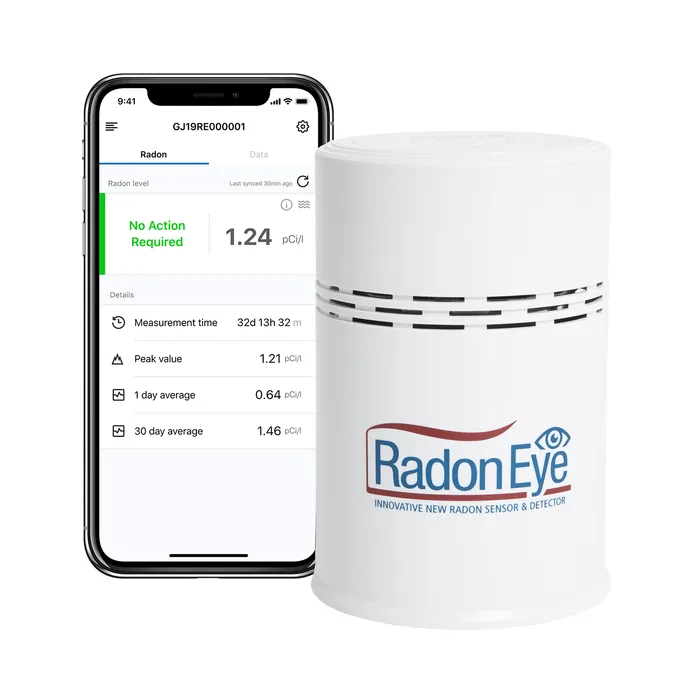
- Buy Ecosense RadonEye A plug in pulsed ionization chamber monitor that shows a first reading in ten minutes and is on C-NRPP's approved consumer monitor list. Amazon
- Buy AccuStar Labs Alpha Track Radon Test Kit (AT-100) A passive long term detector with laboratory analysis included, listed by AARST-NRPP as device AT-8205 and analysed by a listed laboratory. Amazon
- It depends Airthings Corentium Home 2 A battery powered handheld monitor you can move from room to room, with a published accuracy figure and no plug, app or account required. Amazon
- Skip Airthings View Radon A Wi-Fi connected radon monitor whose published radon performance matches the cheaper Corentium Home 2, so the premium buys connectivity rather than measurement. Amazon
What actually matters
- Action level - EPA recommends fixing at 4 pCi/L (150 Bq/m3) and considering a fix between 2 and 4 pCi/L (75 to 150 Bq/m3). It also states there is no safe level, so risk does not vanish below the line.
- Averaging period - Every accuracy claim is tied to how long the device has been running and at what concentration. The same monitor might be within 10 percent after 4 days at a high level and need 7 days at a lower one.
- Device listing - The AARST-NRPP list records, for each continuous monitor, that proof of calibration is due annually and device performance testing every two years. Consumer monitors carry neither obligation because they are not on it.
- Closed-building conditions - For tests under 4 days these must start 12 hours before and hold throughout. Without them a short-term result is not comparable to anything, including your own previous test.
- Lowest lived-in level - EPA says to test the lowest level you actually use, and to retest on a lower level if your living patterns change, such as finishing a basement.
- Laboratory analysis - A passive kit's number comes from a laboratory, and the AARST-NRPP list pairs each approved device with the approved labs allowed to read it. That pairing is the quality control.
- Seasonal timing - MAH-2019 notes that long-term testing intended to reflect annual exposure should include heating season conditions for at least the proportion of the year the heating runs, because winter is usually when indoor radon peaks.
The specs, in plain English
Green flags vs red flags
Green flags
- The exact model number appears on the AARST-NRPP approved device list, or on C-NRPP's approved consumer-grade monitor table.
- The accuracy claim names both a concentration and an averaging period rather than a bare percentage.
- A passive kit states that laboratory analysis and return postage are included, with no separate fee at the end.
- The maker publishes the sensor technology by name, such as pulsed ionization chamber or alpha spectrometry, rather than calling it proprietary.
- The instructions repeat the standards' placement rules and closed-building requirements instead of just saying to put it anywhere convenient.
Red flags
- A monitor described as certified or approved without naming which program, and whose model number does not appear on any published list.
- A device sold for use in real estate transactions when the manufacturer's own help pages advise against professional inspection use.
- A cheap marketplace radon meter from a brand you cannot find on C-NRPP's tables; its not approved list includes several models recalled by Health Canada.
- Marketing that leads with a first reading in minutes and never states how long the reading needs to earn its tolerance.
- No stated measurement range, so you cannot tell whether the device would even register a seriously elevated result.
Who's who: the brands
- Airthings - Norwegian maker whose consumer line uses a passive diffusion chamber with alpha spectrometry, and whose Corentium Pro is the model that appears on both the AARST-NRPP and NRSB device lists.
- Ecosense - Known for pulsed ionization chamber monitors with fast first readings, with the RadonEye Pro RD200P and EcoQube Pro EQ200 carrying the professional listings.
- AccuStar Labs - A radon testing laboratory that supplies its own charcoal and alpha track kits, several of which appear on the AARST-NRPP list paired with its labs as the approved analysis provider.
- Air Chek - A long established North Carolina laboratory whose charcoal devices and analysis service both appear on the AARST-NRPP approved device list.
- Radonova - A Swedish laboratory best known for alpha track detectors such as the Radtrak series, listed on the AARST-NRPP device list with its own analysis provider code.
How to read a listing without getting fooled
Start with the model number, not the product name, because the professional and consumer versions of the same family often share a name and differ entirely in status. Search that exact string against the AARST-NRPP approved device list and, if you are in Canada or just want a second opinion, against C-NRPP's consumer-grade table. Then find the accuracy line and check that it names both a concentration and a duration; a percentage on its own is a slogan. Next, read the timing claims twice: 'first reading in ten minutes' and 'accurate within 10 percent after seven days' can both be true of the same device and mean very different things. Check the power source against where you actually need to test, since a plug in monitor cannot go where there is no outlet. Finally, look for a stated measurement range, because a ceiling that stops short tells you the device was designed for reassurance rather than for finding a serious problem.
How much should you spend?
This is one of the rare categories where the budget option is arguably the more rigorous one. A single passive kit with laboratory analysis included sits firmly in the budget tier and is the only type of device most homes strictly need, since it is what produces a year round average against the action level. Mid-range buys a competent electronic monitor with a published accuracy specification, a real sensor technology named on the spec sheet, and a rolling long term average; that is a genuine upgrade in usefulness if you want to see radon respond to weather, ventilation and mitigation. The premium tier mostly buys connectivity, displays and smart home integration rather than a better measurement, and in at least one case the premium model quotes the same radon accuracy as its cheaper sibling. Professional grade instruments sit above all of this and come with calibration and performance testing obligations, which is what you are paying a measurement professional for rather than something worth buying yourself.
Questions, answered
My monitor reads a different number every hour. Is it broken?
Almost certainly not. Radon entry depends on soil gas pressure, wind, rain, temperature difference and how much you have been opening doors, so indoor levels genuinely swing over hours and across seasons. EPA states plainly that radon levels tend to vary from day to day and season to season, which is why it treats short-term tests as less likely than long-term tests to reflect your year round average. Watch the long term average on the device rather than the live figure.
How does a charcoal kit differ from an alpha track kit?
Charcoal canisters are short-term devices, generally exposed for a few days, and they must be sealed and posted promptly because the charcoal releases radon as well as taking it up. Alpha track detectors are long-term, typically exposed for three months to a year, and record cumulative damage in a plastic film that a laboratory etches and counts. Charcoal gives you a fast screen under closed-building conditions; alpha track gives you an average that closer reflects real living conditions. Both appear on the AARST-NRPP device list when paired with an approved laboratory.
Do consumer radon monitors need recalibration?
Manufacturers of consumer monitors do not generally publish a recalibration interval, and C-NRPP states that the consumer-grade devices on its approved list cannot be professionally calibrated. That is a real difference from the professional instruments, where the AARST-NRPP device list records proof of calibration due annually and device performance testing every two years. In practice it means a consumer monitor's number drifts with no scheduled check, which is another reason to confirm any important result with a lab analysed kit.
Are the very cheap radon meters sold online worth trying?
Be careful with unfamiliar brands. C-NRPP publishes a not approved table alongside its approved consumer monitor list, and it includes a run of low cost models, several of them noted as recalled by Health Canada. A device that reports a plausible looking number while being wrong is worse than no device, because it produces false reassurance about a gas that EPA links to roughly 21,000 lung cancer deaths a year in the United States. If a brand does not appear on either the AARST-NRPP list or C-NRPP's consumer table, spend the money on a lab analysed kit instead.
Or jump to the head-to-head: Ecosense RadonEye vs AccuStar Labs Alpha Track Radon Test Kit (AT-100).