Explained
Reusable Respirators, Explained
After reading, you'll understand how to read a NIOSH approval, pick a filter class from the hazard instead of the price, and spot the fake replacement filters that fail lab testing.
In this guide
First-time buyers usually get two things backwards. They assume the mask is the product and the filter is a consumable, when NIOSH actually approves the two together as one inseparable configuration. And they shop by efficiency number, treating P100 as simply better than N95, when the letter and the number answer completely different questions and neither one touches solvent vapor. Add the fact that fit does more for your real exposure than any spec on the box, and it becomes clear why two people can buy the same mask and end up with very different protection.
The 30-second version
- Approval covers a configuration, meaning a specific facepiece with specific filters, which is why one mask carries many different TC numbers.
- The letter is about oil, not about quality: N-series is restricted to work free of oil aerosols, while R- and P-series handle oil-based particulates.
- The number is efficiency, so 95 means 95 percent, 99 means 99 percent, and 100 means 99.97 percent minimum against the test aerosol.
- Filters stop particles and cartridges stop vapor, and buying the wrong one for the job leaves you completely unprotected while feeling completely protected.
- Fake replacement filters are the real danger, because NIOSH lab-tested a batch sold online and almost every one of them failed.
The products this guide is about
Our verdict on each, with the full reasoning on the companion review.
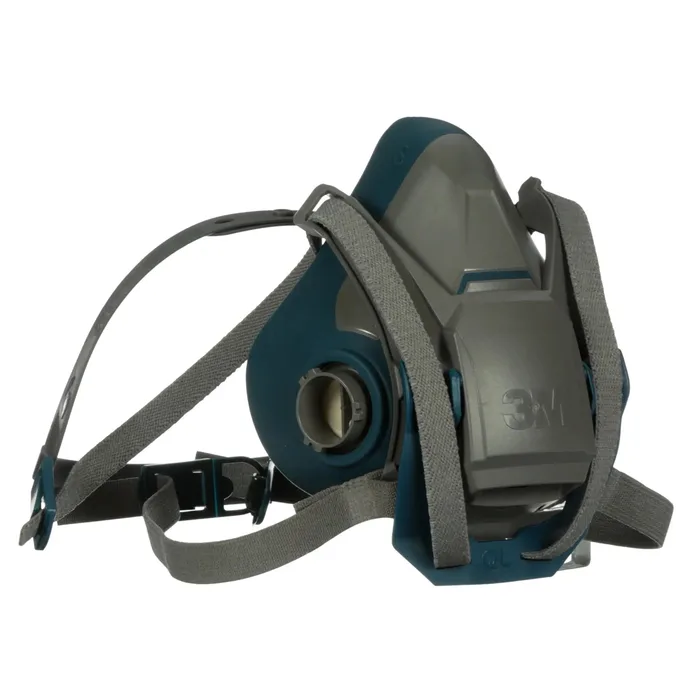
- Buy 3M Rugged Comfort Quick Latch Half Facepiece Reusable Respirator 6500QL Series The most flexible half mask for a home shop, because it takes the 3M bayonet filters and cartridges you can find almost anywhere. Amazon
- Buy GVS Elipse P100 Half Mask Respirator A tiny, light P100 mask that disappears on your face, which is why people who own one actually wear it. Amazon
- It depends GVS Elipse Integra P100 Half Mask with Goggles The same Elipse mask with a sealed ANSI Z87+ goggle moulded on, which is either exactly what you need or completely wrong for you. Amazon
- Skip 3M Secure Click Half Facepiece Reusable Respirator HF-800 Series The best-engineered mask in this comparison, and the wrong one to buy for a home shop, because its filters are the hardest here to walk in and buy. Amazon
What actually matters
- Fit and sizing - a half mask works by sealing to skin, and any leak is unfiltered air arriving straight in your breathing zone. Choosing a model that comes in three sizes and then getting the size right does more for your protection than any upgrade in filter class.
- Filter class chosen by hazard - the series letter tells you whether the filter tolerates oil aerosols and the number tells you its minimum efficiency, but neither has anything to do with gases or vapors. Sanding is a particulate problem, spraying solvent-based finish is a vapor problem, and they need different parts.
- Verifiable NIOSH approval - a genuine product gives you an approval number you can look up on the Certified Equipment List and match against the model names on the record. A listing that says NIOSH approved without a number is a listing you cannot check.
- Where the filters come from - NIOSH approves complete configurations, not components, so a filter that is not named on your facepiece's approval label takes the whole respirator outside its approval even though it clicks on perfectly. This is also where counterfeits concentrate.
- Consumable availability - a respirator you cannot re-supply quickly becomes a respirator you stop using, and a proprietary cartridge family is a long-term cost even when the mask itself is superb. Check what your local retailers actually stock before you commit to a mount.
- Facial hair - NIOSH states that even a little facial hair can interfere with the seal, that even a day or two of stubble can reduce protection, and that people with beards fail fit testing. This is not a fussy detail, it is the failure mode.
- Cleaning and spare parts - reusable means washing the facepiece and eventually replacing valves and harnesses. Masks with published spare part numbers stay in service for years, while sealed designs get thrown out when one flap tears.
The specs, in plain English
Green flags vs red flags
Green flags
- A TC approval number printed on the box that you can find on the NIOSH Certified Equipment List, with model names matching what you bought.
- The mask is offered in at least three sizes rather than one universal size.
- The manufacturer publishes a technical data sheet with materials, weights and the exact filter and cartridge series the approval covers.
- Spare parts are listed by part number, so valves, harnesses and buckles can be replaced instead of the whole mask.
- The filters and cartridges for that mount are stocked by ordinary retailers, not only by one online seller.
Red flags
- Replacement filters sold under a famous part number by a seller who is not the approval holder, especially in unusually large multipacks at an unusually low price.
- Product photos where the certification mark is blurred, cropped, partially covered, or shortened to just the number instead of P100.
- A listing that says NIOSH approved but gives no approval number you can look up.
- A particulate-only mask marketed for paint, solvent, resin or chemical work, which its approval does not cover.
- Claims of protection against hazards no half mask can address, such as oxygen-deficient spaces or atmospheres immediately dangerous to life or health.
Who's who: the brands
- 3M - The default in this category by a wide margin, with the bayonet 6000 and 6500 families plus the newer Secure Click line, and by far the easiest filters and cartridges to find on a shelf.
- GVS - Italian filtration specialist behind the Elipse, the low-profile half mask that woodworkers and drywall sanders reach for when a conventional cartridge mask is too bulky, and the OEM behind several house-brand respirators.
- Moldex - Long-running US maker of the 7000 and 8000 series half masks, known for light, simple designs and a broad set of gas and vapor cartridges.
- PIP (North brand) - The North 5500 and 7700 half masks are now held by PIP Global Holdings, which completed its acquisition of Honeywell's personal protective equipment business in May 2025.
- MSA - Industrial safety veteran with one of the largest sets of NIOSH approvals of any manufacturer, more common on job sites than in home shops.
How to read a listing without getting fooled
Start at the bottom of the listing, not the top. Find the approval number, note the schedule in the middle of it, and search it on the NIOSH Certified Equipment List: the record names the facepiece models and the exact cartridges or filters the approval covers, and anything not on that list is outside the approval. If the brand does not appear as a manufacturer, check the private-label field before assuming the worst, because plenty of house-brand masks are legitimate rebadges. Then read the filter designation as two separate facts, the series letter for oil tolerance and the number for minimum efficiency, and ask whether your actual hazard is particles or vapor. Check the sizes offered, because a model sold in one size is telling you it does not expect to fit you. Finally, look at who sells the replacement filters, because that is where counterfeits concentrate and where your money goes over the life of the mask.
How much should you spend?
Reusable half masks sit in a narrow band. Budget buys a competent low-profile particulate mask with integrated filters, which is genuinely enough if dust is your only hazard, and it is the tier where value is best because the same mask body is what you would wear anyway. Mid-range buys a silicone-sealed cartridge mask with three sizes and access to a full range of filters and cartridges, which is the sensible default for a shop that does more than one kind of work, or a sealed goggle variant if eye protection is the point. Premium buys refinements aimed at people wearing a respirator all day: push-button seal checks, speaking diaphragms, lower profiles for eyewear and welding shields. The part that actually costs money over time is the consumables, so before committing to a mount, price the filters and cartridges for it rather than just the mask. And treat suspiciously cheap replacement filters as a warning rather than a bargain, because NIOSH lab-tested that exact bargain and almost none of it worked.
Questions, answered
How did NIOSH test the fake filters people buy online, and what happened?
NIOSH bought fraudulent P100 filters and cartridges from online marketplaces, targeting the part numbers most often copied, and ran them through the same standard test procedures used to approve respirators under 42 CFR Part 84. Of 240 fraudulent P100 filters tested, 220 exceeded the maximum penetration limit, and all 40 genuine control filters passed. Every one of the 100 fraudulent combination cartridges failed filtration immediately. The fraudulent organic vapor cartridges broke through in under five minutes against a 50-minute minimum. NIOSH also noted the fakes were often visually near-identical to the genuine parts.
Is a reusable half mask better than a disposable N95?
For repeated shop work, usually yes, though for different reasons than people expect. The elastomeric facepiece seals more consistently over many donnings, it does not deform when it gets damp, and the filters can be upgraded or swapped for vapor cartridges as the job changes. Both are half masks, so OSHA assigns them the same protection factor of 10. The disposable wins on convenience for a single short task and on cost if you only ever need one.
How should I store and clean a reusable respirator?
Wash the facepiece with mild soap and warm water, avoiding solvents and abrasive cleaners, which degrade elastomer and valve components. Let it dry fully before reassembling, and inspect the inhalation and exhalation valves for tears or curling every time, since a stuck valve quietly wrecks the seal. Store it sealed in a bag or container away from your work area so it is not absorbing dust and fumes between uses. That matters most for gas and vapor cartridges, which keep adsorbing whatever is in the air around them.
Are there people who should not use a tight-fitting respirator at all?
Yes, and it is worth taking seriously. Breathing through a filter adds resistance and the mask adds heat, which is a real load for people with heart or lung conditions. Occupational use under OSHA requires a medical evaluation before anyone is fit tested or issued a respirator, precisely for this reason. Anyone with a beard they will not shave is also in this group, because the seal cannot be made. In both cases a loose-fitting powered air-purifying respirator is the alternative worth looking at.
Or jump to the head-to-head: 3M Rugged Comfort Quick Latch Half Facepiece Reusable Respirator 6500QL Series vs GVS Elipse P100 Half Mask Respirator.