

Health & Wellness
The Best Reusable Respirators: 4 Compared (and One to Skip)
We compared reusable half-mask respirators for sanding, woodworking and painting on fit and sizing, how easy the filters are to actually buy, comfort over a long session, and whether the NIOSH approval can be verified.
The short version
The 3M Rugged Comfort 6500QL is the best all-round buy for a home shop: a silicone faceseal, three real sizes, a quick-latch that drops the mask off your face without removing the harness, and the 3M bayonet mount, which means filters and cartridges you can find in an ordinary hardware aisle. The GVS Elipse P100 is the value pick and the one you will actually keep wearing, because it is tiny and its filters sit flat against your cheeks instead of hanging off them. The GVS Elipse Integra is for a narrower buyer: it welds an ANSI Z87+ goggle to the same mask, which is excellent overhead or on a grinder and wrong if you wear prescription glasses. We would skip the 3M Secure Click HF-800 for home use, not because it is bad but because it is the best mask here tied to the hardest consumables to buy. All four are half masks, so OSHA assigns them a protection factor of 10, none work in an oxygen-deficient space, and none seal against a beard. Best for: anyone sanding, sawing, stripping or spraying at home who wants protection they can verify rather than assume.
Our picks at a glance
- 3M Rugged Comfort Quick Latch Half Facepiece Reusable Respirator 6500QL Series - Buy. The most flexible half mask for a home shop, because it takes the 3M bayonet filters and cartridges you can find almost anywhere.
- GVS Elipse P100 Half Mask Respirator - Buy. A tiny, light P100 mask that disappears on your face, which is why people who own one actually wear it.
- GVS Elipse Integra P100 Half Mask with Goggles - It depends. The same Elipse mask with a sealed ANSI Z87+ goggle moulded on, which is either exactly what you need or completely wrong for you.
- 3M Secure Click Half Facepiece Reusable Respirator HF-800 Series - Skip. The best-engineered mask in this comparison, and the wrong one to buy for a home shop, because its filters are the hardest here to walk in and buy.
The verdict in 30 seconds
What mattered most
- Type
- Sizes
- Faceseal material
- Weight
- Filters and cartridges
- Gas and vapor upgrade path
A reusable half mask is the piece of shop safety gear most DIYers buy once and then stop thinking about, which is exactly the problem. The mask body is only half the product. The other half is the filter or cartridge you fit to it, and NIOSH approves the two together as one configuration, never separately. That single fact decides which of these masks is right for a home shop. We checked every approval claim in here against the NIOSH Certified Equipment List and left out anything we could not confirm.
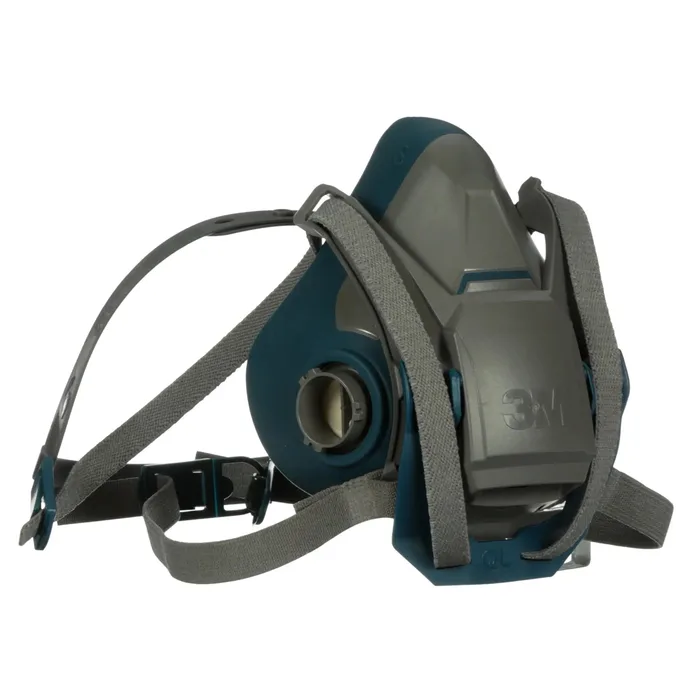
The most flexible half mask for a home shop, because it takes the 3M bayonet filters and cartridges you can find almost anywhere.
Best for: The DIYer who does a bit of everything and wants one mask that takes a dust filter today and an organic vapor cartridge next weekend.
- Silicone rubber faceseal with a nylon overmold, softer against the face and easier to wipe down than a bare thermoplastic mask.
- Three sizes (6501QL small, 6502QL medium, 6503QL large), so you have a real chance of finding one that seals on your face.
- The Quick Latch drops the facepiece off your mouth one-handed without taking the harness off, which matters when you step out of a dusty room every ten minutes.
- The Quick Latch version is not NIOSH approved with 3M supplied air systems, unlike the plain 6500 series.
- Cartridges stand off both cheeks, so it is bulkier than a low-profile mask under a face shield or inside a cabinet.
- At about 110 grams for the facepiece alone it is heavier than the low-profile options before you even add cartridges.
- Like every tight-fitting respirator, it does nothing over a beard or stubble along the sealing surface.
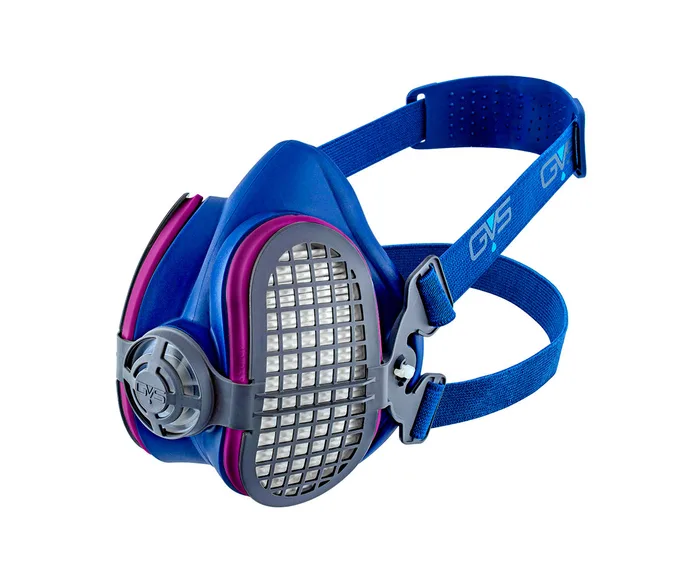
A tiny, light P100 mask that disappears on your face, which is why people who own one actually wear it.
Best for: Woodworkers, drywall sanders and anyone whose hazard is dust rather than vapor, especially if past masks ended up in a drawer because they were annoying.
- The mask body weighs about 3.44 ounces, and about 4.65 ounces with both filters fitted, so it stops feeling like equipment after a few minutes.
- The filters sit flat against the cheeks rather than protruding, so it clears a face shield, safety glasses and a low ceiling joist.
- Three sizes (S/M, M/L and XL) and a latex-free, silicone-free thermoplastic body, useful if silicone irritates your skin.
- The standard P100 model handles particulates only. Solvent vapor from paint, stripper or finish needs the separate Elipse OV P100 model, which is a different purchase.
- The filters are proprietary to the Elipse family, so you cannot pick them up next to the 3M stock at a hardware store.
- There is no drop-down mechanism, so a break means pulling the whole thing off your head and reseating it afterwards.
- The compact shape traps more heat against your face than a mask with a bigger air gap.
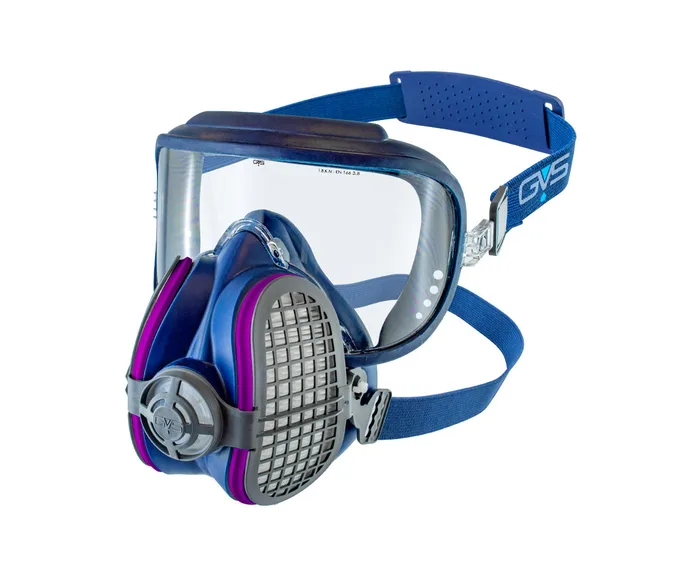
The same Elipse mask with a sealed ANSI Z87+ goggle moulded on, which is either exactly what you need or completely wrong for you.
Best for: Anyone working overhead, on a grinder, or in dust fine enough to get behind ordinary safety glasses, who wants eye and lung protection that cannot leave a gap.
- One sealed unit means no gap between goggle and mask, so overhead sanding and grinding debris cannot find the seam where separate eyewear meets a respirator.
- GVS states the polycarbonate lens withstands 120 metre per second impacts and carries an anti-fog coating plus a scratch-resistant coating.
- It runs on the same Elipse P100 filter range as the standard mask, so you are not adopting a second consumable to stock.
- It comes in two sizes only (SPR549 S/M and SPR550 M/L), where the plain Elipse offers three.
- It replaces your eyewear rather than working with it, so anyone in prescription glasses needs to check the fit before committing.
- The lens is part of the mask, not a separate item, so scratching or fogging the optics is a problem you cannot solve with a cheap replacement part.
- Like the standard Elipse it is a particulate respirator, so it is the wrong tool for solvent vapor.
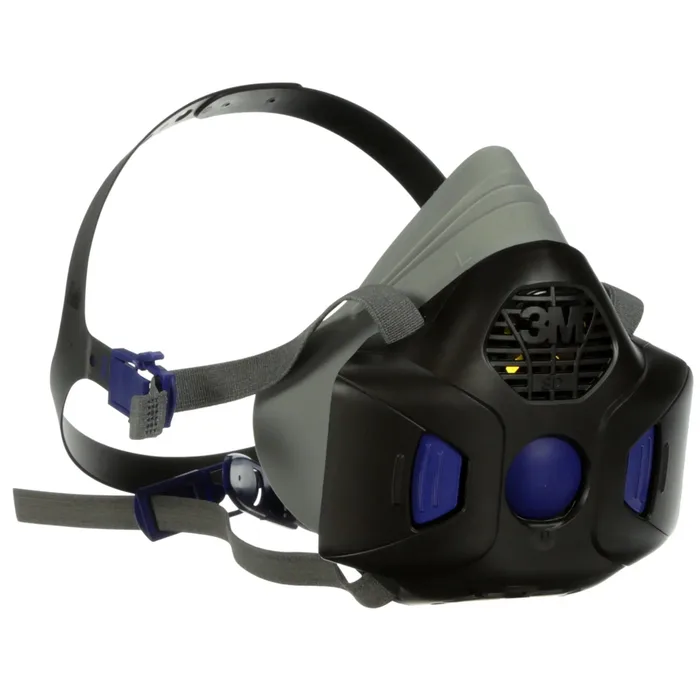
The best-engineered mask in this comparison, and the wrong one to buy for a home shop, because its filters are the hardest here to walk in and buy.
Best for: Professionals in a respirator all day with an industrial supplier account, where the seal check, the diaphragm and the all-day comfort earn their keep and the consumables arrive by the case.
- A push-button seal check confirms a negative-pressure seal in a second, without cupping both cartridges in your palms.
- The faceseal sits lower on the nose bridge and the profile is swept back, the best of these for wearing glasses or a welding shield.
- The SD models add a speaking diaphragm, so you can be understood without breaking the seal to talk.
- It is approved only with 3M Secure Click D8000 cartridges and D3000, D7000 and D9000 filters, a family stocked by industrial distributors rather than ordinary retailers.
- That matters more than it sounds: fitting anything not named on the approval label takes the whole respirator outside its NIOSH approval.
- It is the heaviest here, at 186 to 194 grams for the speaking-diaphragm facepieces depending on size.
- You pay the highest price in this group for benefits aimed at people wearing a mask for full shifts, not for a Saturday afternoon.
| Criteria | Rugged Comfort Quick Latch Half Facepiece Reusable Respirator 6500QL Series Top pick | Elipse P100 Half Mask Respirator | Elipse Integra P100 Half Mask with Goggles | Secure Click Half Facepiece Reusable Respirator HF-800 Series |
|---|---|---|---|---|
| Verdict | Buy it | Buy it | It depends | Skip it |
| Best for | The DIYer who does a bit of everything and wants one mask that takes a dust filter today and an organic vapor cartridge next weekend. | Woodworkers, drywall sanders and anyone whose hazard is dust rather than vapor, especially if past masks ended up in a drawer because they were annoying. | Anyone working overhead, on a grinder, or in dust fine enough to get behind ordinary safety glasses, who wants eye and lung protection that cannot leave a gap. | Professionals in a respirator all day with an industrial supplier account, where the seal check, the diaphragm and the all-day comfort earn their keep and the consumables arrive by the case. |
| Price tier | $$ · mid-range | $ · budget | $$ · mid-range | $$$ · premium |
| Type | Elastomeric half mask, 3M bayonet mount | Elastomeric half mask, integrated P100 filters | Half mask with sealed goggle, integrated P100 filters | Elastomeric half mask, Secure Click mount |
| Sizes | Small, medium, large (6501QL / 6502QL / 6503QL) | S/M, M/L, XL (SPR451 / SPR457 / SPR1343) | S/M, M/L (SPR549 / SPR550) | Small, medium, large (HF-801 / HF-802 / HF-803) |
| Faceseal material | Silicone rubber with nylon overmold | Thermoplastic elastomer, latex and silicone free | Thermoplastic elastomer, latex and silicone free | Silicone rubber on a thermoplastic fascia |
| Weight | About 110 g facepiece | About 3.44 oz body, 4.65 oz with filters | Not published by GVS | 186 to 194 g (SD models) |
| Filters and cartridges | 3M 6000 Series cartridges, 2000 / 2200 / 5000 / 7000 Series filters | GVS Elipse filter range | GVS Elipse filter range (SPR321 replacements) | 3M D8000 cartridges, D3000 / D7000 / D9000 filters |
| Gas and vapor upgrade path | Yes, the full 3M bayonet cartridge range | No, that is a separate Elipse OV P100 model | No, particulate only | Yes, the full Secure Click D8000 range |
| Integrated eye protection | No | No | Yes, ANSI Z87+ goggle | No |
| NIOSH status (Certified Equipment List) | Approved across many configurations, including active approval TC-84A-8267 | Approved, P100 approval TC-84A-6949 | Approved, P100 approval TC-84A-8119 | Approved across dozens of active HF-800 entries |
Which one is right for you?
- The DIYer who does a bit of everything and wants one mask that takes a dust filter today and an organic vapor cartridge next weekend. Buy it 3M Rugged Comfort Quick Latch Half Facepiece Reusable Respirator 6500QL Series
- Woodworkers, drywall sanders and anyone whose hazard is dust rather than vapor, especially if past masks ended up in a drawer because they were annoying. Buy it GVS Elipse P100 Half Mask Respirator
- Anyone working overhead, on a grinder, or in dust fine enough to get behind ordinary safety glasses, who wants eye and lung protection that cannot leave a gap. It depends GVS Elipse Integra P100 Half Mask with Goggles
- Professionals in a respirator all day with an industrial supplier account, where the seal check, the diaphragm and the all-day comfort earn their keep and the consumables arrive by the case. Skip it 3M Secure Click Half Facepiece Reusable Respirator HF-800 Series
How we judged the field
Five things decide whether a reusable respirator actually protects you. Fit comes first, because a half mask is a negative-pressure device: every breath pulls air through the path of least resistance, and if that path is a gap at your cheek rather than the filter, the filter class is irrelevant. Sizing follows directly, which is why a mask sold in three sizes beats an identical mask sold in one. Third is the filter and cartridge system, both the range available and how easily you can buy the right one locally, because a mask you cannot re-supply becomes a mask you stop using. Fourth is verifiable approval: NIOSH approves a facepiece and a specific set of filters together as one configuration, and that configuration has a number you can look up. Fifth is the thing nobody puts on a spec sheet, which is whether the mask is pleasant enough that you put it on for a ten-minute cut rather than telling yourself you will be quick.
We expected to find a fake in this field and did not. We checked the popular hardware-store and marketplace names against the NIOSH Certified Equipment List, including its private-label index, and the ones people actually buy are legitimately approved, often as rebadged versions of masks you already know. So the field splits by design instead. There are conventional cartridge masks, where two cartridges hang off the front and you swap between dust filters and vapor cartridges as the job changes. There are low-profile integrated masks, where slim filters lie flat against the face. There is the sealed goggle variant that merges eye and lung protection into one unit. And there is a premium tier built around a proprietary cartridge mount. We took one of each, and the honest verdict on the last one is that it is the best mask here and still the wrong buy for a home shop.
3M Rugged Comfort Quick Latch Half Facepiece Reusable Respirator 6500QL Series
Buy itThe 6500QL is what we would hand someone setting up a shop. 3M’s own data sheet, revised in November 2025, describes a silicone rubber faceseal with a nylon overmold, polyester and polyurethane straps, and a facepiece weighing about 110 grams in the Quick Latch version. Silicone matters more than it sounds: it stays pliable, it does not go tacky, and it wipes clean without the seal stiffening. The Quick Latch is the feature you notice daily, because it drops the mask off your mouth with one hand while the harness stays on your head and your hard hat or face shield stays put. The real argument for it, though, is the mount. It takes the 3M bayonet system, which means 6000 Series cartridges and 2000, 2200, 5000 or 7000 Series filters, the range you can find in a hardware aisle at short notice. One caveat: the QL version is not approved with 3M supplied air systems, while the plain 6500 is. For anyone who wants one mask that adapts to dust, paint and stripper without a second purchase, this is it.
GVS Elipse P100 Half Mask Respirator
Buy itThe Elipse solves the compliance problem, which is the problem most home shops actually have. GVS lists the mask body at about 3.44 ounces and 4.65 ounces with both filters fitted, and the P100 filters clip flat against the cheeks rather than sticking out. The result is a respirator you can wear under a face shield, lean into a cabinet with, and forget about, which is why it ends up on faces instead of on a shelf. It is approved as a P100 configuration under TC-84A-6949 on the Certified Equipment List, comes in three sizes including an XL, and the body is a latex-free and silicone-free thermoplastic if silicone irritates your skin. The trade-off is scope. The standard model is a particulate mask, full stop, and there is no cartridge you can add for solvent vapor. GVS sells a separate Elipse OV P100 model for that, which is a second purchase rather than a second filter. Buy this for dust and accept the limitation deliberately.
GVS Elipse Integra P100 Half Mask with Goggles
It dependsThe Integra takes the Elipse and moulds a sealed goggle onto it, and whether that is brilliant or useless depends entirely on your work. The case for it is the seam that no longer exists. Separate safety glasses and a half mask always leave a gap where the two meet, and overhead sanding, grinding sparks and fine silica all find it. GVS states the polycarbonate lens withstands 120 metre per second impacts, carries an anti-fog coating and a scratch-resistant coating, and the unit is certified to ANSI Z87+ alongside its NIOSH approval TC-84A-8119. It runs the same Elipse filters, so it adds no new consumable to stock. The case against it is equally clear. It comes in two sizes rather than three, it replaces your eyewear instead of working with it, so prescription glasses are a real question to settle before you buy, and the lens is part of the mask, which makes fogging or scratching a mask problem rather than a cheap replacement. It is still particulate only.
3M Secure Click Half Facepiece Reusable Respirator HF-800 Series
Skip itThis is the best mask in the comparison and we would still not buy it for a garage. 3M’s February 2025 technical properties sheet lists the speaking-diaphragm facepieces at 186, 187 and 194 grams, with a silicone faceseal on a thermoplastic fascia. What you get is genuinely good: a push-button seal check that confirms a negative-pressure seal without cupping both cartridges, a faceseal that sits lower on the nose bridge so glasses clear it, and on the SD versions a diaphragm that lets you be understood without pulling the mask down. The problem is what feeds it. It is approved with 3M Secure Click D8000 cartridges and D3000, D7000 and D9000 filters, a family that industrial distributors stock and almost nobody else does. Because NIOSH approves complete configurations, you cannot substitute the bayonet filters on the shelf next to it without taking the respirator outside its approval. Buy it if you have a supplier account and wear it all day. Otherwise the 6500QL protects you the same and you can always feed it.
Sources
Specs in this review come from these pages.
- NIOSH Certified Equipment List (search every approval number here) (wwwn.cdc.gov)
- NIOSH PPE CASE: Performance Testing of Fraudulent Respirator P100 Filters, Organic Vapor Chemical Cartridges, and Combination Cartridges (September 2025) (cdc.gov)
- OSHA, Assigned Protection Factors for the Revised Respiratory Protection Standard (osha.gov)
- 42 CFR Part 84 Subpart K, Air-purifying particulate respirators (eCFR) (ecfr.gov)
- 3M Rugged Comfort Half Facepiece Reusable Respirator 6500 Series, technical data sheet (multimedia.3m.com)
- GVS, Elipse P100 and Elipse Integra P100 NIOSH respirator product pages (gvs.com)
3M Rugged Comfort Quick Latch Half Facepiece Reusable Respirator 6500QL Series vs GVS Elipse P100 Half Mask Respirator: which should you buy?
The choice between the 6500QL and the Elipse P100 is really a choice about what you are protecting yourself from and how often. The 6500QL is a platform. Its whole argument is the 3M bayonet mount: today a 2000-series P100 for sanding, next month a 6001 organic vapor cartridge for the deck stain, and you can buy either at short notice without planning ahead. It costs you bulk. Two cartridges stand off both cheeks, the facepiece alone is around 110 grams, and it is the harder of the two to wear under a face shield or in a tight cabinet. The Elipse trades that flexibility for the opposite virtue. It is small, it is light, its filters lie flat, and the honest measure of a respirator is not its filter class but the fraction of dusty minutes you actually spend wearing it.
So: if your work involves solvents, paint, stripper, epoxy or anything with a smell, buy the 6500QL, because the vapor cartridge you will eventually need already exists on that mount. If your work is dust, chips, drywall and stone, buy the Elipse, get the size right, and enjoy not thinking about it. If you do both but mostly dust, the cheapest honest answer is the Elipse plus a separate Elipse OV P100 for the two weekends a year you spray something, rather than a big cartridge mask you resent wearing. And whichever you pick, get the size right first. A large mask on a small face leaks, and no filter class on earth compensates for that.
What to look for
- Read the TC number, do not just look for the word NIOSH: the approval number on the box has a schedule in the middle (84A for particulate filter respirators, 23C for chemical cartridge respirators) and a serial number identifying one exact facepiece-plus-filter combination, and you can type it straight into the NIOSH Certified Equipment List.
- Check that you can actually buy the filters: the mask is a one-time purchase and the consumables are forever, so a proprietary cartridge family sold only through industrial distribution is a real cost even when the mask itself is excellent.
- Pick the filter class from the hazard, never from the price: N-series filters are restricted to work free of oil aerosols while R- and P-series handle oil-based particulates, the number is the minimum efficiency (95, 99 or 99.97 percent), and none of them do anything at all about gases or solvent vapor.
- Buy a mask that comes in sizes: a half mask is a negative-pressure device, so every breath finds the leak first, and a model offered in small, medium and large gives you a far better chance of a seal than a one-size model with a nicer spec sheet.
- Check that facial hair does not cross the sealing surface: NIOSH says even a day or two of stubble can reduce protection and that people with beards fail fit testing, so if you will not shave, a loose-fitting powered air-purifying respirator is the real alternative rather than a tight mask worn hopefully.
- Do a user seal check every time you don it, not just the first time: cover the filters, inhale gently, and feel the facepiece pull in and hold, because a strap that shifted in the truck undoes everything the mask was rated to do.
Our final take
Buy the 3M Rugged Comfort 6500QL if you want one mask covering dust today and solvent vapor next month, and buy the GVS Elipse P100 if your hazard is dust and you want the mask you will actually keep wearing. Take the Elipse Integra only if sealed eye protection is the point rather than a bonus. The Secure Click HF-800 is the finest piece of engineering here and still the wrong purchase for a home shop, because you cannot conveniently buy what it eats. Then spend the ten seconds that matters more than the mask you chose: get the size right, check the seal before every job, and buy only the filters printed on the approval label.
Questions, answered
What does a TC number actually tell me, and why does one mask have so many?
A NIOSH approval number looks like TC-84A-8267. The middle part is the schedule, meaning the type of respirator: 84A is a non-powered particulate filter respirator, 23C is a chemical cartridge respirator, 19C is supplied air and 21C is powered air-purifying. The final digits identify one specific approved configuration, which is a facepiece plus a named set of filters or cartridges. That is why a single popular half mask appears on the Certified Equipment List under dozens or even hundreds of separate numbers, one per combination. You look it up by searching the list for the number printed on your box, then checking that the model names on the record match what is actually in your hands.
Are cheap replacement filters from an online marketplace a reasonable way to save money?
No, and this is the one place in this category where the evidence is unambiguous. In September 2025 NIOSH bought filters and cartridges sold online under genuine part numbers and ran them through the same standard test procedures used for approval. Of 240 fraudulent P100 filters, 220 exceeded the 0.03 percent penetration limit, some reaching 3 to 4 percent, while all 40 genuine controls passed. All 100 fraudulent combination cartridges failed filtration immediately, some passing more than half the test particles, and every fraudulent organic vapor cartridge broke through in under five minutes against a 50-minute requirement. The rule underneath is the part to remember: NIOSH approves complete configurations, not components, so a filter not named on your facepiece's approval label voids the approval no matter what is printed on it.
How do I choose between a P100 filter and an organic vapor cartridge?
By the hazard, not by the price. Under 42 CFR Part 84, particulate filters are graded by a series letter and an efficiency number. N-series filters are restricted to workplaces free of oil aerosols, while R- and P-series are intended for particulates that include oil-based liquids. The number is minimum efficiency: 95 means 95 percent, 99 means 99 percent, and 100 means 99.97 percent. None of that touches gases or vapors. Sanding, sawing, grinding and drywall work are particulate problems, so a P100 is the sensible default. Solvent-based paint, stripper, lacquer and two-part finishes give off vapor, and that needs an organic vapor cartridge, usually a combination cartridge that also carries a P100 layer for overspray.
Do I need a fit test if I am just working at home?
OSHA requires fit testing for occupational use, and its thresholds are worth knowing even if nobody is inspecting your garage. A quantitative fit test asks for a fit factor of at least 100 on a half mask and 500 on a full facepiece, and a qualitative test is pass or fail on whether you can taste or smell the agent at all. You cannot replicate that at home, but you can do the thing that catches most bad fits, which is a user seal check every single time you put the mask on. Cover the filters, inhale gently, and feel whether the facepiece pulls in and holds. If air whistles in anywhere, reseat it or try another size. Buying a mask that comes in three sizes rather than one is the biggest variable you control.
I have a beard. Is there any way to make a half mask work?
Not reliably, and NIOSH is unusually direct about it. Its guidance states that even a little facial hair can interfere with the seal, that even a day or two of stubble can reduce protection, and that because facial hair prevents a tight seal, individuals with beards fail fit testing and tight-fitting respirators are unsuitable for them. NIOSH and OSHA do not currently endorse beard bands or under-mask covers as a substitute. The real alternative is a loose-fitting powered air-purifying respirator, which supplies filtered air under a hood or helmet and does not depend on a face seal. Those cost considerably more, but for a bearded woodworker they are the honest answer rather than a compromise that quietly does nothing.
Deciding between the top two? See our head-to-head: 3M Rugged Comfort Quick Latch Half Facepiece Reusable Respirator 6500QL Series vs GVS Elipse P100 Half Mask Respirator.
More Health & Wellness reviews
 The Best Seat Cushions for Office Chairs: 4 Compared (and One to Skip)
  The Best Silk and Satin Sleep Bonnets: 4 Compared (and One to Skip)
  The Best Sleep Masks: 4 Compared (and One to Skip)
  The Best Smart Rings: 4 Compared (and One to Skip)
  Best Smart Bathroom Scales for 2026
  The Best Sunrise Alarm Clocks (Wake-Up Lights) for 2026