Explained
Racing Wheels, Explained
After reading, you'll understand how racing wheels differ, which specs matter, and how to avoid buying a wheel that cannot work with your console.
In this guide
First-time buyers usually compare torque numbers and stop there. The bigger traps are platform licensing, which locks most wheels to PlayStation or Xbox, and box contents, since some flagship bases ship without pedals. Torque figures also are not quoted the same way across brands. Knowing a handful of terms makes listings much easier to compare.
The 30-second version
- Pick your platform first, because PlayStation and Xbox versions of a wheel are separate products.
- Direct drive is now mid-range, so belt and gear wheels make sense mainly at the lowest budgets.
- Torque figures are not standardized, so compare peak with peak and constant with constant.
- Check the box contents, since some premium bases come without pedals.
- Force feedback is the point of a wheel, and a wheel without it is closer to a large controller.
The products this guide is about
Our verdict on each, with the full reasoning on the companion review.
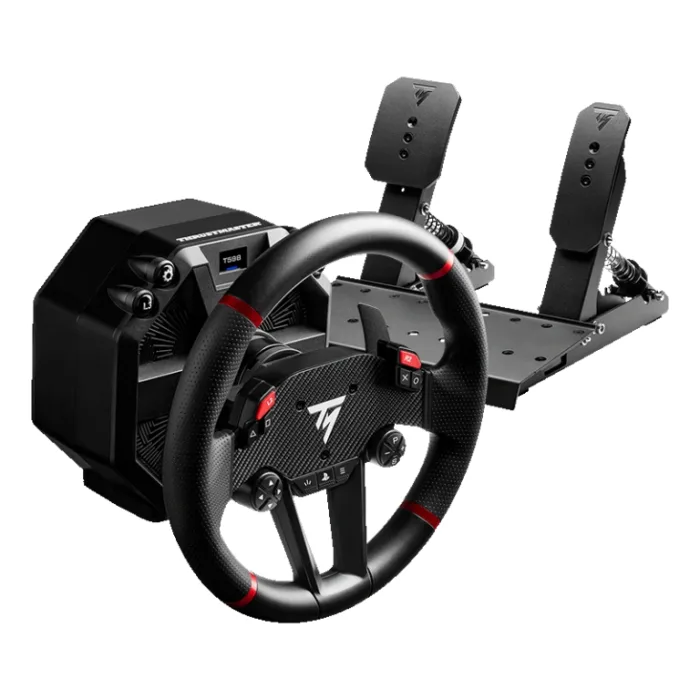
- Buy Thrustmaster T598 (PlayStation / PC) A direct drive wheel, rim and metal pedals in one box for PS5, PS4 and PC, with 5 Nm of constant torque and boosted peaks. Amazon
- Buy MOZA Racing MOZA R3 Racing Wheel and Pedals for Xbox & PC An Xbox-licensed direct drive bundle with a 3.9 Nm base, a 22-button wheel, Hall-sensor pedals and a table clamp. Amazon
- It depends Logitech G PRO Racing Wheel The strongest base here at 11 Nm, with TRUEFORCE haptics and a pro button layout, sold as wheel and base without pedals. Amazon
- It depends Fanatec CSL DD QR2 Ready2Race Bundle (5 Nm) A PC direct drive bundle that starts at 5 Nm and can be raised to 8 Nm, inside the widest upgrade ecosystem here.
- It depends Turtle Beach VelocityOne Race KD3 Racing Wheel & Pedals A compact Xbox and PC direct drive set with a color display and expansion ports, but the lowest torque of the direct drive picks. Amazon
- Skip HORI Racing Wheel APEX (SPF-004U) A licensed PlayStation wheel and pedal set at a low price, but its maker page lists no force feedback and only 270 degrees of turn. Amazon
What actually matters
- Platform license - Wheels are licensed for PlayStation or Xbox, plus PC. Buying the wrong version usually means it will not work at all on your console.
- Drive type - Direct drive puts the wheel on the motor shaft, while gear and belt designs transmit force through extra parts. Direct drive gives clearer, quicker feedback.
- Torque - Measured in newton meters (Nm), torque sets how hard the wheel can push back. More is not always better on a desk, and most players do not run at full strength.
- Pedals - A wheel is only half a setup without pedals. Check whether they are included and whether the brake can be upgraded.
- Rotation range - This is how far the wheel turns lock to lock. Wider ranges let games match the steering of different cars.
- Quick release - A quick release lets you swap rims for different car types. It also signals that the maker sells upgrade wheels.
- Mounting - A table clamp is fine to start, but stronger bases need a solid desk, stand or cockpit. Look for bottom bolt holes or T-nut rails.
The specs, in plain English
Green flags vs red flags
Green flags
- The listing names the exact console version and PC support.
- Torque is stated with how it is measured, such as peak or constant.
- Pedals with Hall-effect or magnetic sensors are included.
- A quick release rim and a published list of add-ons.
- Bottom mounting holes or rails for a stand or cockpit, plus a table clamp.
Red flags
- No mention of force feedback anywhere on the maker page.
- A narrow rotation range such as 270 degrees.
- A single torque number with no explanation, compared against rivals' peak figures.
- Pedals sold separately without the listing making that clear.
- Platform support that says 'compatible' without an official console license.
Who's who: the brands
- Thrustmaster - A long-running wheel maker with belt, hybrid and direct drive bases and a wide range of add-on rims for PlayStation, Xbox and PC.
- MOZA Racing - A direct drive specialist with low-cost bases and a growing range of wheels, pedals and accessories.
- Logitech G - The most familiar name in console wheels, now selling direct drive models with its TRUEFORCE haptics.
- Fanatec - An enthusiast brand known for its QR2 quick release and a large ecosystem of interchangeable parts.
- Turtle Beach - A gaming accessory brand whose VelocityOne line covers Xbox and PC racing and flight gear.
How to read a listing without getting fooled
Start with the platform line and make sure the exact model is licensed for your console, not just 'compatible'. Next, find the drive type and torque, and note whether the torque is peak, constant or boosted. Then read the box contents line by line: rim, base, pedals, clamp and power supply should all be listed. Finally, look for the upgrade story, such as a quick release, a third-pedal kit and compatible shifters. If a maker page leaves out force feedback or torque entirely, treat that as the answer.
How much should you spend?
Budget wheels often save money by dropping force feedback or using small gear motors, which is the trade to avoid. The mid-range tier now includes complete direct drive bundles with pedals for both PlayStation and Xbox, and that is where most buyers should shop. Premium bundles add more torque, better pedals or a deeper upgrade ecosystem. Flagship bases deliver the most torque but often ship without pedals, so budget for a pedal set on top.
Questions, answered
Do I need a cockpit or stand?
Not to start. Every wheel in our comparison includes a table clamp. A stand or cockpit becomes worthwhile when the desk flexes, the pedals slide, or you move to a higher-torque base.
Can I use a PlayStation wheel on PC?
Usually yes. Most console wheels list PC support alongside their console license, as the T598, MOZA R3 and Turtle Beach KD3 do. Check the maker page for the exact model before buying.
What does TRUEFORCE mean?
TRUEFORCE is Logitech's name for high-frequency feedback layered on top of normal force feedback. Logitech says it conveys in-game physics, road conditions and motor vibrations. It is specific to Logitech wheels and supported games.
Are three pedals better than two?
A clutch pedal matters mainly for manual-gearbox cars and some rally driving. Most modern race cars use paddle shifters, so two pedals are enough to start. A load cell brake upgrade usually improves lap times more than adding a clutch.
Or jump to the head-to-head: Thrustmaster T598 (PlayStation / PC) vs MOZA Racing MOZA R3 Racing Wheel and Pedals for Xbox & PC.