Explained
Power Conditioners and Surge Protection, Explained
After reading, you'll understand which numbers on a power conditioner listing describe real protection, which ones mean very little, and which claims nobody has ever measured.
In this guide
First-time buyers get caught out because two very different products share a shelf and a vocabulary. One is a surge protector, a safety device with a standard, a defined test waveform and published ratings behind it. The other is a power conditioner, which may include that same protection plus filtering sold on a promise about sound quality that is almost never quantified. The words on the front of the box will not reliably tell you which one you are holding, so you have to read the specification table instead.
The 30-second version
- Surge protection is measurable, and any unit worth buying publishes a clamping voltage, a surge current rating and the conductor pairs it covers.
- MOV-based protection is a consumable, because varistors lose a little voltage with every surge they absorb until they conduct continuously and fail.
- Joules are the least useful headline number, since there is no industry standard for calculating one and the figure is often a total across all three wiring combinations.
- Filtering is measurable but its audibility is not established, so treat decibel figures as real and treat lowered noise floor claims without measurements as sales copy.
- A conditioner sits in series with your amplifier, so check the breaker rating and look for high-current outlets before putting a big amplifier behind one.
The products this guide is about
Our verdict on each, with the full reasoning on the companion review.
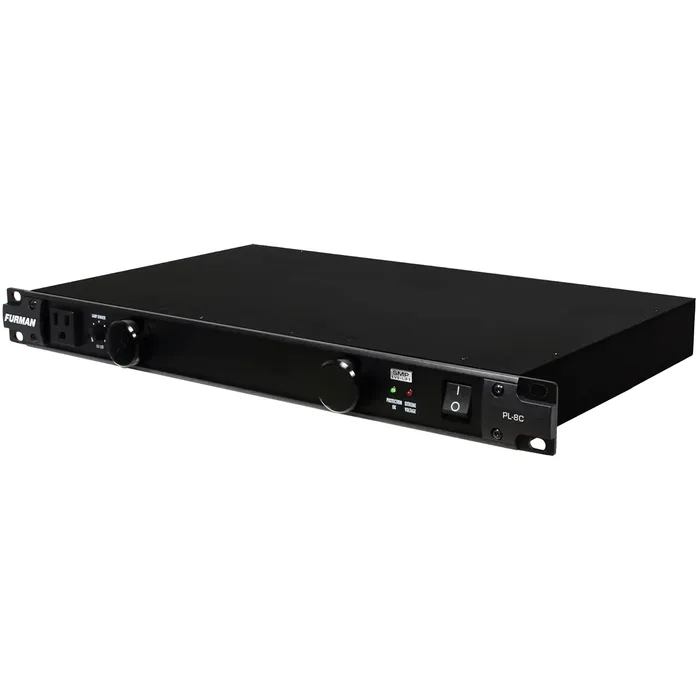
- Buy Furman Classic Series PL-8C A 1U rack conditioner that publishes a clamping voltage, a surge current rating and an attenuation curve in decibels, which is more than most of this category will tell you.
- Buy Tripp Lite by Eaton Isobar 6 Ultra (ISOBAR6ULTRA) Budget tier, network-grade surge numbers, and the only unit here whose datasheet spells out suppression on all three conductor pairs and names its UL 1449 edition. Amazon
- It depends Zero Surge 8R15W 8-Outlet Series Mode Surge Protector Series-mode protection with no metal oxide varistors at all, so there is nothing inside that quietly wears out with every surge it absorbs.
- Skip AudioQuest Niagara 1200 A premium-tier conditioner whose own specification table names technologies but publishes no surge rating, no clamping voltage and no attenuation figure at all.
What actually matters
- Clamping or let-through voltage - the peak voltage that reaches your equipment while the protector absorbs a test surge. It is the most useful protection number on a spec sheet, and 330 V is the value you see most often on consumer units because it is the lowest step on the standard ladder.
- Protection modes - which pairs of conductors are suppressed: line to neutral, line to ground and neutral to ground. Cheaper units cover the first only, which leaves two paths into your equipment untouched, though a few makers argue that diverting surge energy to ground creates its own problems in interconnected systems.
- MOV degradation - metal oxide varistors absorb surge energy by conducting, and each event permanently lowers their turn-on voltage. End of life is commonly defined at a shift of about ten percent, and repeated events stack, so a protector has a finite service life whether or not anything looks wrong.
- The protection indicator - a light or an automatic shutoff telling you the suppression circuit is spent. It matters, but the indications are not standardised between brands, so the manual is the only way to learn whether your unit cuts power on failure or keeps passing it.
- Published filter response - attenuation in decibels at named frequencies, ideally several points across a range rather than one number. A trademarked technology with no figures attached cannot be compared with anything.
- Current headroom - the breaker rating, the wattage ceiling and whether there are dedicated high-current outlets. Amplifiers draw far more on transients than their average consumption implies.
- Over-voltage shutdown - a relay that disconnects everything when the supply rises past a set threshold, usually caused by a wiring fault such as an open neutral. Sustained over-voltage destroys more equipment than lightning does.
The specs, in plain English
Green flags vs red flags
Green flags
- The specification table gives a clamping or let-through voltage and names the test surge it was measured against.
- All three protection modes are listed explicitly: line to neutral, line to ground and neutral to ground.
- There is a protection indicator, and the manual says what happens to the outlets when it changes state.
- Filter performance appears as decibels at named frequencies rather than as a trademark.
- The maker names a safety listing with an edition number and publishes the breaker rating and wattage ceiling.
Red flags
- A large joule number is the only protection figure anywhere on the listing.
- Noise reduction is described only with adjectives, or with a named technology and no measurement.
- The listing leads on response time in nanoseconds, which is not a meaningful difference between protectors.
- There is no protection indicator and no statement of what happens when the suppression circuit is used up.
- The unit is sold on sound quality at a premium tier while publishing no surge rating, no clamping voltage and no attenuation figures.
Who's who: the brands
- Furman - The professional audio and AV default, known for Series Multi-Stage Protection and for manuals that publish clamping voltages and attenuation curves instead of adjectives.
- Tripp Lite by Eaton - The Isobar line is the long-running workhorse, notable for isolated filter banks and for datasheets that spell out joules, let-through, protection modes and surge current.
- Zero Surge - A small US manufacturer that has built series-mode, non-sacrificial protectors with no metal oxide varistors since 1989.
- Panamax - A home theatre power management brand focused on rack units with over- and under-voltage protection and IP-based remote power management.
- AudioQuest - An audiophile cable and accessory brand whose Niagara conditioners are handsomely built and sold on named noise-dissipation technologies, with a published peak-current figure only on the larger models.
How to read a listing without getting fooled
Start at the bottom of the listing rather than the top. Find the specification table and look for four things in order: a clamping or let-through voltage with the test surge named, the protection modes, the breaker and wattage ratings, and any filter attenuation given in decibels at stated frequencies. If all four are present you can compare the product against anything else on the market. If the table offers a joule number and a list of trademarked technologies, you are reading marketing laid out like a specification. Then download the manual, which is usually more candid than the sales page: it will tell you what the protection indicator means, whether the unit shuts down or keeps passing power once the suppression is spent, whether it compensates for high or low line voltage, and whether the maker forbids daisy chaining. Finally, count outlets against your actual rack and check the depth, because several of these are long boxes designed to hide behind equipment rather than sit on a shelf.
How much should you spend?
At the budget tier you can already buy genuinely good surge protection: a metal housing, thousands of joules, all three protection modes, isolated filter banks, diagnostic LEDs and a lifetime warranty with connected-equipment cover. That tier is where most households should stop. The mid tier buys a rack chassis, more outlets, isolated banks, a latching over-voltage cutoff and a published clamping figure, which is a real upgrade if you own a rack rather than a shelf. The premium tier splits in two: units that spend the money on a fundamentally different protection technology and publish endurance data to justify it, and units that spend it on casework and a story about sound. Only the first kind earns the premium, and the way to tell them apart is to check whether the extra money bought you extra numbers.
Questions, answered
Is a surge protector the same thing as a power conditioner?
No, although most conditioners include one. A surge protector handles transients: brief, high-voltage events lasting microseconds. A conditioner adds filtering for continuous high-frequency noise, and sometimes voltage regulation on top of that. A plain power strip with no suppression at all does neither, and safety bodies are explicit that ordinary strips, fuses, breakers and GFCIs do not protect against surges. Look for a stated clamping voltage rather than assuming.
Does a UPS give me surge protection as well?
Usually yes, but read the specification instead of assuming the battery covers it. Many uninterruptible supplies include MOV-based suppression with its own joule rating and let-through figure, and many add automatic voltage regulation for sags and swells. What they generally do not include is the deeper multi-stage filtering found in AV conditioners. A UPS is the right answer if your problem is outages or brownouts; a conditioner is the right answer if your problem is transients and noise.
Can I plug a surge protector into another surge protector?
Do not, and not only for safety reasons. Manufacturers forbid it in writing: Zero Surge states its plug-in series may not be daisy chained with power strips, surge protectors or uninterruptible supplies. Chaining also stacks impedances and can undermine the clamping behaviour you paid for. Use one properly rated unit plugged straight into a correctly wired grounded outlet.
Is whole-house surge protection enough on its own?
It is the right first layer but not the whole answer. A panel-mounted device intercepts the large events arriving from outside, and residential surge protection has been progressively written into the electrical code since 2020. It does not address the many smaller surges generated by equipment inside the building, which industry estimates put at the majority of all surges. The usual advice is layered: protection at the panel, plus a point-of-use unit at the equipment you actually care about.
Or jump to the head-to-head: Furman Classic Series PL-8C vs Tripp Lite by Eaton Isobar 6 Ultra (ISOBAR6ULTRA).