Explained
Replacement Earpads, Explained
After reading, you'll understand why a worn pad makes a headphone sound thin, what leather, velour and perforated pads each do to the sound, and how to check that a pad actually fits your model.
In this guide
Most people buy their first replacement pads because the old ones started flaking or because their ears hurt, and they treat the choice as a comfort decision. Then the headphone sounds different and they assume something is broken. Nothing is broken. The pad is part of the acoustic system, and changing its material, thickness or seal changes what reaches your ear. The second thing that trips people up is fitment, because listings advertise long compatibility lists and some of them are one universal pad with an adapter.
The 30-second version
- Seal is the dominant variable, so a flattened or cracked pad loses bass long before anything else about the headphone fails.
- Leather seals and velour breathes, which is why swapping between them shifts the bass and treble balance rather than just the feel.
- Thickness is a tuning decision, because pad depth sets the distance from driver to ear and the volume of air trapped in front of it.
- OEM pads restore, third-party pads re-voice, and only one of those is what most people actually mean when they say upgrade.
- Universal pads with adapter rings are the trap, since they change depth, opening and seal at once on a headphone that was voiced around none of it.
The products this guide is about
Our verdict on each, with the full reasoning on the companion review.
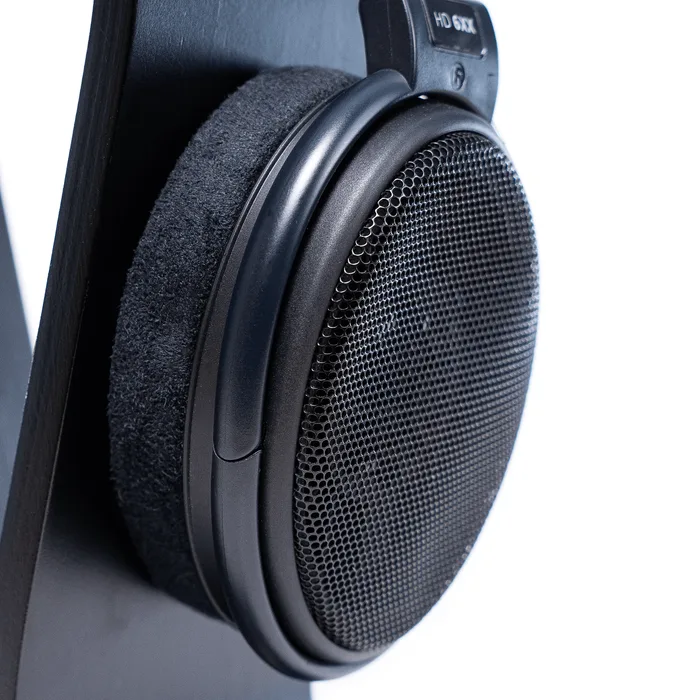
- Buy Dekoni Audio Replacement Earpads for Sennheiser HD600 / HD650 / HD6XX / HD58X / HD660S One well-supported pad platform for the whole HD600 family, with seven materials so you can pick the sound you want instead of accepting whatever ships in the box.
- Buy beyerdynamic EDT 990 VB Velour Ear Pads The genuine beyerdynamic velour pad, part number 1000893, which restores the exact material and geometry the DT 880 and DT 990 families were voiced around. Amazon
- It depends Wicked Cushions WC FreeZe V2 Cloud Cooling Gel Earpads Angled, extra-thick memory foam with a dual-layer cooling gel top for the HyperX Cloud family, aimed squarely at long sessions rather than at accuracy. Amazon
- Skip Brainwavz Sheepskin Earpads for Sennheiser HD600 / HD650 / HD660S / HD58X / HD6XX A universal oval pad bonded to a plastic adapter ring, which Brainwavz itself warns may alter the sound output of the headphone. Amazon
What actually matters
- Seal - how completely the pad closes the gap between cup and head. Without a seal the driver cannot build low-frequency pressure, which is why worn pads sound thin and why glasses arms cost you bass.
- Pad material - leather, protein leather, velour, suede, fabric or a hybrid of two. Material decides how airtight the contact surface is, and therefore how much bass survives and how prominent the treble sounds.
- Pad depth - the thickness from mounting surface to the face that touches your head. Depth sets how far your ear sits from the driver, which changes the upper midrange and the sense of space.
- Inner opening - the size and shape of the hole your ear sits in. Too small and the pad presses on your ear, which hurts and also changes the acoustics by blocking part of the driver.
- Foam type - slow-rebound memory foam versus standard polyurethane foam. Memory foam conforms and distributes clamping force, standard foam is springier and tends to hold its shape and seal longer.
- Fitment - whether the pad is designed for your exact model or is a generic shape adapted to fit. A model-specific pad matches the mounting geometry, a universal one compromises somewhere.
- OEM versus compatible - whether the manufacturer made it or a third party did. OEM parts return the headphone to its designed condition, compatible parts are a deliberate substitution with a different result.
The specs, in plain English
Green flags vs red flags
Green flags
- The seller lists your exact model number rather than only a product family name.
- Published dimensions for thickness, height and inner opening, so you can compare against your stock pads.
- The manufacturer of your headphone sells the pad itself and gives it a part number.
- Several material options for the same headphone, which shows the seller understands that material is a tuning choice.
- Clear installation instructions or a video, since some pads need the driver ring removed or a foam disc transferred.
Red flags
- The word universal, or a listing that mentions an adapter ring in the fine print.
- A compatibility list spanning many unrelated brands from one pad shape.
- Marketing that promises better sound without ever saying how the sound will change.
- No dimensions anywhere on the page, combined with claims that the pads are thicker than stock.
- A disclaimer buried in the description saying the pads may alter the sound output, on a product sold as an upgrade.
Who's who: the brands
- Dekoni Audio - Specialises in aftermarket pads across a very wide model range, and sells several materials for the same headphone so you can pick the tuning you want.
- beyerdynamic - Sells its own EDT-series pads as catalogued spare parts with part numbers, including for headphones that have been in production for decades.
- Brainwavz - Broad and inexpensive coverage of consumer and gaming headphones, with a mix of model-specific pads and universal shapes fitted using adapter rings.
- Wicked Cushions - Gaming-headset focused, known for cooling gel and thicker angled foam aimed at long sessions rather than at neutral sound.
- ZMF Headphones - Boutique maker whose pads are matched to each headphone visually and according to frequency response, accounting for pad depth, inner diameter and material.
How to read a listing without getting fooled
Start at the bottom of the listing, not the top. The marketing copy will tell you the pads are softer, cooler and better sounding; the compatibility section and the dimensions tell you whether that is plausible. Find your exact model in the fitment list, not just the family, because makers reuse names across generations and a 'series' listing may not cover yours. Then look for three numbers: thickness, outer height and width, and the inner opening. If they are absent, assume the pad is not a like-for-like match for your stock pads. Check whether an acoustic foam disc is included or whether you are expected to reuse yours. Finally, search the page for the words universal and adapter. If either appears, you are buying a generic pad that has been made to clip in, which is a mechanical solution to a mechanical problem and no solution at all to the acoustic one.
How much should you spend?
Earpads span a surprisingly wide range for such a simple object. At the budget tier you get third-party pads in fabric, PU or gel, usually with generous compatibility lists and, sometimes, adapter rings doing the heavy lifting; these are fine when comfort is the goal and the headphone was not tuned tightly in the first place. The mid-range is where manufacturer spare parts live, and it is the tier we would push most people toward, because a genuine OEM pad is the only thing that reliably returns a headphone to how it sounded new. Premium pads mean real leather, fenestrated or hybrid constructions and slow-rebound memory foam from specialists, and they make sense when you have deliberately decided to change the voicing rather than restore it. Given that pads wear out every couple of years with regular use, budget for them as a recurring cost rather than a one-off.
Questions, answered
How often should earpads be replaced?
There is no fixed interval, because it depends on how much you wear them, how much you sweat and whether the pad is fabric or a coated synthetic. Protein-leather pads on daily-use headphones commonly start flaking within a couple of years. The practical test is mechanical rather than calendar-based: press the pad and see whether it springs back, and look for cracking, bald patches or permanent dents. Treat them as a consumable, like tyres, rather than as a permanent part of the headphone.
Can I put velour pads on a headphone that shipped with leather ones?
Usually yes mechanically, if a velour version exists for your model, and the result will be a real change rather than a subtle one. Expect less deep bass because velour leaks air and cannot hold pressure the way a sealed leather face does, and expect the treble to feel more present as a consequence. You will also lose some isolation, which matters if you use the headphones anywhere noisy. Many people prefer velour anyway because it is cooler and does not peel, so it is a legitimate trade rather than a downgrade.
Do I need to worry about the foam disc behind the pad?
Yes, more than most people expect. That thin disc damps driver resonances and is part of the tuning, and several manufacturer pad sets, including beyerdynamic's EDT range, are sold without it because you are meant to reuse yours. If your old disc is compressed, torn or grey with dust, replacing the pad around it only does half the job. Check the listing for whether a disc is included before you order, and inspect the old one during the swap.
Are pads sold for a whole list of headphone models trustworthy?
Sometimes, because manufacturers genuinely do reuse the same cup geometry across a product family, and a legitimate pad for the Sennheiser HD600 will honestly fit the HD650 and HD6XX too. The warning sign is a list that crosses brands, or one where the description mentions a universal shape or an adapter ring. In that case the seller has one pad and many adapters, and the fit is mechanical rather than acoustic. Read the fine print for the word universal and treat it as a different category of product.
Or jump to the head-to-head: Dekoni Audio Replacement Earpads for Sennheiser HD600 / HD650 / HD6XX / HD58X / HD660S vs beyerdynamic EDT 990 VB Velour Ear Pads.