Explained
Speaker Isolation Pads, Explained
After reading, you'll understand what decoupling actually does, which of these specs are checkable and which are marketing, and when a pad is not the fix at all.
In this guide
First-time buyers usually arrive at this category having read that isolation pads will tighten their bass, and that framing sets them up for disappointment. What a pad reliably does is stop a vibrating cabinet from driving the desk or shelf underneath it, which is a mechanical problem with a mechanical fix. What it does not do is change the way your room behaves, and in a small room the room is usually the loudest voice in the argument. The other thing nobody mentions is that a good part of what people hear after fitting a pad is the change in angle and height, not the isolation.
The 30-second version
- Decoupling is real, and it is the one thing every product in this category genuinely does.
- Room response is not what a pad fixes, because distance from walls and corners dominates low frequency behaviour by margins no foam layer approaches.
- Height and tilt do a lot of the audible work, so a product that raises the tweeter to ear level is changing something you will notice more than the material underneath.
- Almost nobody publishes measurements, and treating a claim as evidence is how buyers end up paying premium money for adjectives.
- A load rating is only useful if the pad still has thickness left, because a compliant layer that has compressed flat has stopped isolating.
The products this guide is about
Our verdict on each, with the full reasoning on the companion review.
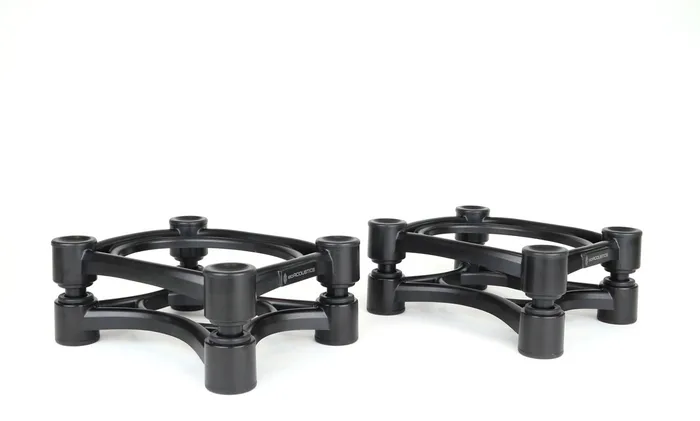
- Buy IsoAcoustics ISO-155 Isolation Stands A stand, not a pad, and the only option here that lets you set height and tilt independently. Amazon
- Buy Primacoustic IsoWedge Monitor Isolation Pads Plain high density polyurethane foam that does the decoupling job and, unusually, comes with a published spec sheet. Amazon
- It depends Auralex ProPAD Studio Monitor Isolation Pads A three layer foam, rubber, and MDF platform that trades adjustability for mass and damping. Amazon
- Skip Rockville RRS190S Studio Monitor Isolation Pads A very widely bought two-part foam wedge whose only published performance number is a load claim that does not mean much. Amazon
What actually matters
- Decoupling - This is the actual function: a compliant layer that breaks the rigid path between the speaker cabinet and the surface it rests on. Genelec's own description of its Iso-Pod stand says the isolation and damping reduce midrange coloration caused by vibration transmitted to supporting surfaces.
- Acoustic axis height - The height at which the speaker's output is designed to be measured, usually between the tweeter and the woofer on a two-way. Genelec recommends putting it at ear level, typically 1.2 to 1.4 m from the floor, which is the single geometric factor most desktop setups get wrong.
- Tilt range - How far you can angle the speaker up or down to aim it at your ears. Genelec advises staying within 15 degrees of tilt; the foam wedges in our comparison give 3 to 8 degrees and the ISO-155 up to 6.5.
- Compression under load - How far the material squashes with your speaker on it. This is the number that determines whether a pad is still working, and it is almost never published, which is why a bare weight capacity figure is close to useless on its own.
- Material and density - Whether the maker names the polymer and its density. High density polyurethane foam with a stated load limit is a real spec; high quality foam is not.
- Footprint and stability - Whether the pad supports the whole base of the cabinet. Overhang concentrates load on part of the foam, compresses it unevenly, and can leave a tall monitor rocking.
- Speaker boundary interference - The cancellation and reinforcement that happens when sound reflects off the wall behind a speaker and recombines with the direct sound. It is controlled by distance from the wall, and Genelec advises keeping that distance the same for both speakers in a stereo pair.
The specs, in plain English
Green flags vs red flags
Green flags
- The maker names the material, including polymer type and ideally a density or durometer figure.
- The stated load limit is a specific, believable number rather than a round marketing figure.
- Height and tilt are quoted as ranges with actual dimensions, not described as adjustable.
- There is a downloadable spec sheet or manual rather than only a bulleted product page.
- Any third-party certification or lab testing is named, with the testing body identified.
Red flags
- The only performance information is adjectives about clarity, focus, or soundstage.
- A large weight capacity is quoted with no density, durometer, or compression figure alongside it.
- The page uses absolutes such as eliminates vibrations, which no compliant layer achieves.
- Stated dimensions on the maker's page conflict with what retailers list.
- The product is sold as an acoustic treatment for room problems that are actually caused by speaker placement.
Who's who: the brands
- IsoAcoustics - Canadian maker of stands and isolator feet, and the one company in this category that publishes a white paper describing lab testing at a national research institute.
- Auralex - Long-established American acoustics brand whose MoPAD and ProPAD lines are among the most recognised desktop isolation products.
- Primacoustic - Canadian studio acoustics brand that publishes fuller spec sheets than most, including material, load limits, and fire ratings, across its IsoPads and Recoil Stabilizer platforms.
- Genelec - Finnish monitor manufacturer that builds decoupling Iso-Pod stands into its own speakers and publishes unusually detailed placement guidance.
- Rockville - Budget audio brand whose foam isolation pads sell in very large numbers on the strength of price and tilt options rather than published specification.
How to read a listing without getting fooled
Start at the bottom of the listing, not the top. The paragraph about clarity and soundstage is the same on every product in this category and carries no information, so skip it and look for four numbers: the height the product adds, the tilt range in degrees, the stated load limit, and the footprint. If a maker gives you all four you can work out whether the thing will fit your speaker and whether it will change your tweeter height, which are the two questions that actually matter. Then look for a named material. High density polyurethane foam is a fact; high quality foam is filler. Finally, check whether any figure is repeated consistently between the maker's page and retailer listings, because a mismatch usually means nobody at the company is treating those numbers as specifications.
How much should you spend?
The budget tier gets you foam wedges, and they are genuinely adequate at the mechanical job of decoupling a monitor from a desk. If your speakers already sit at roughly ear height, this is where most people should stop. The mid-range tier buys you construction rather than performance: mass layers, rubber tops, larger platforms, and better fit and finish, all of it useful on a resonant desk but none of it backed by published measurement. The premium tier is where you find stands with real height adjustment, and this is the only tier where you are buying a different capability rather than a nicer version of the same one. The honest way to think about it is that you should pay premium money if you need geometry, not because you expect a premium isolator material to sound better than a cheap one, because no maker has published data that would justify that expectation.
Questions, answered
Can I just use something I already own instead?
Mechanically, yes, and it is worth trying before you spend. A dense foam offcut, a folded rubber mat, or even a sturdy stack of books under a small monitor will change the coupling between speaker and desk. What you will not get is a repeatable, stable angle or a material that keeps its compliance for years. Products in this category are mostly buying you convenience, consistency, and a known load rating, not a physical principle you cannot access any other way.
Do these help my downstairs neighbour?
Somewhat, and this is the least oversold benefit in the category. Structure-borne energy travels well through floors and walls, and interrupting the rigid path between a speaker and the surface it stands on reduces how much of it gets in. If the speaker is on a desk that stands on the floor, you are only removing one link in the chain, so the effect will be partial. For serious results you would need to decouple the desk or the stand from the floor as well, which is a bigger project than a pair of foam wedges.
Should I get a pad or a proper speaker stand?
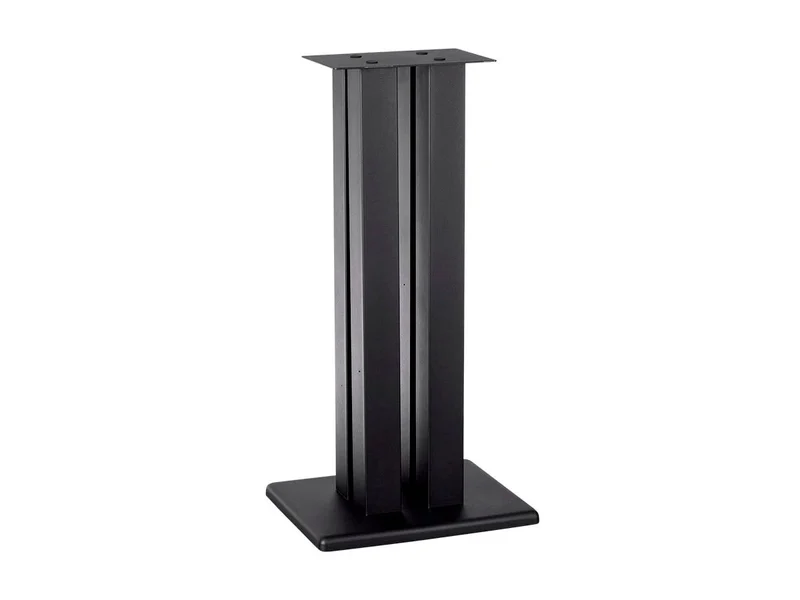
If your monitors need to come up more than a few inches, a stand is the honest answer and a pad is a compromise. Genelec's guidance puts a two-way monitor's acoustical centre at ear level, typically 1.2 to 1.4 m from the floor, and no desktop pad closes that kind of gap. Some products blur the line, and the IsoAcoustics ISO-155 reaches 8.2 in (210 mm) at its tall setting, which is enough for many desk setups. Decide by measuring the gap first.
Will isolating my monitors reduce my bass?
You may perceive less bass afterwards, and it is worth understanding why before you conclude something went wrong. Some of what you were hearing was the desk or shelf being driven by the cabinet and radiating low-mid energy of its own, which sounded like bass but was not part of the speaker's output. Removing it usually reads as tighter and less boomy rather than thinner. No maker in this comparison publishes measurements of the change, so treat any specific claim about bass extension with caution.
Or jump to the head-to-head: IsoAcoustics ISO-155 Isolation Stands vs Primacoustic IsoWedge Monitor Isolation Pads.