Explained
Stylus Cleaners, Explained
After reading, you'll understand why direction and chemistry decide everything about a stylus cleaner, and how to check what your own cartridge maker permits before you buy one.
In this guide
Almost nobody buying a first stylus cleaner realises the product is optional but the technique is not. The delicate part is not the diamond, which is very hard, but the thin tube it sits on and the rubber suspension that tube passes into. Most cleaning damage comes from pushing that tube sideways, or from liquid creeping back along it into the cartridge. Once you know those two failure modes, the whole category sorts itself out quickly.
The 30-second version
- Brush back to front, from the rear of the cartridge toward the tip, which is the direction the record moves under the needle.
- Never brush sideways, because lateral force is what bends a cantilever or breaks the diamond off it.
- Fluid is a maker-specific question, since Ortofon forbids solvents outright while Audio-Technica sells a water and ethanol cleaner of its own.
- Use as little liquid as possible, because fluid that wicks up the cantilever into the suspension is the failure you cannot reverse.
- Clean records do most of the work, so a record brush earns its keep faster than any stylus product you can buy.
The products this guide is about
Our verdict on each, with the full reasoning on the companion review.
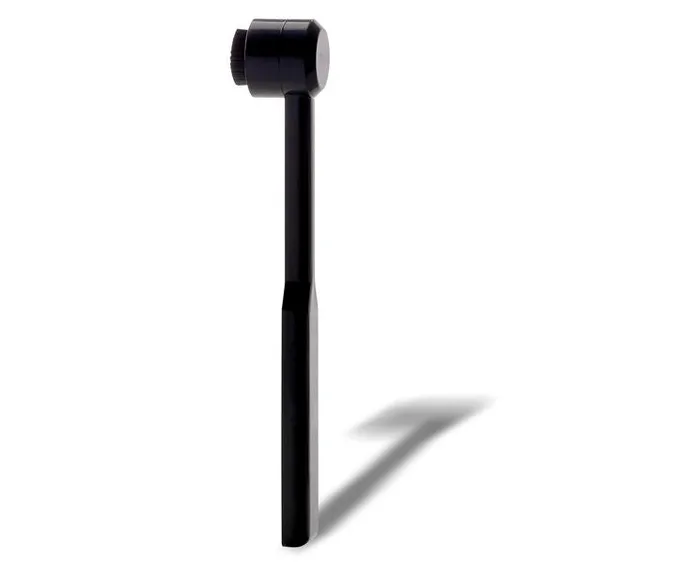
- Buy Ortofon Stylus Brush, Fiber The dry fibre brush a major cartridge maker tells its own customers to use, with the technique spelled out in its own FAQ. Amazon
- Buy Flux-Hifi FLUX-Sonic A battery powered pad that vibrates the dirt off the tip, so there is no brushing stroke to get wrong.
- It depends The LAST Factory LAST Stylus Cleaner A long-standing fluid and cap brush that dissolves what a dry brush leaves behind, if your cartridge maker allows fluid at all. Amazon
- Skip Onzow Zerodust The famous gel blob, and the one product in this group that a cartridge manufacturer names in print as something it does not recommend. Amazon
What actually matters
- Direction of travel - a stylus brush should move the way the record moves, from the rear of the cartridge toward the tip. Ortofon states the rule and both prohibitions in its FAQ, and The LAST Factory tells you to always brush from back to front.
- Stylus cement - many cartridges bond the diamond to the cantilever with adhesive rather than forming both from one piece. Ortofon warns that solvents used on the stylus and cantilever may damage stylus cement, which is why the fluid question is not fussiness.
- Wicking into the cartridge - liquid follows the cantilever tube back toward the body by capillary action. Ortofon says interior parts of the cartridge can be affected seriously by the intrusion of solvents, and that is the failure that ends a cartridge outright.
- Warranty position - Ortofon states its warranty service will not be valid where solvent treatment has caused a malfunction, so the chemistry choice has a financial consequence and not only a technical one.
- Applicator design - a brush mounted in the bottle cap meters a trace of fluid onto the tip. Anything that lets you deposit a drop invites the exact excess that causes wicking.
- Pad geometry - a shallow firm polymer pad contacts the tip and releases it, while a deep tacky mound holds it for the moment you are lifting out. DS Audio makes the point directly, saying its ST-50 cleans at the tracking force already set on the tonearm.
- Record hygiene - the stylus only picks up what is in the groove. Ortofon says cleaning records before every use increases the lifetime of the diamond, so upstream cleaning beats downstream cleaning.
The specs, in plain English
Green flags vs red flags
Green flags
- The maker publishes the cleaning stroke, and it says to sweep from the rear of the cartridge toward the stylus tip.
- A fluid product names its ingredients on the label or files a public safety data sheet you can read.
- The maker addresses adhesives and suspension explicitly rather than only claiming the product is gentle.
- The applicator is a cap-mounted brush or a pad, not anything that puts a drop of liquid on the assembly.
- The product is sold by a company that also makes cartridges or has been in the record care business long enough to publish real instructions.
Red flags
- The listing says to wipe or clean the stylus with no mention of direction at all.
- A fluid with no stated composition and no safety data sheet anywhere on the maker's site.
- Any instruction to remove the stylus assembly for cleaning when the product does not require it.
- Marketing that promises compatibility with all cartridges when cartridge makers themselves publish conflicting guidance.
- A gel deep enough that the tip visibly sinks in, especially if there is no note about keeping the platter still.
Who's who: the brands
- Ortofon - Danish cartridge maker with the most explicit published stylus care guidance of the group, including the direction rule, a blanket position against solvents and gels, and a named warning about one popular gel cleaner.
- Audio-Technica - Sells both a stylus fluid, the AT607a, whose ingredients it lists as deionized water and ethyl alcohol, and a polyurethane gel pad, the AT617a, so its customers have a maker-sanctioned wet option.
- The LAST Factory - Long-running American record care company whose stylus cleaner comes with a cap brush, back-to-front brushing guidance and a published safety data sheet.
- Flux-Hifi - German maker of the powered FLUX-Sonic stylus cleaner, one of the few accessory brands that publishes oscillation frequency and amplitude figures rather than adjectives.
- DS Audio - Japanese optical cartridge specialist whose ST-50 pad uses a urethane gel developed for clean-room dust control and is designed to clean at the tonearm's existing tracking force.
How to read a listing without getting fooled
Read a stylus cleaner listing in two passes. First look for the verb and the direction: a maker that has thought about your cartridge will tell you to sweep from the rear of the cartridge toward the tip, and a listing that just says clean or wipe has told you nothing. Second, if there is liquid involved, look for composition and a compatibility statement. Named ingredients, a downloadable safety data sheet, or an explicit line about adhesives and suspension all count. Vague reassurance does not. Ignore claims about restored detail and improved soundstage, which are unfalsifiable and identical across every product in the category. Then do the step nobody mentions: open your own cartridge maker's care page. That single page overrides every accessory listing, because it is the document that decides both what is safe for your cartridge and what your warranty still covers afterwards.
How much should you spend?
This is a category where the budget tier is genuinely the recommended tier. A dry fibre brush from a cartridge manufacturer sits at the budget end and is the item most people should own, because it is the method those manufacturers publish for their own products. Fluid cleaners and gel pads occupy the mid-range, and the money there buys chemistry or a washable polymer surface rather than better cleaning, which is why the maker's compatibility statement matters more than the tier. Powered cleaners are the premium tier and are worth considering only if you play a lot of records, own a cartridge expensive enough to justify it, and have confirmed your maker permits fluid. Spending more does not reduce risk here. Reading the care page does.
Questions, answered
Can I use a magic eraser or a plain melamine sponge on my stylus?
We would not, and no cartridge manufacturer in this comparison suggests it. Melamine foam works by fine abrasion, which is the opposite of what you want against a polished diamond and a thin cantilever. None of the makers that publish stylus care guidance list it as an approved method. Stick to what the maker of your cartridge actually names.
Should I clean the stylus before playing or after?
Both, if you follow the strictest published guidance. Ortofon asks owners to remove dust from the diamond before and after playback of each record, and to brush whenever they play a new record or change sides. The LAST Factory takes a lighter view for its fluid, suggesting cleaning at the end of a session or when debris is visible rather than before every play. A dry brush pass costs a few seconds, so making it part of putting the record on is the easy habit.
Is a powered cleaner actually ultrasonic?
Usually not, despite how the category is described. Flux-Hifi publishes a working frequency of 210 Hz for the FLUX-Sonic, which is a low audio frequency and nowhere near ultrasound. That is a deliberate design choice rather than a shortcoming, since the company states the small amplitudes involved are what protect an assembly sitting inside a magnetic coil. Treat ultrasonic in accessory marketing as a loose label and look for the published figures instead.
What do I do if I think I have already bent the cantilever?
Stop playing records with it. A bent cantilever changes the angle at which the diamond meets the groove, which means it can wear your records as well as sounding wrong. Look at the cartridge from the front and from the side under good light, or through the magnifier on a stylus cleaner lid if yours has one. If it is a replaceable stylus assembly, fit a new one. If it is a moving coil, contact the manufacturer about a repair or exchange programme rather than trying to straighten anything yourself.
Or jump to the head-to-head: Ortofon Stylus Brush, Fiber vs Flux-Hifi FLUX-Sonic.