Explained
Vinyl Record Storage, Explained
After reading, you'll understand what a shelf load rating actually means for a wall of vinyl, why divider spacing matters more than capacity, and how to tell a real record storage spec sheet from a decorated guess.
In this guide
First time buyers usually shop on how many records a unit claims to hold, which is the least reliable number on the page. Capacity claims rarely say whether they assume bare paper sleeves or sleeved records, and they almost never come with a weight rating. Meanwhile the two specs that decide whether your records stay flat, divider spacing and shelf load, are missing from most listings entirely. Learn to read those and the category gets a lot smaller and a lot clearer.
The 30-second version
- Upright and supported, not stacked flat and not leaning, is the whole preservation rule in one line.
- Records are dense, and the Library of Congress puts grooved discs at 35 or more pounds per shelf foot.
- A capacity in LPs is not a spec, unless the maker also says what sleeving it assumes.
- Dividers beat capacity, because a half empty undivided shelf is where the leaning damage happens.
- Tall plus heavy plus front loaded, means anchoring is part of the purchase, not an optional accessory.
The products this guide is about
Our verdict on each, with the full reasoning on the companion review.
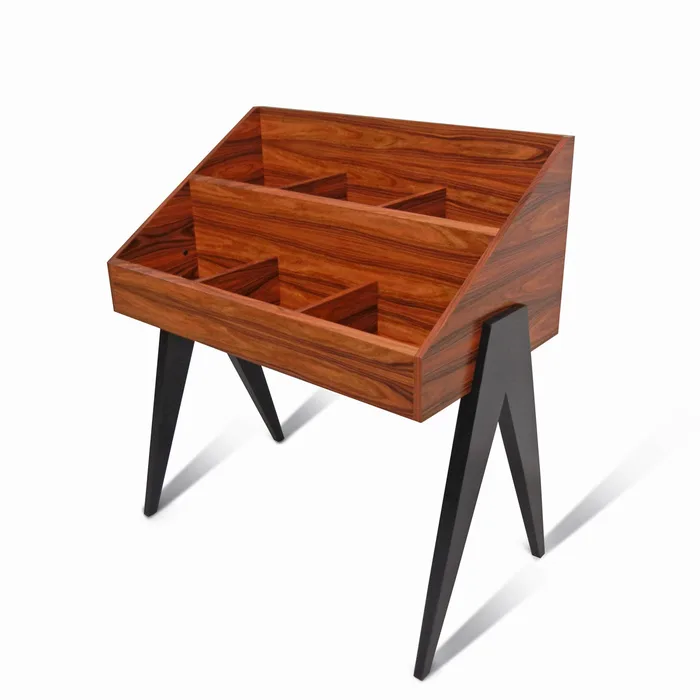
- Buy Atocha Design Record Stand A purpose built six bin record stand with published per bin capacity and a plywood core chosen for the load.
- Buy IKEA KALLAX Shelving Unit, 77x147 cm The cube shelf the whole hobby defaults to, for good geometric reasons, with one load figure you should know about. Amazon
- It depends Line Phono Turntable Stand + Vinyl Record Storage Turntable, gear shelf and 200 records in a footprint smaller than a nightstand, with the best published load rating in this group.
- Skip Crosley Vinyl Record Storage Crate A good looking carrying box that a lot of people mistakenly buy in multiples as a storage system. Amazon
What actually matters
- Orientation - The Library of Congress says to store all formats upright, with discs on edge. Flat stacks press the bottom records and produce warping and ring wear over time.
- Divider spacing - The same guidance calls for sturdy, immovable dividers every 4 to 6 inches that support the entire face of the disc in its sleeve. Wide open bins let records lean, and a leaning record eventually takes that shape.
- Shelf load rating - This is the number that separates furniture that will sag from furniture that will not. Compare it against the weight of the load you actually intend to put on it, not the load you imagine.
- Clear internal width - A 12 inch record in its jacket needs more than 12 inches of clear space, plus a little more for fingers. Nominal cube sizes and actual openings are not the same thing.
- Sleeving - Outer poly sleeves and thicker inner sleeves add width to every record. A collection in outers takes up noticeably more linear space than the same collection bare.
- Shelf construction - A plywood or solid wood core resists a concentrated centre load far better than particleboard with honeycomb paper filling. Sag does not reverse once it appears.
- Stability - Loaded record storage is heavy and the weight sits forward. Anything tall needs to be anchored to the wall, and makers who say so are giving you real information.
The specs, in plain English
Green flags vs red flags
Green flags
- The maker publishes a weight rating per shelf, not just a capacity in albums.
- Fixed dividers or bins, with a stated capacity per bin rather than one number for the whole unit.
- Internal dimensions listed separately from external dimensions.
- A plywood, solid wood or 13 ply core named explicitly in the materials list.
- Clear anchoring instructions and hardware, or a low wide design that does not need them.
Red flags
- A big LP capacity headline with no weight rating and no internal dimensions anywhere on the page.
- Adjustable or removable dividers with no stated way to lock them in position.
- Openings described only as roughly 12 inches, or dimensions given for the outside only.
- Deep shelves with long unsupported spans and a particleboard build.
- No mention of anchoring on a tall unit that is obviously going to be loaded with something heavy.
Who's who: the brands
- Atocha Design - Made to order record cabinets and stands built in upstate New York, with published per drawer and per bin LP capacities.
- Symbol Audio - High end audio and vinyl furniture, from a hand made Dovetail record crate rated for up to 75 LPs through to large LP storage cabinets.
- Line Phono - US made turntable stands that combine a gear shelf with record storage and publish a per shelf weight capacity.
- Way Basics - Tool free record cubes and shelves built from their zBoard recycled paperboard, with a recommended maximum load of 30 to 50 pounds depending on the unit.
- IKEA - The KALLAX cube system is the default record wall for most collectors, thanks to 33 cm openings and a large accessory range.
How to read a listing without getting fooled
Start at the bottom of the listing, not the top. Find the weight and measurements block and look for two things: a max load per shelf, and internal rather than external dimensions. If the load rating is missing, the maker either has not tested it or does not want to publish it, and both are worth knowing. Next, work out the linear space. Multiply the number of shelf feet by 35 pounds and compare that to the rating; if your answer is bigger, the unit is not designed for a solid wall of vinyl even if the marketing photo shows one. Then check divider spacing against the 4 to 6 inch guidance and decide whether you will need filler blocks. Finally, look at what the capacity claim assumes. A number quoted without any mention of sleeves is almost certainly a bare paper sleeve count, so knock a chunk off if you sleeve your records.
How much should you spend?
Budget tier buys you crates and light cube shelving, which is fine for a small collection or as a carrying box, but this is where you find no load ratings, no dividers and paper based cores. Mid range is where the category gets sensible: purpose built stands and turntable furniture that publish a weight capacity, use plywood or 13 ply construction, and give you at least some internal structure. Premium is made to order hardwood and plywood furniture with fixed bins, published per bin capacities and finishes designed to live in a room rather than a corner. The honest advice is that the jump from budget to mid range buys you more protection for your records than the jump from mid range to premium does; the premium tier mostly buys you materials, craft and the pleasure of using it.
Questions, answered
Why does a 12 inch record need more than 12 inches of space?
The 12 inch figure describes the disc, not the package. The jacket is larger than the disc, and if you use an outer sleeve it is larger again. Then you need clearance to get your fingers in and lift a record out without dragging its neighbours. Treat any opening close to 12 inches as unusable and look for the internal dimension, not the external one.
Is MDF or particleboard actually a problem for records?
It is not a chemical problem, it is a structural one. Records concentrate weight along the centre of a shelf, and the Library of Congress warns that this can cause some shelving to collapse. Dense MDF used in short spans, as in a small turntable stand, is generally fine. Particleboard with paper filling over a long unsupported span, loaded with vinyl, is where sag shows up, and sag does not reverse.
How do I stop the last few records in a row from leaning?
Fill the gap. A wooden block, a purpose made bin divider or a stack of empty jackets behind the last record keeps the row vertical. This is why the Library of Congress asks for dividers every 4 to 6 inches: shorter runs simply cannot lean far. If you buy a unit with wide bins, plan on some kind of filler from day one rather than waiting until you notice a curved album.
Is a crate ever the right answer?
Yes, for carrying. A crate with handles is the easiest way to take a selection of records to a friend's house, a gig or a shop. The trouble starts when crates become the storage plan, because they have no dividers, they get stacked, and stacking makes everything below the top crate effectively invisible. One crate alongside a proper shelf is a good setup. Four crates on the floor is not.
Or jump to the head-to-head: Atocha Design Record Stand vs IKEA KALLAX Shelving Unit, 77x147 cm.