Explained
Turntable Cartridges, Explained
After reading this you will know whether a cartridge will physically fit your arm, electrically work with your phono input, and what it will cost you over the years you own it.
In this guide
A phono cartridge is the small device on the end of your tonearm that turns groove wiggles into an electrical signal. Most of buying one is not a sound quality decision at all: it is a compatibility decision wearing a sound quality costume. The two things that trip up first time buyers are plugging a low output moving coil cartridge into a phono input that cannot amplify it, and treating the stylus as a permanent part rather than a consumable that quietly grinds your records once it wears.
The 30-second version
- Check your phono stage before anything else. Moving magnet cartridges have high output and work with any phono input; low output moving coil cartridges need a dedicated MC setting or a step up transformer, and without one they sound thin, quiet and hissy.
- Mount type decides whether it fits. Nearly every modern tonearm uses half inch standard mount with two screws through a headshell, but some older and budget decks use P-mount (T4P), which plugs straight in and is not interchangeable without an adapter.
- Stylus profile is the real performance ladder. Conical sits at the bottom, elliptical is the sensible middle, and line contact profiles such as microlinear and Shibata sit at the top, with nude versions beating bonded ones at the same nominal shape.
- A worn stylus damages records. This is the cost almost nobody counts: by the time a tip sounds obviously dull it has already been reshaping groove walls, and replacing a record collection costs vastly more than replacing a stylus on schedule.
- User replaceable styli change the long run maths. On most moving magnet cartridges the stylus pulls off and a new one pushes on with no tools and no realignment, which makes an inexpensive body a smart foundation; moving coil cartridges usually need a factory rebuild instead.
The products this guide is about
Our verdict on each, with the full reasoning on the companion review.
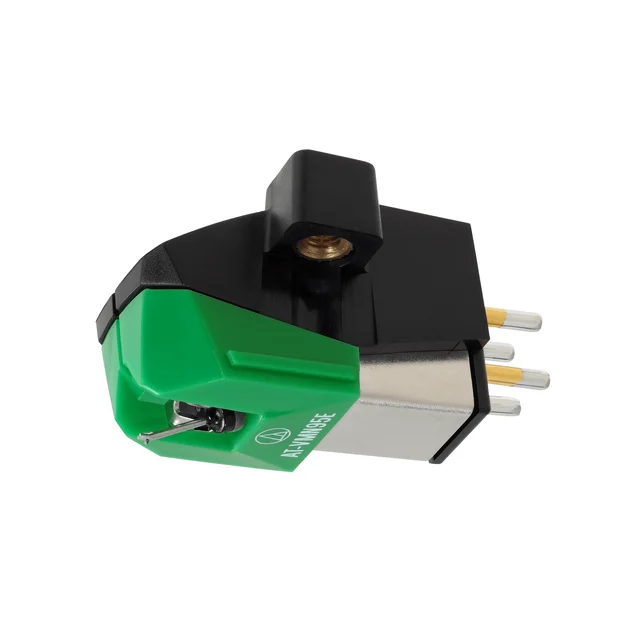
- Buy Audio-Technica AT-VM95E The lowest friction real upgrade in vinyl: it fits everything, works with any phono input, and its whole stylus ladder drops into the same body. Amazon
- Buy Ortofon 2M Blue A nude elliptical stylus on a proven moving magnet body, and it drops straight onto the 2M Red your turntable probably shipped with. Amazon
- It depends Hana EL A genuinely lovely low output moving coil that does nothing useful unless your phono stage has a real moving coil input. Amazon
- Skip Ortofon 2M Red A perfectly decent cartridge sold as an upgrade to people who already have it fitted to their turntable. Amazon
What actually matters
- Moving magnet versus moving coil. This is the fork in the road. Moving magnet (MM) cartridges put out a strong signal that any phono input can handle. Low output moving coil (MC) cartridges put out a fraction of that and need a phono stage with a genuine MC setting or a step up transformer. Get this wrong and the cartridge does not sound bad, it barely works. High output moving coil designs exist specifically to sidestep the problem.
- Mount type. Half inch standard mount (also written as two screw mount) is what almost all modern tonearms use, and it requires alignment with a protractor. P-mount, also called T4P, plugs directly into the arm and comes pre aligned, which is simpler but drastically narrows your choices. Confirm which arm you have before you shop, not after the box arrives.
- Stylus profile. The shape of the diamond decides how much of the groove wall it can follow. A conical tip rides high and struggles with the tightly packed grooves near the label. Elliptical follows the wall more closely. Line contact profiles such as microlinear and Shibata contact a longer stretch of wall again, improving high frequency retrieval and spreading wear over more surface. The catch is that better profiles are less forgiving of sloppy setup.
- Nude versus bonded. At the same nominal profile, a nude diamond (solid, shaped from one piece) has lower tip mass than a bonded one (a small diamond glued to a metal shank), so it tracks more accurately. A nude elliptical usually outperforms a bonded elliptical noticeably, which is why the jump between two cartridges described identically on paper can be real.
- Is the stylus user replaceable? On most moving magnet cartridges it is, and that changes ownership economics completely: wear becomes a cheap two minute part swap instead of a whole new cartridge. Some ranges go further and let you fit better profiles to the same body, so your upgrade path costs a stylus rather than a cartridge. Moving coil cartridges generally require a factory rebuild or trade in.
- Weight, body height and compliance. Your tonearm has a usable cartridge weight range, and a tall body can throw off arm height enough to need a headshell spacer. Compliance describes how springy the suspension is and how well it pairs with your arm's effective mass. Both figures are in the manuals, and both cause more setup misery than they should.
- Tracking force and alignment. Every cartridge has a manufacturer recommended tracking force, and it is not a suggestion. Too light mistracks and damages records faster than slightly too heavy. A cheap digital stylus scale and a printed alignment protractor are worth more than a cartridge upgrade if you currently own neither.
The specs, in plain English
Green flags vs red flags
Green flags
- The listing states the type clearly as moving magnet, high output moving coil or low output moving coil, and quotes an output voltage you can check against your phono input.
- Mount type is stated plainly as half inch standard or P-mount, and mounting hardware is included in the box.
- The stylus is user replaceable, and replacement styli for that body are widely stocked rather than a special order.
- The same body accepts better stylus profiles, so your next upgrade is a part rather than a whole new cartridge.
- Manufacturer specs list recommended tracking force, cartridge weight and body height, which means you can check arm compatibility before buying.
- The brand has been making the range long enough that stylus supply is likely to outlive your interest in it.
Red flags
- A seller pushes a low output moving coil cartridge without asking what phono stage you own.
- The stylus profile is described only as diamond or precision, with no mention of conical, elliptical or line contact.
- No replacement stylus appears to be sold separately, which means wear costs you the entire cartridge.
- The cartridge is the one already fitted to your turntable from the factory, sold to you again as an upgrade.
- Unbranded or generic replacement styli with vague compatibility claims, where tip quality and fit are a lottery.
- Listings that lead with exotic materials and marketing adjectives while omitting output, mount type and recommended tracking force.
Who's who: the brands
- Audio-Technica - The default recommendation at the affordable end, known for bodies that accept a whole ladder of stylus profiles, so upgrades cost a stylus rather than a cartridge.
- Ortofon - Danish maker whose 2M Red is a common factory fit, with a colour coded moving magnet range where styli swap between bodies; the current bodies are sold as the 2MR series.
- Hana - Japanese specialist in moving coil cartridges praised for natural, coherent presentation, but only worth it if you already have moving coil capable amplification.
- Nagaoka - Long running Japanese cartridge maker whose MP series is a common alternative at the affordable end, often described as warm and forgiving.
- Goldring - British brand covering both moving magnet and moving coil ranges, generally offering conventional half inch fitting and straightforward stylus availability.
- Shure and Grado - Two names you will meet in used listings and older systems; check current stylus availability carefully before buying into either, because supply varies by model.
How to read a listing without getting fooled
Read a cartridge listing in a fixed order and most of the marketing falls away. First, type and output: is it moving magnet, high output moving coil or low output moving coil, and does the quoted output suit the phono input you actually own? If a listing hides this, that is a decision. Second, mount: half inch standard or P-mount, and are the screws included? Third, stylus profile, and specifically whether it says nude or bonded, because those two words separate cartridges that otherwise read identically. Fourth, whether the stylus is user replaceable and whether better styli fit the same body, which tells you the shape of your next few years rather than your next week. Fifth, the boring numbers: recommended tracking force, cartridge weight and body height, checked against your tonearm's manual. Only then read the descriptive copy, and discount anything about airy highs or holographic imaging, since those descriptions were written under conditions you will not replicate. Independent testing and owner reports agree far more about tracking behaviour and setup fussiness than they do about tone, so weight the practical findings higher.
How much should you spend?
Spending more buys you three things in rough order: a better stylus profile, a lighter and stiffer cantilever, and tighter manufacturing tolerances. The profile is where most of the audible gain lives, which is why the value sweet spot sits at the first cartridge with a genuine nude elliptical stylus rather than a bonded one. Below that, you are mostly paying for a shape that cannot follow the groove properly. Above it, gains get smaller and demands get larger: line contact profiles reward careful alignment and punish sloppy setup, so the money only pays off if you also own a stylus scale and a protractor and will use them. The bigger economic question is not the sticker at all, it is whether the stylus is user replaceable. A modestly priced moving magnet body that accepts better styli can be upgraded twice over the years for the cost of parts, while a sealed moving coil means a factory rebuild every time the tip wears. Two other rules of proportion: do not spend more on a cartridge than the tonearm can resolve, and do not buy a low output moving coil if making it work means also buying a phono stage, because that combined outlay buys a better outcome spent elsewhere. Finally, budget for the stylus as a recurring cost from day one, not as a surprise.
Questions, answered
How do I tell whether my phono stage will work with a moving coil cartridge?
Look for an MM/MC switch, an input labelled MC, or gain and loading settings in the manual. If your phono input is a single unlabelled pair of RCA sockets marked PHONO, or your turntable has a built in preamp with a line level output, assume moving magnet only. A low output moving coil plugged into a moving magnet input sounds quiet, thin and hissy, and that is a gain mismatch rather than a faulty cartridge. If you want moving coil sound without new electronics, high output moving coil designs exist for exactly that reason.
How often should I replace the stylus, and what happens if I do not?
Manufacturers quote a life in playing hours, and the figure varies with stylus profile and tracking force. Track your hours roughly rather than waiting for the sound to degrade, because by the time a worn tip sounds obviously dull it has already been reshaping groove walls. That is the cost people fail to count: a stylus is cheap and replaceable, a damaged record is neither. Keeping records clean and setting tracking force accurately both extend stylus life meaningfully.
Can I just replace the stylus instead of buying a whole new cartridge?
On most moving magnet cartridges, yes, and it changes the long run maths considerably. The stylus assembly pulls off the front of the body and a new one pushes on, with no tools and no realignment. Some ranges go further and let you fit better profiles to the same body, so an inexpensive body becomes a long term foundation. Moving coil cartridges generally do not work this way and need a factory rebuild or trade in, which is worth pricing before you buy one, not after.
Is a better stylus profile genuinely worth it, or is it marketing?
It is real and it shows up in tracking behaviour. A conical tip sits high in the groove and struggles with the tightly packed modulation near the label. An elliptical follows the groove wall more closely. Line contact profiles such as microlinear and Shibata contact a longer section of wall again, which improves high frequency retrieval and spreads wear over more surface. Nude versions beat bonded ones at the same nominal profile because a solid diamond has lower tip mass. The catch is that better profiles are less forgiving of sloppy alignment, so the gain only appears if you set the cartridge up properly.
Do I need a protractor and a stylus scale, or can I eyeball it?
If you are fitting a half inch mount cartridge, you need both, and they are inexpensive. Alignment sets the cartridge angle and position so the stylus sits correctly in the groove across the record, and tracking force sets how hard it presses. Guessing at either gives you distortion that sounds like a bad cartridge and wear that behaves like a bad decision. P-mount cartridges are pre aligned, so they are the exception. If you are buying your first cartridge and own neither tool, buy the tools first.
My turntable came with a cartridge already fitted. Should I upgrade it?
Check exactly which model is on the arm before you buy anything. A surprising number of upgrade purchases are the same cartridge the turntable shipped with, which means paying twice for the same performance. If the factory cartridge belongs to a range where better styli fit the same body, the genuine upgrade is usually a stylus rather than a cartridge, and it takes two minutes with no realignment. If it is an unbranded conical cartridge, replacing the whole thing with a body that opens a proper stylus ladder is the better foundation.
Or jump to the head-to-head: Audio-Technica AT-VM95E vs Ortofon 2M Blue.