Explained
Turntables, Explained
After reading, you will understand the handful of parts that decide whether a turntable sounds good and treats your records kindly, and how to read a spec sheet without being fooled.
In this guide
A turntable is one of the few gadgets where the cheap option can actively cost you money, because a badly designed deck slowly wears out the records you play on it. Most of the marketing talks about looks and Bluetooth, but the parts that actually matter, the cartridge, the tonearm, and how the deck controls tracking force, rarely make the headline. This guide decodes those terms so you can tell a real record player from a decorative one.
The 30-second version
- Record safety comes first. A deck with an adjustable counterweight and anti-skate sets the stylus down at the right pressure, while a fixed heavy-tracking suitcase player grinds your grooves a little more with every spin.
- The cartridge is the part that touches the music. A moving-magnet cartridge you can swap later lets a modest deck grow with you, whereas a bonded ceramic cartridge is a dead end.
- Belt and direct drive both work. Belt drive isolates motor noise for quiet home listening; direct drive reaches speed instantly and holds it, which suits hand cueing.
- A built-in preamp saves money and clutter. A switchable phono preamp lets the deck plug into any input now and route through a better external stage later.
- Bluetooth and USB are conveniences, not quality. They matter only if you actually plan to digitize records or stream, and they say nothing about how the deck sounds.
The products this guide is about
Our verdict on each, with the full reasoning on the companion review.
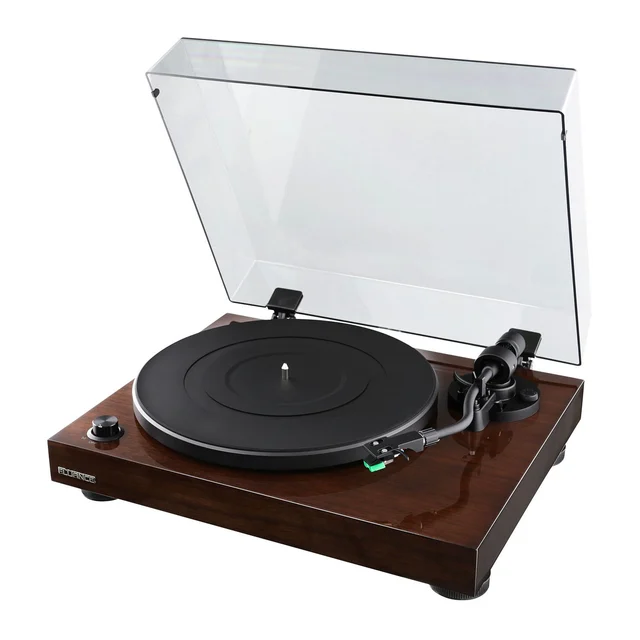
- Buy Fluance RT81 A belt-drive deck that spends its budget on the parts that shape sound rather than on gadgets. Amazon
- Buy Audio-Technica AT-LP120XUSB A direct-drive workhorse with a switchable preamp and USB out for people who want to do more than listen. Amazon
- Buy Pro-Ject Debut EVO 2 The step-up pick, with a carbon tonearm and an Ortofon-built cartridge aimed at sound quality over features. Amazon
- Skip Crosley Cruiser Plus A charming suitcase player with no adjustable counterweight or anti-skate, so tracking force cannot be set for record care. Amazon
What actually matters
- Tracking-force control decides how hard the stylus presses into the groove; an adjustable counterweight plus anti-skate is the single feature that separates decks that preserve records from ones that wear them.
- Cartridge type and mount shape the sound and your upgrade path; a standard-mount moving-magnet cartridge can be improved later, while a bonded ceramic one cannot.
- Drive type affects noise and behavior; belt drive keeps motor vibration away from the platter, direct drive gives instant, steady speed.
- Tonearm quality governs how faithfully the stylus tracks the groove; a well-balanced arm reduces distortion and wear, a stiff, light material helps at the higher end.
- Preamp (phono stage) is required to make a turntable loud enough for normal inputs; whether it is built in decides how much extra gear you need.
- Plinth mass and isolation damp vibration; a heavier base keeps footsteps and speaker energy from reaching the needle and causing skips.
- Speed support matters only to your collection; 33 and 45 cover almost everything, and 78 RPM is relevant only if you own older shellac records.
The specs, in plain English
Green flags vs red flags
Green flags
- An adjustable counterweight and anti-skate you can set yourself
- A standard-mount moving-magnet cartridge with an elliptical stylus you can upgrade
- A switchable built-in preamp, so it connects to any input and can be bypassed later
- A heavy plinth and platter that damp vibration and resist skipping
- Clear mention of belt or direct drive rather than vague 'audiophile' claims
Red flags
- A ceramic cartridge, especially one described as bonded or non-removable
- No counterweight or anti-skate, with a fixed heavy tracking force
- Built-in speakers inches from the platter, which can vibrate the needle into skipping
- Marketing that leads with looks, colors, or Bluetooth but never mentions the cartridge or tonearm
- A suitcase or all-in-one design pitched as good for a growing record collection
Who's who: the brands
- Fluance - Value-focused belt-drive decks that spend their budget on cartridge and tracking rather than gadgets.
- Audio-Technica - Makes both well-regarded cartridges and versatile direct-drive decks, often with USB output.
- Pro-Ject - Austrian specialist in step-up belt-drive turntables aimed at sound quality, frequently paired with Ortofon cartridges.
- Ortofon - A long-established cartridge maker; its pickups appear on many quality decks and as popular upgrades.
- Crosley - Known for inexpensive, colorful suitcase players that look appealing but lack an adjustable counterweight or anti-skate.
How to read a listing without getting fooled
Read a turntable listing from the stylus outward, not from the features box inward. First find the cartridge: if it says moving magnet with an elliptical stylus and the words 'upgradeable' or 'standard mount', that is a good sign; if it says ceramic, or the cartridge is not named at all, treat the deck as decorative. Next confirm there is an adjustable counterweight and anti-skate, because without them you cannot set a safe tracking force. Only then look at drive type, and do not be swayed by 'direct drive' or 'belt drive' alone, since both are fine when the rest of the deck is well made. Finally, check whether a preamp is built in and switchable, and treat USB, Bluetooth, and speaker features as extras that matter only if you specifically need them. Glossy photos, color choices, and vague words like 'high fidelity' tell you nothing; the parts list tells you everything.
How much should you spend?
Spend enough to clear the line between a real record player and a toy, and that line is defined by parts, not looks. The cheapest all-in-one suitcase players are the false economy here, because their fixed heavy tracking wears the records you buy, so their true cost climbs every time you listen. The value sweet spot sits at the entry level of proper belt-drive and direct-drive decks that include an adjustable counterweight, anti-skate, an upgradeable moving-magnet cartridge, and a switchable preamp; at that tier you get clean, quiet sound and gentle record handling without extra gear. Spending more buys a stiffer tonearm, a better factory cartridge, and a heavier, more isolated build, which pull ahead on sound but usually drop conveniences like a built-in preamp, meaning you also budget for a separate phono stage. Beyond that, improvements get subtle and personal, so it is often wiser to put extra money into a better cartridge or a proper phono stage than into a fancier plinth.
Questions, answered
Do cheap suitcase turntables really damage records?
Yes, gradually. Many use a ceramic cartridge with a heavy, fixed tracking force and no anti-skate, so the stylus presses harder into the groove than a balanced deck would. Repeated plays add wear that a turntable with an adjustable counterweight would largely avoid, so they are best kept for records you do not care about.
Do I need a separate preamp?
Only if your turntable does not have one and your amplifier or speakers lack a phono input. Many decks include a switchable built-in preamp, which connects to any line input directly. Step-up models often omit the preamp to save on sound quality, so you would add a receiver with a phono stage or a standalone phono preamp.
Belt drive or direct drive, which is better?
Neither wins outright. Belt drive isolates motor vibration from the platter, which favors quiet home listening. Direct drive reaches speed instantly and holds it steadily under your hand, which suits cueing and DJ use. For pure listening a good belt drive has a small edge, but build quality matters more than drive type.
Can I upgrade the cartridge or stylus later?
On proper decks, yes. Turntables with a standard-mount moving-magnet cartridge let you swap the stylus or the whole cartridge for a better one as your budget allows, so a modest deck can improve over time. Suitcase players usually bond a ceramic cartridge in place, leaving no meaningful upgrade path.
Is a built-in Bluetooth or USB turntable a compromise on sound?
Not inherently, but those features are conveniences, not sound-quality markers. USB is useful only if you plan to digitize records, and Bluetooth if you want to stream to wireless speakers. Judge the deck by its cartridge, tonearm, and tracking controls first, and treat connectivity as a bonus rather than a reason to buy.
Or jump to the head-to-head: Fluance RT81 vs Audio-Technica AT-LP120XUSB.