Explained
Turntable Mats, Explained
After reading, you'll understand why a mat's thickness matters more than its material, and how to tell a real spec from a marketing adjective.
In this guide
Most people buy their second turntable mat because the first one keeps sticking to their records. That is a good reason. What trips them up is everything else: a wall of claims about detail and bass, a category where almost nobody publishes a measurement, and one genuinely important consequence that hardly any listing mentions. A mat sets how high your record sits, and that height is part of your cartridge alignment. Get that straight and the rest of the decision becomes simple.
The 30-second version
- Thickness is the real spec, because it changes your tonearm geometry whether or not you notice.
- Felt holds static, which is why felt mats lift off with the record and collect dust.
- Slipmats and hi-fi mats are opposites, one is built to let the record slide, the other to hold it still.
- Nobody publishes measurements, so claims about bass, detail and noise floor should be read as claims.
- Your stock mat may be deliberate, and replacing it is a change, not automatically an upgrade.
The products this guide is about
Our verdict on each, with the full reasoning on the companion review.
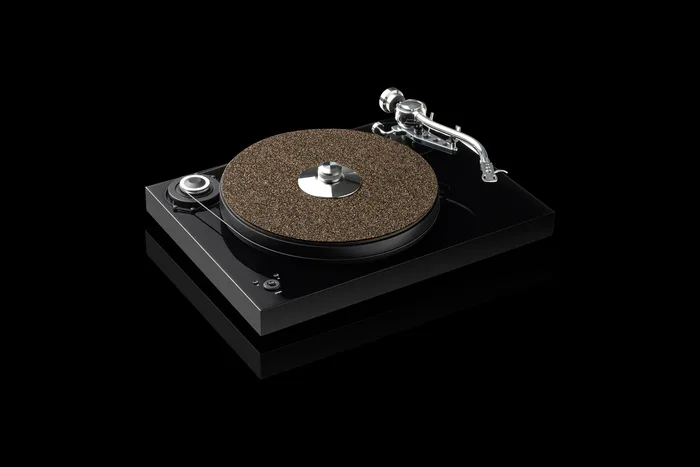
- Buy Pro-Ject Audio Systems Cork & Rubber It The only mat here that lets you pick your thickness, which is the one spec that really changes what your stylus is doing. Amazon
- Buy Turntable Lab Cork Record Mat Three millimetres of plain cork from a shop that tells you in the listing not to DJ with it.
- It depends Ortofon Slipmat, Scratch A proper DJ slipmat, sold in pairs, designed to do the exact opposite of what a hi-fi mat should do.
- Skip Hudson Hi-Fi Acrylic Turntable Mat Nicely machined and properly specified, but the reasoning for acrylic is a story rather than a result. Amazon
What actually matters
- Thickness - It sets how high the record sits, which sets the angle of your tonearm and stylus. It is the only mat property that changes something measurable in your setup.
- Material - Cork, rubber, composites, felt, leather and acrylic all damp differently and hold static differently. Rigid materials like acrylic damp very little; cork and rubber damp more.
- Static behaviour - A mat that holds charge will cling to the record and attract dust onto the playing surface. This is easy to observe at home, unlike most claims in this category.
- Slip versus grip - A DJ slipmat is designed to let the record slide over the platter. A listening mat is designed to stop it. Buying the wrong one is the most common mistake here.
- Diameter - Mats run from a little under a record's diameter to slightly over it. It matters mainly if you use a clamp, a weight or a peripheral ring.
- Label recess - A record's raised paper label can hold the disc off a perfectly flat mat. A recessed centre lets the playing surface sit down properly.
- What is published - A maker that gives you material, thickness, diameter and weight is telling you something checkable. One that gives you only adjectives is not.
The specs, in plain English
Green flags vs red flags
Green flags
- The thickness is stated in millimetres, not just as 'thin' or 'ultra thin'.
- The listing says what the mat is made of, specifically, rather than 'premium material'.
- Diameter and weight are published alongside thickness.
- The maker states whether it is intended for DJ use or for listening.
- The maker sells, or points you to, a tonearm spacer or explains the height change.
Red flags
- Claims about improved bass, lower noise floor or more detail with no measurement shown.
- No thickness figure anywhere in the listing or spec table.
- 'Anti-static' asserted for a material that is a known insulator, with no test described.
- Product photos that never show the mat's edge, so you cannot judge how thick it is.
- A hi-fi listing that also promises great slip performance, since those are opposite goals.
Who's who: the brands
- Pro-Ject Audio Systems - Austrian turntable maker with a long accessory line, and one of the few that publishes mat dimensions and sells a tonearm spacer to go with them.
- Turntable Lab - A retailer with its own house-brand mats, notable for stating thickness and for labelling its cork mats as not recommended for DJ use.
- Ortofon - Danish cartridge maker whose accessory range includes professional DJ slipmats sold in pairs.
- Hudson Hi-Fi - Accessory maker selling cork and rubber, acrylic and silicone mats, with dimensions listed on its acrylic mat.
- Music Hall - US turntable brand whose cork mat listing is unusually explicit that a thin mat generally does not require a VTA adjustment.
How to read a listing without getting fooled
Read a mat listing from the spec table upwards, not from the headline down. Find the thickness first and compare it against whatever is on your deck now; the difference between those two numbers is what you are actually buying. Then find the material and the diameter. If any of the three is missing, note the gap rather than filling it in with a guess, because mats are frequently listed with a photograph and a paragraph of adjectives and nothing else. Once you have the numbers, read the prose separately and sort it into two piles: statements about what the mat is made of and how it is built, which are checkable, and statements about what it does to the sound, which in this category are almost never backed by published data. A listing that gives you a thickness and a modest claim is more trustworthy than one that gives you no thickness and a big one.
How much should you spend?
This is a cheap category, which is part of why it attracts such large claims. Budget mats cover most plain cork and most felt slipmats, and at that level you should still expect a stated thickness. Mid-range buys you composites, machined acrylic, leather, and mats with a label recess or a published weight, and the extra usually goes on manufacturing tolerance and finish rather than on any demonstrated performance. Premium mats exist and can cost as much as an entry-level cartridge, and at that point you are paying for engineering claims that, so far as we can find, nobody has published measurements for. Our honest advice is that spending mid-range money on a mat with fully published dimensions gets you everything verifiable in this category, and that the money above that is better spent on a stylus.
Questions, answered
What is the difference between a platter mat and a slipmat?
A platter mat is meant to hold the record still and couple it to the platter, usually in cork, rubber, leather or acrylic. A slipmat is meant to let the record slide freely over the spinning platter so a DJ can cue and scratch, and it is usually felt. The two goals are directly opposed. If a listing uses both words interchangeably, check the material and the intended use before you buy.
Do I need a record clamp or weight with a new mat?
Not automatically. A clamp presses the record down onto the mat, which can help a slightly dished record sit flatter and improves the coupling between disc and mat. It also adds mass to the platter, which not every bearing is designed for, so check what your turntable maker says before adding one. Some mat makers recommend pairing a clamp with their product. Treat that as a suggestion, not a requirement.
Will a cork mat crumble or leave residue on my records?
Good-quality cork and cork composites are made from compressed granules bonded together and should not shed in normal use. Cheap cork can shed at the edges over time, which you would see as small dark specks on the platter. Wipe the mat occasionally with a dry cloth and check the underside of a record now and then. If you do see residue, that is a sign of a poorly bonded mat rather than a property of cork itself.
Can I stack two mats to get the thickness I want?
You can physically, but it is a bad idea. Two mats introduce a loose interface between them that can shift as the platter turns, and you lose the flat, predictable coupling that a single mat gives you. You also stack up the height change, which compounds the tracking angle problem rather than solving it. If you want a specific thickness, buy a mat made at that thickness or fit a tonearm spacer to compensate for the one you have.
Or jump to the head-to-head: Pro-Ject Audio Systems Cork & Rubber It vs Turntable Lab Cork Record Mat.