

Audio
The Best Turntable Mats: 4 Compared (and One to Skip)
We compared four platter mats on the two things you can actually verify: how much height they add, and how they behave with static. Everything else in this category is claim, not measurement.
The short version
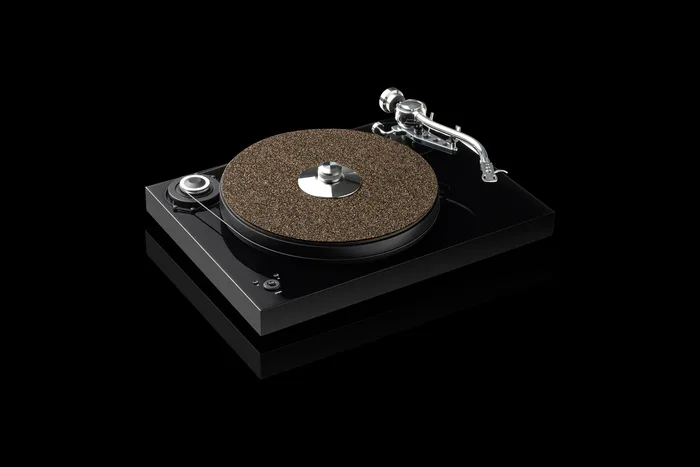
The Pro-Ject Cork & Rubber It is our pick, mostly because it is the only mat here sold in two thicknesses, so you can take the 1 mm version if your tonearm height is fixed and the 3 mm version if you can raise the arm. The Turntable Lab Cork Record Mat is the value choice: 3 mm of plain cork, grippier than felt, and the maker is straight enough to say it is not for DJ use. Ortofon's Scratch slipmat is the 'it depends' pick, and it depends entirely on whether you cue records by hand, because a slipmat is built to let the record slide over the platter, which is the opposite of what a listening mat should do. We would skip the Hudson Hi-Fi acrylic mat: it is nicely made, but the claims around acrylic are not backed by any measurement we could find, and a rigid 3 mm slab raises your record without damping much. Here is the thing almost nobody mentions: swapping a 2 mm felt mat for a 3 mm cork one lifts the record by 1 mm, which tilts a 230 mm tonearm by roughly a quarter of a degree and changes the rake angle of the stylus in the groove. On a deck with adjustable arm height that is a five minute correction; on a fixed arm it is permanent. Best for: anyone replacing a tired felt mat who wants less static and better grip, and who is willing to check the arm afterwards.
Our picks at a glance
- Pro-Ject Audio Systems Cork & Rubber It - Buy. The only mat here that lets you pick your thickness, which is the one spec that really changes what your stylus is doing.
- Turntable Lab Cork Record Mat - Buy. Three millimetres of plain cork from a shop that tells you in the listing not to DJ with it.
- Ortofon Slipmat, Scratch - It depends. A proper DJ slipmat, sold in pairs, designed to do the exact opposite of what a hi-fi mat should do.
- Hudson Hi-Fi Acrylic Turntable Mat - Skip. Nicely machined and properly specified, but the reasoning for acrylic is a story rather than a result.
The verdict in 30 seconds
What mattered most
- Material
- Thickness
- Diameter
- Height change vs a 2 mm felt mat
- Intended use
- Label recess
Turntable mats sit in the strangest corner of hi-fi. They are cheap, they are easy to swap, and the marketing around them promises things nobody publishes any data for. Two effects, though, are mechanically real and checkable at home: a mat's thickness changes the angle your stylus sits at in the groove, and different materials hold static charge very differently. We picked four mats that between them cover cork, cork and rubber, felt for DJs, and acrylic, and we judged them on published specs rather than adjectives.
The only mat here that lets you pick your thickness, which is the one spec that really changes what your stylus is doing.
Best for: Someone replacing a felt mat who wants to control exactly how much height they are adding.
- Sold in 1 mm and 3 mm versions, so you can match the mat to your arm's adjustability.
- Pro-Ject publishes material, diameter and thickness, which is more than most rivals do.
- Cork and rubber composite grips the record instead of lifting off with it.
- No weight figure is published.
- The 'less noise' and 'avoids static load' claims come with no measurement behind them.
- Two thickness options means one more decision to get wrong at the point of purchase.
- At 300 mm it is slightly wider than a record, so it is visible under the disc.
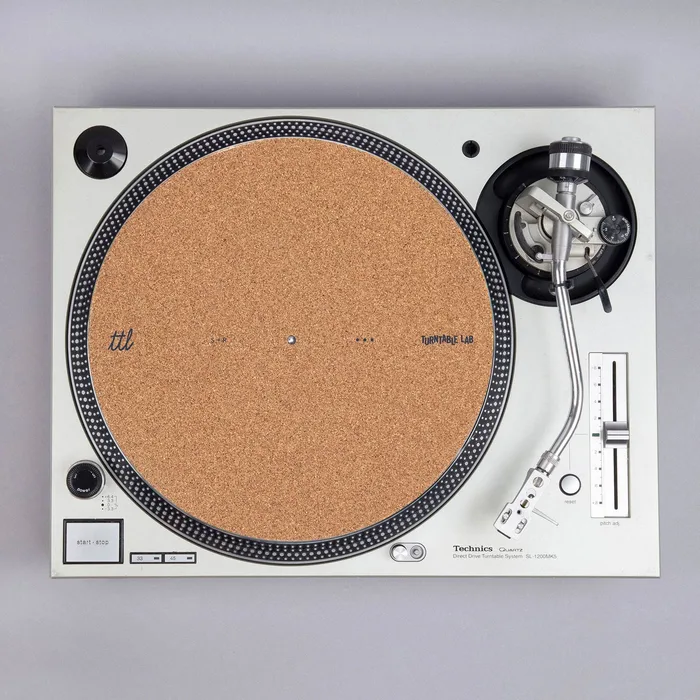
Three millimetres of plain cork from a shop that tells you in the listing not to DJ with it.
Best for: A belt-drive owner who wants the cork upgrade without paying for a composite.
- Thickness is published as 3 mm, so you can work out the height change before you buy.
- The listing states plainly that it is not recommended for DJ use, which is the right way round.
- Cork grips better than felt and does not cling to the record when you lift it.
- No diameter or weight is published.
- The 'improves sound quality playback' claim has no data attached.
- 3 mm is enough to shift your tracking angle on most decks.
- The printed logo is a matter of taste and cannot be turned off.
A proper DJ slipmat, sold in pairs, designed to do the exact opposite of what a hi-fi mat should do.
Best for: Anyone cueing records by hand on a direct-drive deck, and nobody else.
- Built for hand cueing and scratching, which is a real job that cork mats cannot do.
- Ortofon states it will not scuff or damage vinyl and describes the surface as matte.
- Comes as a pair in a sleeve, which is how DJs actually buy mats.
- Ortofon does not name the material or publish a thickness, so you cannot predict the height change.
- Slip between record and platter is speed error, which is the last thing a listener wants.
- Felt-type slipmats are known for lifting with the record and holding static charge.
- Nothing here is aimed at the person who just wants to sit and listen.
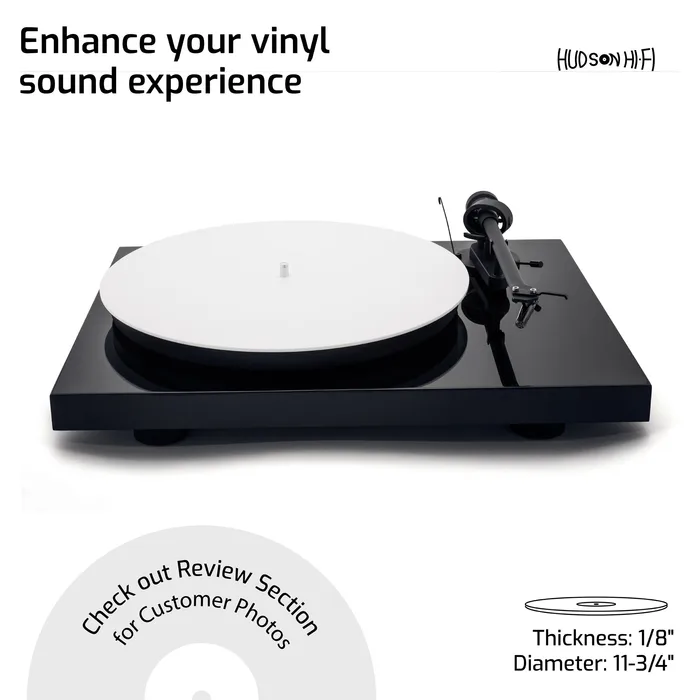
Nicely machined and properly specified, but the reasoning for acrylic is a story rather than a result.
Best for: Someone who specifically wants a hard, flat, wipe-clean surface and accepts the height change.
- Full specs are published: 3 mm thick, 298.5 mm across, CNC-machined acrylic.
- A recessed label area stops the raised label holding the record off the mat.
- Rigid and dead flat, with several colour options.
- Acrylic is rigid, so it does very little damping compared with cork or rubber.
- The listing describes it as anti-static, but acrylic is an insulator and no test is shown.
- 'Cleaner, more detailed playback' has no published measurement behind it.
- At 3 mm it still raises your record about a millimetre over a typical felt mat, for no clear gain.
| Criteria | Cork & Rubber It Top pick | Cork Record Mat | Slipmat, Scratch | Acrylic Turntable Mat |
|---|---|---|---|---|
| Verdict | Buy it | Buy it | It depends | Skip it |
| Best for | Someone replacing a felt mat who wants to control exactly how much height they are adding. | A belt-drive owner who wants the cork upgrade without paying for a composite. | Anyone cueing records by hand on a direct-drive deck, and nobody else. | Someone who specifically wants a hard, flat, wipe-clean surface and accepts the height change. |
| Price tier | $$ · mid-range | $ · budget | $ · budget | $$ · mid-range |
| Material | Cork and rubber composite | Cork | Not named by Ortofon | CNC-machined acrylic |
| Thickness | 1 mm or 3 mm | 3 mm | Not published, listed as extra thin | 3 mm (1/8 in) |
| Diameter | 300 mm | Not published | 12 in | 298.5 mm (11.75 in) |
| Height change vs a 2 mm felt mat | 1 mm lower or 1 mm higher | About 1 mm higher | Cannot be calculated | About 1 mm higher |
| Intended use | Hi-fi, grip | Hi-fi, maker says not for DJ use | DJ, slip | Hi-fi, grip |
| Label recess | No | No | No | Yes |
| Anti-static claimed by maker | Yes, 'avoids static load' | Yes, 'lessens static electricity' | Not claimed | Yes, stated in the listing |
| Sold as | Single mat | Single mat | Pair | Single mat, several colours |
Which one is right for you?
- Someone replacing a felt mat who wants to control exactly how much height they are adding. Buy it Pro-Ject Audio Systems Cork & Rubber It
- A belt-drive owner who wants the cork upgrade without paying for a composite. Buy it Turntable Lab Cork Record Mat
- Anyone cueing records by hand on a direct-drive deck, and nobody else. It depends Ortofon Slipmat, Scratch
- Someone who specifically wants a hard, flat, wipe-clean surface and accepts the height change. Skip it Hudson Hi-Fi Acrylic Turntable Mat
How we judged the field
Five things decide whether a mat is right for your deck, and only some of them are things makers will tell you. Thickness comes first, because it is the one property that changes your setup whether you want it to or not: raise the record and you tilt the tonearm, which changes vertical tracking angle and stylus rake angle. Material comes second, and it splits into how much it damps and how it behaves electrically, since felt is famous for lifting with the record and holding charge while cork and rubber generally do not. Diameter matters if you use a clamp or a peripheral ring. Slip versus grip is the fourth, and it is not a spectrum but two opposite design goals. Fifth is simply what the maker is willing to publish, because a listing with a thickness in millimetres is worth more than a listing with three adjectives.
The field splits cleanly. On one side are hi-fi mats made of cork, cork and rubber composites, leather or acrylic, all of which try to grip the record and stay put. On the other are DJ slipmats, usually felt, which exist so the record can slide freely over a spinning platter. Within the hi-fi group the real division is thickness: mats around 1 mm to 1.5 mm barely disturb the geometry of a deck that came with felt, while 3 mm and up require you to think about arm height. We picked four that cover both groups and four different materials, and we checked every published number against the manufacturer’s own page. Where a figure was not published, we have said so rather than guessing.
Pro-Ject Audio Systems Cork & Rubber It
Buy itPro-Ject publishes what you need and not much more: cork and rubber, 300 mm across, brown, and a choice of 1 mm or 3 mm. That choice is the whole reason it wins here. Every other mat in this comparison hands you one height and leaves you to work out afterwards what it did to your tonearm; this one lets you decide before you buy. Pro-Ject’s own advice is to try the thick version on thin metal platters and the thin one on dense or heavy platters, which reads as a sensible starting point rather than a rule. The claims are modest by the standards of this category: it avoids static load and produces less noise. There is no published measurement behind either, and we are not going to pretend otherwise, though the static difference between cork and felt is something you can confirm yourself by lifting a record off. No weight figure is published. For something you will live with for years, that thickness option is worth more than any adjective in the listing. It is the mat for the person who wants to keep control of their setup.
Turntable Lab Cork Record Mat
Buy itThree millimetres of cork, a printed logo, and a listing that says the useful thing out loud: not recommended for DJ use. That single line is worth more than it looks, because it is the clearest statement of intent any maker here gives you. Cork grips. A record sitting on cork stays where the platter puts it, and it does not come away clinging to the underside of the disc the way felt does. Turntable Lab does not publish a diameter or a weight for this one, which is a genuine gap, and it does claim the mat improves sound quality playback without pointing at any data, so treat that as a claim rather than a finding. The parts you can check are the 3 mm and the grip, and both are useful. If your deck came with a felt mat around 2 mm thick, this raises the record by roughly a millimetre, so look along the arm with the stylus down and see whether it is still parallel. Adjust if you can. If you cannot, decide whether you mind before you order.
Ortofon Slipmat, Scratch
It dependsThis is not a hi-fi mat and Ortofon does not pretend it is. It is a 12 inch professional slipmat sold in pairs, matte surfaced, described as extra thin, and aimed squarely at scratching and turntablists. A slipmat exists so the record can stay still while the platter keeps spinning underneath it, which is exactly the property you do not want when you sit down to listen, because slip between record and platter is speed error. If you cue by hand on a direct-drive deck, this is the right tool and the pair packaging makes obvious sense. If you own a belt-drive turntable and a cartridge you spent real money on, it is the wrong tool no matter how well made it is. Ortofon does not name the material or publish a thickness, so you cannot work out in advance what it will do to your arm height, and there is no anti-static claim either. For a DJ none of that matters much. For a listener it should matter a great deal, which is why this one lands on ‘it depends’ rather than ‘buy’.
Hudson Hi-Fi Acrylic Turntable Mat
Skip itHudson publishes proper numbers here, which we do appreciate: CNC-machined acrylic, 3 mm thick, 298.5 mm across, with a recessed area so a raised label does not hold the record up off the mat. The build is not the problem. The reasoning is. Acrylic is rigid, so it does very little damping in the way cork or a cork and rubber composite does; what it mostly provides is a hard flat surface for the record to sit on, which your platter already is. The listing calls it anti-static, but acrylic is an insulator and no test is shown, so we would want that demonstrated. The claim that it delivers cleaner, more detailed playback has no published measurement behind it that we could find. And the widely repeated idea that acrylic belongs on an acrylic platter because the impedances match is a manufacturer story, not a measured result. At 3 mm it still lifts your record about a millimetre over a typical felt mat, so you take the geometry consequence without a clear benefit in return.
Sources
Specs in this review come from these pages.
- Pro-Ject Audio Systems - Cork & Rubber it platter mat specifications (project-audio.com)
- Pro-Ject Audio Systems - VTA it 1.5 mm tonearm spacer (project-audio.com)
- Pro-Ject Audio Systems - X2 B user guide (VTA adjustment, 230 mm effective tonearm length) (project-audio.com)
- Turntable Lab - Cork Record Mat product page (turntablelab.com)
- Ortofon - Slipmat, Scratch product page (ortofon.com)
- Hudson Hi-Fi - Acrylic Turntable Mat product page (hudsonhifi.com)
Pro-Ject Audio Systems Cork & Rubber It vs Turntable Lab Cork Record Mat: which should you buy?
The two picks are closer than the price gap suggests, and the real question is not which cork is better but how much height you can afford to add. The Turntable Lab mat is a single 3 mm decision. If your tonearm pillar can be raised, that is fine and you should buy the cheaper mat without a second thought. If your arm is fixed at the factory, 3 mm on top of a 2 mm felt mat is a permanent millimetre of extra height you cannot take back, and the Pro-Ject at 1 mm becomes the sensible answer instead. That is the entire case for spending more on the Pro-Ject: you are paying for the option, not for better cork.
There is a second, smaller difference. Pro-Ject publishes a 300 mm diameter, which matters if you use a record clamp or a peripheral ring and need to know how the mat sits relative to the disc. Turntable Lab does not publish a diameter at all. Against that, Turntable Lab is clearer about intended use and states in plain language that the mat is not for DJ work, whereas Pro-Ject leaves that to be inferred. Neither maker publishes a measurement supporting any sound claim, so do not choose between them on that basis. Choose on thickness first, then on whether you want the composite or plain cork, and then, honestly, on which one you would rather look at.
What to look for
- Thickness in millimetres: this is the only spec that changes your setup whether you want it to or not, so if a listing does not state it, that is a reason to hesitate.
- Your arm’s adjustability: find out whether your tonearm pillar can be raised before you shop, because that single fact decides how thick a mat you can safely buy.
- Slip or grip: DJ slipmats and hi-fi mats have opposite goals, and a listing that is vague about which one it is has told you something already.
- Static behaviour: felt is the material most associated with lifting off with the record and holding charge, and cork, rubber and composites generally behave better, which you can test in an afternoon.
- Diameter and label recess: if you use a clamp or a weight, a mat that supports the record right out to the edge and clears the raised label will sit flatter.
- What the maker will not say: claims about bass, detail or noise floor with no published measurement are marketing, and the honest listings in this category are the ones that stick to material, size and weight.
Our final take
Buy a mat for the reasons you can verify. Cork and cork-rubber composites grip better than felt and are far less prone to lifting off with the record, and that alone is worth the small outlay if your felt mat has started clinging. Just decide the thickness deliberately rather than discovering it afterwards, because every millimetre you add tilts the tonearm and changes the angle the stylus meets the groove. If your arm height adjusts, you have a free hand and the Turntable Lab cork mat is the value answer. If it does not, take the 1 mm Pro-Ject and keep your geometry. And if your deck came with a mat that still works, you are allowed to leave it alone.
Questions, answered
Does changing my mat really change VTA, or is that an audiophile myth?
It is straightforward geometry, not folklore. Your tonearm pivots at a fixed height, so if you raise the record surface by a millimetre you tilt the arm by a millimetre at the far end. Pro-Ject's own X2 B manual specifies a 230 mm effective tonearm length, so a 1 mm lift works out at roughly a quarter of a degree of tilt, and 3 mm at roughly three quarters of a degree. That tilt changes the vertical tracking angle of the arm and the rake angle of the stylus in the groove. Whether you can hear a quarter of a degree is a separate argument, but the change itself is real and you should know it happened.
What if my turntable's arm height cannot be adjusted?
Then a thicker mat is a permanent change, so choose thickness deliberately rather than by accident. Many entry-level decks fix the arm at the factory and give you no way to raise the pillar. Some makers sell a shim for exactly this reason: Pro-Ject's VTA it is a 1.5 mm tonearm spacer, and the product page says outright that it exists so you can use upgrade platters, mats and cartridges. If no spacer is offered for your deck, stay within about a millimetre of your original mat's thickness. That is why a 1 mm or 1.5 mm cork mat is often the safer swap than a 3 mm or 5 mm one.
Will a new mat improve my bass or lower the noise floor?
We found no maker in this category publishing a measurement to support that, and we looked at the manufacturers' own pages. What you see instead are claims: less noise, more detail, tighter bass. Treat all of them as unsubstantiated until somebody shows a before and after. What a mat genuinely does is change how the record is coupled to the platter, how much static builds up, and how high the record sits. Those are real mechanisms, and if you hear a difference it is most likely one of them at work. Be sceptical of anything phrased as an audio improvement without a number attached.
Can I use a DJ slipmat on a hi-fi turntable?
You can, but you are choosing a mat designed to do the opposite job. A slipmat is engineered so the record can stay still while the platter keeps turning, which is precisely what a DJ needs for cueing and scratching. For listening, any slip between record and platter is speed instability. Felt slipmats are also the material most associated with static: they tend to lift off with the record and attract dust. Turntable Lab is unusually clear about this and labels its cork mats 'not recommended for DJ use', which is the same distinction stated from the other direction.
My turntable came with a mat. Is replacing it automatically an upgrade?
No, and this is worth saying plainly. Some decks ship with a mat chosen to suit that specific platter, and some are designed with the record sitting almost directly on the platter surface. Swapping in something thicker changes your tracking geometry and may undo a deliberate design decision. If your existing mat is intact, not shedding, and not clinging to records, there is no obligation to change it. The strongest reasons to swap are a felt mat that lifts with every record, visible wear, or a thin metal platter that you want to damp. Cosmetics are a legitimate reason too, as long as you check the arm afterwards.
Deciding between the top two? See our head-to-head: Pro-Ject Audio Systems Cork & Rubber It vs Turntable Lab Cork Record Mat.
More Audio reviews
 Best Turntables of 2026: Value, Sound, and One to Skip
  The Best Ukuleles: 4 Compared (and One to Skip)
  The Best USB Microphones for Podcasting and Streaming
  The Best Vinyl Record Storage: 4 Compared (and One to Skip)
  The Best Wired In-Ear Monitors: 4 Compared (and One to Skip)
  The Best Wireless Microphones: 4 Compared (and One to Skip)