

Audio
The Best Turntable Stylus Cleaners: 4 Compared (and One to Skip)
We compared four stylus cleaners on the things that actually protect a cartridge: which direction they make you move the stylus, whether they involve fluid, and what the cartridge makers themselves say about that fluid.
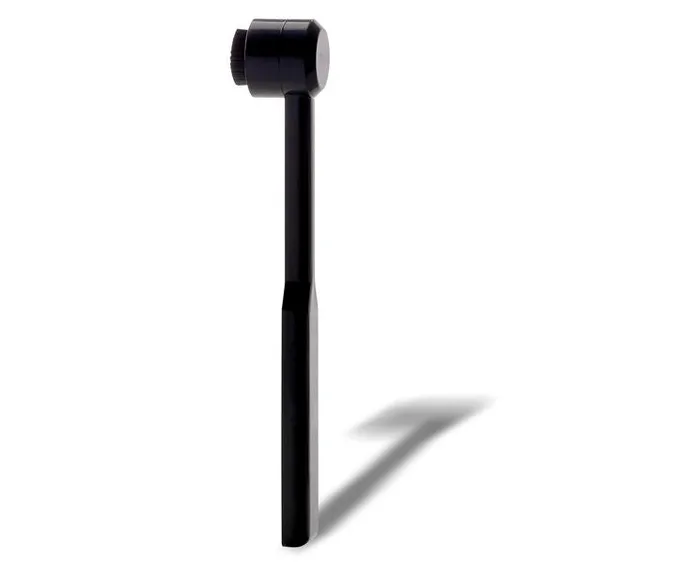
The short version
Ortofon's Stylus Brush, Fiber is the pick for almost everyone, because a dry brush swept from the rear of the cartridge toward the tip is the method cartridge makers themselves publish, and Ortofon states it usually leaves nothing further to clean. The Flux-Hifi FLUX-Sonic is the premium option: a 210 Hz powered pad that does the work with no brushing motion at all, and it includes its own fluid. The LAST Factory Stylus Cleaner is the fluid-and-brush choice, and it suits you only if your cartridge maker permits fluid, because LAST's own safety data sheet lists isopropyl alcohol while Ortofon says solvents of any kind can damage stylus cement and voids warranty cover if they cause a fault. Skip the Onzow Zerodust: it is a well known gel pad, but Ortofon publishes a note in its own FAQ saying it does not recommend it, and a gel deep enough to sink a stylus into is the one design where a moving platter can put sideways load on the cantilever. Whatever you buy, remember that clean records are what keep a stylus clean, and Ortofon says brushing records before every use extends diamond life. Best for: anyone who wants to clean a stylus without turning a small cleaning job into a cartridge repair.
Our picks at a glance
- Ortofon Stylus Brush, Fiber - Buy. The dry fibre brush a major cartridge maker tells its own customers to use, with the technique spelled out in its own FAQ.
- Flux-Hifi FLUX-Sonic - Buy. A battery powered pad that vibrates the dirt off the tip, so there is no brushing stroke to get wrong.
- The LAST Factory LAST Stylus Cleaner - It depends. A long-standing fluid and cap brush that dissolves what a dry brush leaves behind, if your cartridge maker allows fluid at all.
- Onzow Zerodust - Skip. The famous gel blob, and the one product in this group that a cartridge manufacturer names in print as something it does not recommend.
The verdict in 30 seconds
What mattered most
- Type
- Fluid included
- Stated composition
- How the stylus is contacted
- Maker's compatibility statement
- Published usage guidance
A stylus cleaner is a tiny purchase attached to a very expensive failure mode. Move a brush the wrong way and you can bend a cantilever; use the wrong fluid and you can attack the adhesive holding the diamond on, or let liquid creep back into the cartridge body. The four products here cover the four real designs: a dry fibre brush, a powered vibration cleaner, a fluid with an applicator brush, and a gel pad. What separates them is not cleaning power, it is what their makers and your cartridge maker will actually stand behind.
The dry fibre brush a major cartridge maker tells its own customers to use, with the technique spelled out in its own FAQ.
Best for: Anyone who wants the safest routine cleaning method, and anyone whose cartridge maker says dry brush only.
- Ortofon publishes the exact technique with it: sweep from the rear of the cartridge toward the stylus tip, never tip to rear and never side to side.
- No fluid and no gel, so there is nothing that can attack stylus cement or seep into the cartridge body.
- Ortofon states that after this treatment there is normally no need for further stylus cleaning.
- A dry brush lifts loose dust and release agent, but it will not dissolve residue that has already baked onto the tip.
- Technique is entirely on you, and one careless sideways stroke is the classic way people bend a cantilever.
- The bristles are small and dark and easy to lose track of against a dark cartridge.
- No magnifier or light, so you are cleaning something you mostly cannot see.
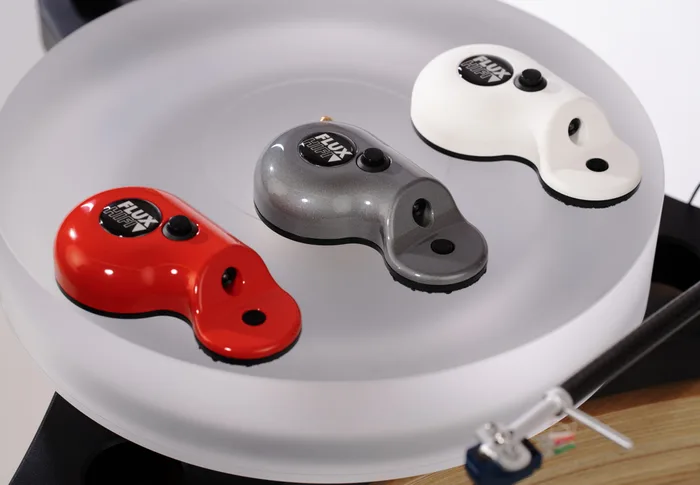
A battery powered pad that vibrates the dirt off the tip, so there is no brushing stroke to get wrong.
Best for: High-hours listeners with a valuable cartridge whose maker has no objection to cleaning fluid.
- Flux publishes real numbers: 210 Hz oscillation, maximum 8 micrometre amplitude in X and Y and 2 to 5 micrometres in Z, which the company says protects the assembly sitting in the magnetic coil.
- The stylus simply rests on the pad, so no lateral brushing force is applied by hand at all.
- An LED lights the pad so you can place the stylus precisely, and Flux says the cartridge does not need to be removed.
- It works with fluid, so it is off the table if you own a cartridge whose maker says no fluids.
- Flux does not publish the composition of FLUX-Fluid, only that it will not damage the bond between stylus tip and cartridge and that it contains an added oil.
- It costs many times what a brush costs and runs on two AAA batteries you will eventually have to replace.
- The included fluid is a small 5 ml supply, so heavy users end up buying refills.
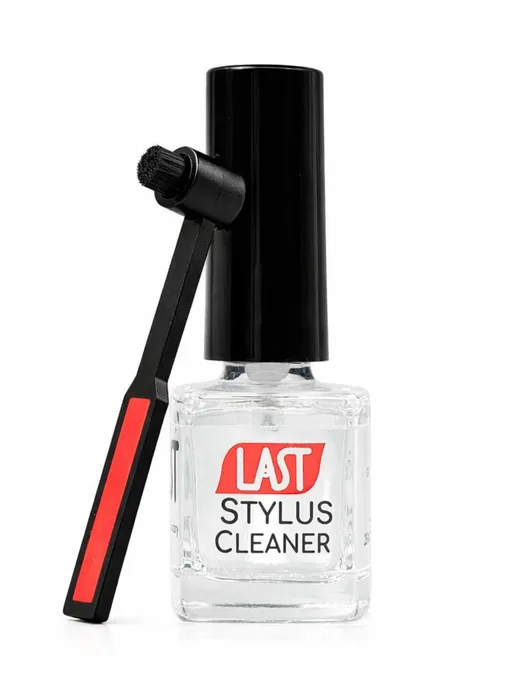
A long-standing fluid and cap brush that dissolves what a dry brush leaves behind, if your cartridge maker allows fluid at all.
Best for: Owners of cartridges whose maker explicitly permits fluid cleaning, who have residue a dry brush will not shift.
- LAST's guidance gets the direction right, telling you to always brush from back to front.
- LAST states the formula is safe for the adhesives and materials used in modern and vintage cartridges and contains no components that can damage the stylus suspension.
- The cap brush is the applicator, so there is no separate dropper and no chance of flooding the tip from a bottle.
- LAST's own safety data sheet lists isopropyl alcohol and water alongside proprietary ingredients, and Ortofon tells its customers not to use solvents of any kind on a stylus.
- Ortofon also says solvent intrusion can seriously affect interior parts of the cartridge and that its warranty will not cover a fault caused that way, so this is a genuine compatibility decision, not a preference.
- It is easy to load too much fluid onto the brush, and excess that travels up the cantilever is the failure you cannot undo.
- It is a consumable, so you will be buying bottles again.
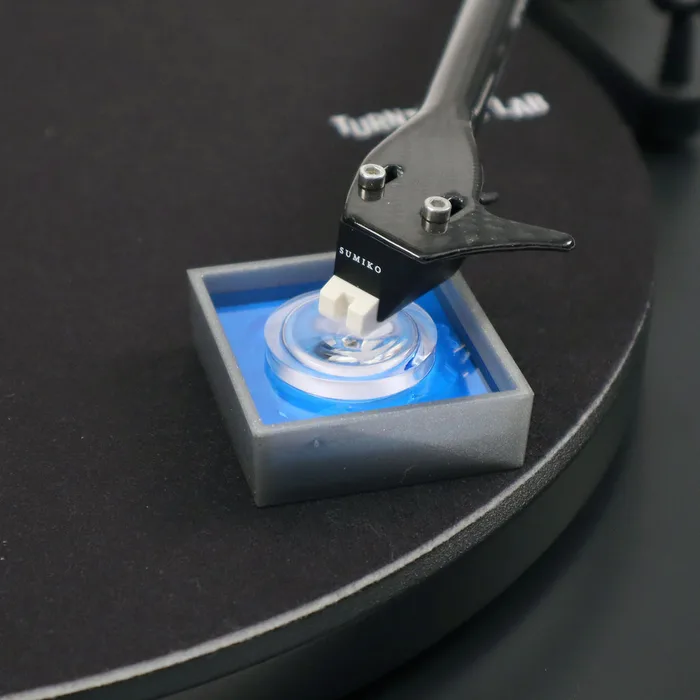
The famous gel blob, and the one product in this group that a cartridge manufacturer names in print as something it does not recommend.
Best for: Hard to justify. If you want a pad rather than a brush, choose a firm, shallow one and check your cartridge maker's guidance first.
- Lowering the stylus straight down removes the sideways brushing stroke that damages cantilevers.
- A reusable pad with no fluid to buy or apply.
- Ortofon's own FAQ carries a note stating that it does not recommend the use of the Onzow Zerodust stylus cleaner.
- Ortofon's care guidance goes further and tells owners to use a dry brush only and to avoid fluids and gels entirely.
- You lower a stylus into a raised, tacky mound, so the cartridge is committed to the gel for the moment it takes to lift back out, and any platter movement during that moment loads the cantilever sideways.
- It costs considerably more than a brush that a cartridge maker will actually stand behind.
| Criteria | Stylus Brush, Fiber Top pick | FLUX-Sonic | LAST Stylus Cleaner | Zerodust |
|---|---|---|---|---|
| Verdict | Buy it | Buy it | It depends | Skip it |
| Best for | Anyone who wants the safest routine cleaning method, and anyone whose cartridge maker says dry brush only. | High-hours listeners with a valuable cartridge whose maker has no objection to cleaning fluid. | Owners of cartridges whose maker explicitly permits fluid cleaning, who have residue a dry brush will not shift. | Hard to justify. If you want a pad rather than a brush, choose a firm, shallow one and check your cartridge maker's guidance first. |
| Price tier | $ · budget | $$$ · premium | $$ · mid-range | $$ · mid-range |
| Type | Dry fibre brush | Powered vibrating pad | Fluid with cap applicator brush | Gel pad |
| Fluid included | None | 5 ml FLUX-Fluid in the box | The product is the fluid | None |
| Stated composition | Not applicable | Not published, beyond an added oil | SDS lists isopropyl alcohol and water plus proprietary ingredients | Not applicable |
| How the stylus is contacted | Swept rear of cartridge to tip | Rests on a vibrating pad | Brushed back to front | Lowered into a raised gel mound |
| Maker's compatibility statement | Ortofon's own recommended method | No cartridge removal needed | Stated safe for MM and MC, and for cartridge adhesives | Ortofon states it does not recommend this cleaner |
| Published usage guidance | Every new record and every side change | About 15 seconds, after roughly 5 to 6 LP sides | When debris is visible or at the end of a session | Not found on a maker page |
| Power | None | 2 AAA batteries | None | None |
| Reusable or consumable | Reusable, no consumables | Reusable, fluid is consumable | Consumable bottle | Reusable, washable surface |
Which one is right for you?
- Anyone who wants the safest routine cleaning method, and anyone whose cartridge maker says dry brush only. Buy it Ortofon Stylus Brush, Fiber
- High-hours listeners with a valuable cartridge whose maker has no objection to cleaning fluid. Buy it Flux-Hifi FLUX-Sonic
- Owners of cartridges whose maker explicitly permits fluid cleaning, who have residue a dry brush will not shift. It depends The LAST Factory LAST Stylus Cleaner
- Hard to justify. If you want a pad rather than a brush, choose a firm, shallow one and check your cartridge maker's guidance first. Skip it Onzow Zerodust
How we judged the field
Five things decide whether a stylus cleaner is worth owning. First, direction: the product should either enforce or clearly instruct a back to front stroke, from the rear of the cartridge toward the tip, because lateral and backward force is what bends cantilevers. Second, chemistry: if there is fluid, we want to know what is in it, because many cartridges hold the diamond to the cantilever with adhesive and some solvents attack it. Third, wicking risk: how easy is it for liquid to travel up the cantilever into the suspension and coil assembly, which is the failure that ends a cartridge rather than inconveniencing it. Fourth, what the cartridge makers say, since they set your warranty terms and they do not agree with each other. Fifth, whether the thing actually removes the residue you have, because a dry brush and a solvent solve different problems.
The field splits cleanly by mechanism. Dry fibre brushes are cheap, universally endorsed and limited to loose material. Fluid and brush products dissolve baked-on residue but put you into the chemistry argument. Gel and polymer pads remove the brushing stroke altogether, which sounds like the safest idea until you notice how deep some of them are. Powered cleaners vibrate the tip clean, which removes hand technique from the equation but usually still involves fluid. We picked one of each, chose the two that most people should actually buy, flagged the fluid product as a decision rather than a recommendation, and skipped the gel pad that a cartridge manufacturer names in print.
Ortofon Stylus Brush, Fiber
Buy itOrtofon’s Stylus Brush, Fiber is unglamorous and it is the right answer for most people. What earns it the top spot is not the bristles, it is the instruction set attached to them. Ortofon tells you to run the brush a few times along the cantilever in the direction of the stylus tip whenever you play a new record or change sides, and spells out the prohibition: never from the tip to the rear of the cartridge, and never from side to side. It then makes a claim most accessory makers would not, saying that following this treatment there is normally no need for further stylus cleaning. Because there is no fluid and no gel, there is nothing here that can soften stylus cement or find its way into the cartridge body. The limitation is real: a dry brush picks up dust and the slick release agent from new records, but it will not dissolve residue that has already welded itself to the diamond. For routine use, before and after every side, this is what you want in your hand.
Flux-Hifi FLUX-Sonic
Buy itThe FLUX-Sonic is the one product here that removes hand technique from the job. You set the cartridge down on a small pad, the pad vibrates, and the dirt comes off. Flux-Hifi publishes the numbers rather than adjectives: oscillation at 210 Hz, with a maximum amplitude of 8 micrometres in the X and Y axes and 2 to 5 micrometres in Z, which the company says is deliberately restrained to protect an assembly sitting inside a magnetic coil. Note that despite how these devices are usually described, 210 Hz is a low audio frequency, not ultrasound. An LED illuminates the pad so you can land the stylus accurately, the base has felt and latex anti-slip knobs, it runs on two AAA cells, and Flux says a pass takes about 15 seconds and suits use after roughly five to six LP sides. It ships with 5 ml of FLUX-Fluid, which Flux says will not damage the bond between stylus tip and cartridge and includes an added oil. That fluid is also the catch, and it is why this is a premium pick rather than the universal one.
The LAST Factory LAST Stylus Cleaner
It dependsLAST has been selling stylus care products for decades, and its guidance gets the basics right: always brush from back to front, and use the fluid when you see debris or at the end of a playing session. LAST states the formula is designed for delicate stylus assemblies, is compatible with moving magnet and moving coil cartridges, and remains safe for the adhesives and materials used in modern and vintage cartridges. Its safety data sheet lists isopropyl alcohol (11 to 13 percent) and water (80 to 90 percent) alongside proprietary ingredients. That is the whole decision in one line. If you own an Audio-Technica, whose own AT607a fluid is deionized water and ethyl alcohol, a fluid cleaner is clearly within the maker’s expectations. If you own an Ortofon, the maker says do not use solvents of any kind, warns about damage to stylus cement and solvent intrusion into the cartridge interior, and says the warranty will not cover a resulting fault. Same bottle, opposite answers.
Onzow Zerodust
Skip itThe Zerodust is the product everyone has heard of, and it is the one we would leave on the shelf. The mechanism is appealing: lower the stylus into a soft gel, lift it out, dirt stays behind, no brushing stroke to get wrong. It is reusable and involves no fluid. But Ortofon prints a specific note in its own stylus care FAQ saying it does not recommend the use of the Onzow Zerodust stylus cleaner, and its care page tells owners to use a dry brush only and avoid fluids and gels. When a cartridge manufacturer singles out one accessory by name, that is not a forum opinion you can weigh against other forum opinions. There is also a design point worth understanding: this is a raised, tacky mound rather than a shallow firm pad, so the tip is held for the moment it takes to lift out, and any platter movement in that moment loads the cantilever sideways. If you want a pad, look at shallow firm ones instead.
Sources
Specs in this review come from these pages.
- Ortofon: Stylus and record care FAQ (ortofon.com)
- Ortofon: Protect your equipment (ortofon.com)
- Audio-Technica: AT607a Cartridge Stylus Cleaner (audio-technica.com)
- Flux-Hifi: FLUX-Sonic technology and specifications (flux-hifi.de)
- The LAST Factory: Stylus Cleaner Safety Data Sheet (thelastfactory.com)
- DS Audio: ST-50 Stylus cleaner (ds-audio-w.biz)
Ortofon Stylus Brush, Fiber vs Flux-Hifi FLUX-Sonic: which should you buy?
The Ortofon brush and the FLUX-Sonic are not really competing for the same job, and understanding that saves you money. The brush is preventive. Used the way Ortofon describes, before and after every side, it stops residue accumulating in the first place, and Ortofon’s position is that this normally leaves nothing further to clean. The FLUX-Sonic is corrective. It exists for the residue that has already bonded to the diamond, the kind that a dry brush will simply slide over, and it removes it without you making a single stroke by hand. If you play a few records a week on a modestly priced cartridge, the brush is not a compromise, it is the correct tool.
The deciding question is your cartridge maker, not your budget. If you own an Ortofon, the guidance is explicit and one-sided: dry brush only, no fluids, no gels, and solvent-caused faults are not covered. That rules out the FLUX-Sonic along with every other wet method, and it makes the brush your whole shopping list. If you own an Audio-Technica or another maker that sells its own cleaning fluid, a wet method is clearly sanctioned and the FLUX-Sonic becomes a reasonable upgrade for a high-value cartridge that sees heavy use. Buy the brush either way. Add the powered cleaner only once you have checked the care page for your specific cartridge and found nothing that forbids it.
What to look for
- Direction, stated by the maker: if the packaging or product page does not tell you to move from the rear of the cartridge toward the stylus tip, the maker has not thought hard about the thing most likely to break your cartridge.
- Published fluid composition: Audio-Technica lists deionized water and ethyl alcohol for its AT607a and The LAST Factory files a safety data sheet naming isopropyl alcohol, so a fluid that tells you nothing at all deserves less trust than one that does.
- A statement about adhesive and suspension: the good fluid makers address it directly, with LAST saying the formula is safe for cartridge adhesives and contains nothing that can damage the stylus suspension, and Flux saying its fluid will not damage the bond between stylus tip and cartridge.
- Application method that limits volume: a cap-mounted applicator brush puts a controlled trace of fluid on the tip, which matters because excess is what travels up the cantilever into the cartridge body.
- Pad depth and firmness, if you want a gel: a shallow, firm pad meets the tip and releases it, whereas a deep tacky mound holds it, and DS Audio states its ST-50 pad cleans at the tracking force already set on the tonearm.
- Your own cartridge maker’s care page: this is the only check that actually settles the fluid question, because Ortofon forbids solvents and voids warranty cover for solvent-caused faults while Audio-Technica sells a fluid of its own.
Our final take
Buy the Ortofon brush, learn the stroke, and use it before and after every side. It is the cheapest thing in this comparison and the only one every party involved agrees is safe. Then go and read your own cartridge maker’s care page before you buy anything wet, because that page, not a review, decides whether the FLUX-Sonic or the LAST bottle belongs anywhere near your tonearm. The Zerodust is off the list on the strength of Ortofon naming it. And if you only take one habit away, make it record cleaning rather than stylus cleaning: the tip only collects what the groove is holding, and Ortofon says brushing records before every use extends the life of the diamond.
Questions, answered
Which direction do I move a stylus brush?
Back to front, meaning from the rear of the cartridge body toward the stylus tip, which is the direction the record travels under the needle. Ortofon states this in plain language in its FAQ: use the brush in the forward direction from the rear of the cartridge toward the stylus tip, never from stylus tip to the rear, and never from side to side. The LAST Factory says the same thing more briefly: always brush from back to front. The reason is mechanical. The cantilever is a thin tube designed to move in the plane of the groove, and sideways or backward loading is what bends it or snaps the tip off.
Is alcohol safe on a stylus?
It depends entirely on who made your cartridge, and the makers genuinely disagree. Ortofon does not recommend solvents of any kind on a stylus, states that solvents may damage stylus cement and that interior parts of the cartridge can be seriously affected by solvent intrusion, and says its warranty service will not be valid where such treatment caused the fault. Audio-Technica takes the opposite position and sells its own AT607a stylus cleaning fluid, listing the ingredients as deionized water and ethyl alcohol. The LAST Factory sells a cleaner whose safety data sheet lists isopropyl alcohol and says the formula contains no components that can damage the stylus suspension. Read your cartridge maker's own care page before you put anything wet near the tip.
What actually ruins a cartridge during cleaning?
Two things, and neither is dirt. The first is sideways force on the cantilever, which is why brushing across the stylus or dragging it backward is the technique everyone warns about. The second is fluid travelling up the cantilever into the cartridge body, where the suspension and the coil assembly live. Ortofon describes this failure directly, warning that interior parts of the cartridge can be affected seriously by the intrusion of solvents. That is why fluid products generally tell you to apply a small amount with the supplied brush rather than dripping it on, and why you wipe the applicator before putting it back.
Do I still need a stylus cleaner if I clean my records?
You need less of one, and that is the honest answer. A stylus picks up whatever is sitting in the groove, so record hygiene is upstream of stylus hygiene and does more work than any cleaning product. Ortofon says cleaning records before every use increases the lifetime of the diamond as well as improving what you hear. The LAST Factory makes the same point from the other direction on its own product page, noting that you do not have to use the cleaner before every record if your records are clean. A record brush plus a stylus brush is a better first purchase than any single expensive stylus gadget.
How often should I clean the stylus, and how long should it last?
Ortofon's guidance is a dry brush pass whenever you play a new record or change sides, plus removing dust from the diamond before and after each record. Flux-Hifi recommends its powered cleaner after roughly five to six LP sides. The LAST Factory suggests cleaning when you can see debris or at the end of a listening session rather than before every play. On life, Ortofon says that with proper care up to 1000 hours is possible without degradation of performance, and adds that DJ use involving scratching and back cuing cuts that to about 500 hours at most. Proper care in Ortofon's definition includes correct tracking force, antiskating and azimuth, not just cleaning.
Deciding between the top two? See our head-to-head: Ortofon Stylus Brush, Fiber vs Flux-Hifi FLUX-Sonic.
More Audio reviews
 The Best Home Subwoofers: 4 Compared (and One to Skip)
  The Best Budget True Wireless Earbuds (and the One to Skip)
  The Best Turntable Cartridges: 4 Compared (and One to Skip)
  The Best Turntable Mats: 4 Compared (and One to Skip)
  Best Turntables of 2026: Value, Sound, and One to Skip
  The Best Ukuleles: 4 Compared (and One to Skip)