

Audio & Headphones
The Best Speaker Isolation Pads: 4 Compared (and One to Skip)
We compared four ways to lift a studio monitor off a desk or shelf, judging them on mechanical decoupling, height, tilt control, and whether the maker publishes anything you can actually check.
The short version
The IsoAcoustics ISO-155 is our pick because it is the only one of these four that does the whole job: it decouples the cabinet and raises it, offering 3 to 8.2 inches of height and up to 6.5 degrees of dial-in tilt. The Primacoustic IsoWedge is the value pick, and it is unusual here in publishing a believable load limit of 44 lb along with a fire rating rather than only adjectives. The Auralex ProPAD suits one specific buyer: someone on a hollow, resonant desk whose monitors already sit at ear height, because it adds a rubber and MDF mass layer but only a 3 degree wedge. Skip the Rockville RRS190S, which is the same foam wedge as everything else but whose headline number is a 100 lb support claim that tells you nothing about how far the foam compresses under a speaker. Before you buy any of them, check where your speaker sits relative to the walls, because placement will move your bass far more than a pad ever will. Best for: anyone whose monitors sit on a desk, shelf, or console and who wants the cabinet decoupled and the tweeter pointed at their ears.
Our picks at a glance
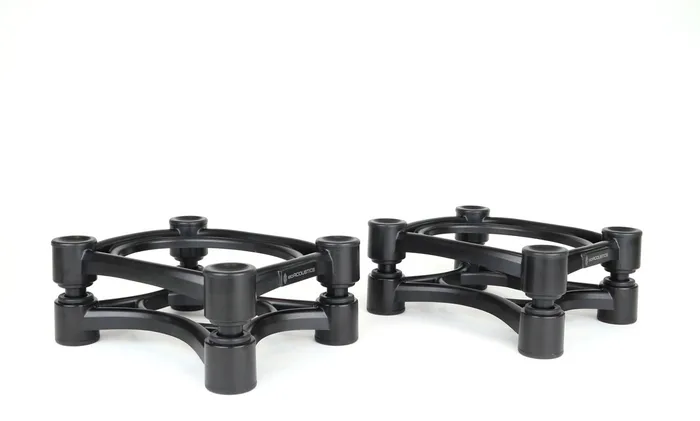
- IsoAcoustics ISO-155 Isolation Stands - Buy. A stand, not a pad, and the only option here that lets you set height and tilt independently.
- Primacoustic IsoWedge Monitor Isolation Pads - Buy. Plain high density polyurethane foam that does the decoupling job and, unusually, comes with a published spec sheet.
- Auralex ProPAD Studio Monitor Isolation Pads - It depends. A three layer foam, rubber, and MDF platform that trades adjustability for mass and damping.
- Rockville RRS190S Studio Monitor Isolation Pads - Skip. A very widely bought two-part foam wedge whose only published performance number is a load claim that does not mean much.
The verdict in 30 seconds
What mattered most
- Type
- Height added
- Tilt
- Stated load limit
- Materials named by maker
- Published test data
Isolation pads go under studio monitors and bookshelf speakers, and this is one of the most adjective-heavy corners of audio. Nearly every product page promises tighter bass and improved clarity; almost none publishes a resonance frequency, a transmission-loss figure, or a foam durometer you could verify. The mechanism underneath is real, though, and Genelec describes it plainly on its own Iso-Pod page: unwanted vibration travels from the cabinet into the surface it sits on, and the work surface also throws a first-order reflection back at you that causes comb filtering. We judged four common products on how well they break that connection, and on how much of the audible change is really coming from the height and tilt they add rather than from the material itself.
A stand, not a pad, and the only option here that lets you set height and tilt independently.
Best for: Someone whose monitors currently sit too low on a desk and who wants decoupling and correct tweeter height from one purchase.
- Height is genuinely adjustable, from 3 in (76 mm) short to 8.2 in (210 mm) tall, so the tweeter can actually reach ear level.
- Up to 6.5 degrees of tilt up or down, set with inserts rather than by stacking foam.
- IsoAcoustics publishes a white paper on anechoic and laser-vibrometry testing at the National Research Council of Canada, which is more than any other maker here does.
- The NRC testing in that white paper was run on the GAIA hi-fi isolators, not on the ISO series, and no numeric axis values are given in the text.
- Weight rating drops from 40 lb (18 kg) at the short setting to 35 lb (16 kg) at the tall setting, so heavy monitors and full height do not combine well.
- The tube-and-spacer assembly is fiddly to reconfigure once monitors are on it.
- Costs many times what a foam wedge costs, and part of what you are paying for is height you could get from a cheap stand.
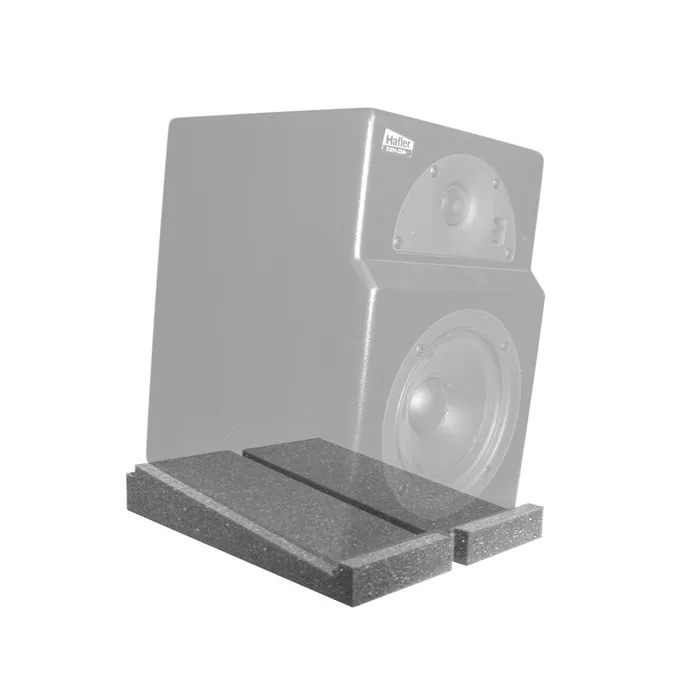
Plain high density polyurethane foam that does the decoupling job and, unusually, comes with a published spec sheet.
Best for: Anyone whose speakers already sit at roughly the right height and who just wants them off the desk without spending much.
- Primacoustic states the material as high density polyurethane foam and a load limit of 44 lb (20 kg), a figure that sounds like it was measured rather than rounded up.
- A fixed 6 degree slope that works either way up, so you can aim a monitor down from a meter bridge or up from a low desk.
- Primacoustic states the pads pass California's C117 fire retardant certification, which is a real third-party standard rather than a sound claim.
- The slope is fixed at 6 degrees, so you get one angle up, one down, and nothing in between.
- At 2 in (51 mm) tall it adds almost no height, so it will not fix a tweeter sitting below your ears.
- Primacoustic publishes no acoustic measurements for these pads, only a description of what decoupling does.
- Sold in boxes of four pieces at 12 x 4 in (305 x 102 mm) each, which is a slightly awkward quantity for one pair of monitors.
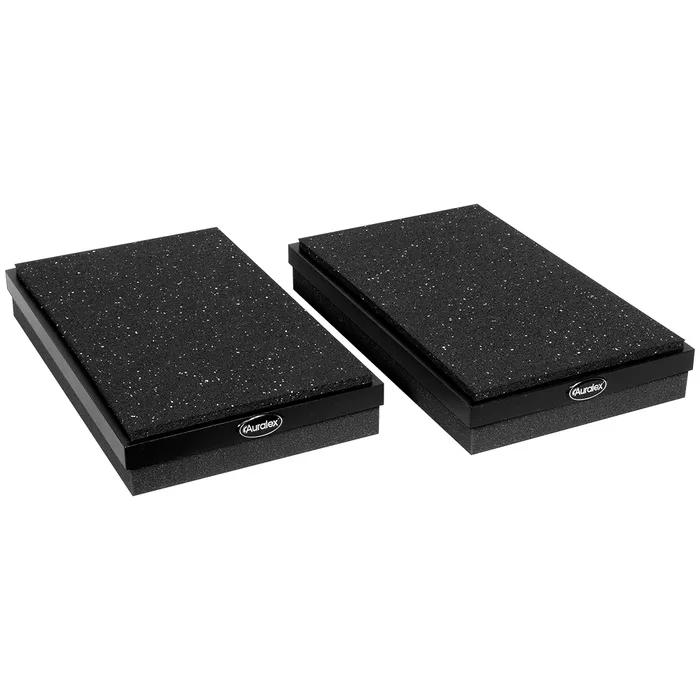
A three layer foam, rubber, and MDF platform that trades adjustability for mass and damping.
Best for: Someone on a hollow or resonant desk whose monitors are already close to ear height and who wants mass and grip more than adjustability.
- Three layer build that Auralex lists as a PlatFoam base, a damping rubber layer, and an MDF mass layer, which is more structure than a plain wedge.
- Ships as two platforms and two angling pieces, enough for a stereo pair.
- Flat 8 x 13 in (203 x 330 mm) footprint supports the whole base of most nearfield cabinets rather than two strips of it.
- The supplied wedge is only 3 degrees, far less angle than the plus or minus 8 degrees the Rockville set offers.
- Auralex does not publish a weight capacity for the ProPAD on its product page.
- Adds only 2.125 in (54 mm) flat or 3.125 in (79 mm) with the wedge, so it will not solve a height problem.
- The claims on the page are all adjectives, including increased midrange resolution and improved low frequency definition, with no measurement behind them.
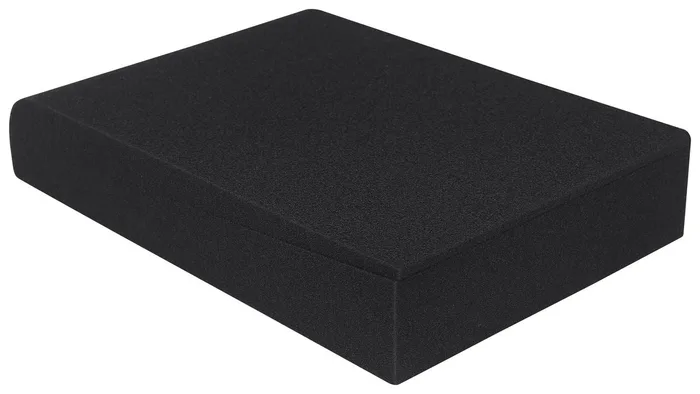
A very widely bought two-part foam wedge whose only published performance number is a load claim that does not mean much.
Best for: Almost nobody, though it will physically work if you need tilt today and the alternatives are unavailable.
- Five angle positions, flat plus or minus 4 degrees and plus or minus 8 degrees, which is more tilt range than the Primacoustic or Auralex options.
- Two pads in a box, enough for a stereo pair, at the lowest outlay in this group.
- Each pad is two 4 degree pieces, so changing the angle needs no extra parts.
- The headline spec is support for up to 100 lb, but a foam pad's usefulness depends on how far it compresses under load, and Rockville publishes no density, durometer, or compression figure.
- The material is described only as high quality, high density foam, with no polymer type or density given.
- Rockville's page gives a 7.5 x 9.5 in footprint but no height, so you cannot tell how much it raises the speaker.
- The page claims the pads eliminate vibrations and unwanted noises, an absolute that no compliant foam layer can deliver.
| Criteria | ISO-155 Isolation Stands Top pick | IsoWedge Monitor Isolation Pads | ProPAD Studio Monitor Isolation Pads | RRS190S Studio Monitor Isolation Pads |
|---|---|---|---|---|
| Verdict | Buy it | Buy it | It depends | Skip it |
| Best for | Someone whose monitors currently sit too low on a desk and who wants decoupling and correct tweeter height from one purchase. | Anyone whose speakers already sit at roughly the right height and who just wants them off the desk without spending much. | Someone on a hollow or resonant desk whose monitors are already close to ear height and who wants mass and grip more than adjustability. | Almost nobody, though it will physically work if you need tilt today and the alternatives are unavailable. |
| Price tier | $$$ · premium | $ · budget | $$ · mid-range | $ · budget |
| Type | Decoupling stand with adjustable height | Foam wedge | Foam, rubber, and MDF platform | Two-part foam wedge |
| Height added | 3 in to 8.2 in (76 to 210 mm) | 2 in (51 mm) | 2.125 in flat, 3.125 in with wedge | Not stated by maker |
| Tilt | Up to 6.5 deg up or down, set with inserts | Fixed 6 deg slope, usable either way | 3 deg wedge | Flat, plus or minus 4 deg, plus or minus 8 deg |
| Stated load limit | 40 lb (18 kg) short, 35 lb (16 kg) tall | 44 lb (20 kg) | Not published | Up to 100 lb claimed |
| Materials named by maker | ABS frame, stainless steel poles, proprietary isolators | High density polyurethane foam | PlatFoam base, rubber layer, MDF mass layer | High density foam, type not stated |
| Published test data | White paper on NRC anechoic and laser-vibrometry testing, run on the GAIA line | None acoustic; C117 fire rating stated | None | None |
| Footprint | 6.1 x 7.5 in (155 x 190 mm) per stand | 12 x 4 in (305 x 102 mm) per piece | 8 x 13 in (203 x 330 mm) per platform | 7.5 x 9.5 in per pad |
| What is in the box | Pair of stands | Four pieces | Two platforms plus two wedges | Two pads |
Which one is right for you?
- Someone whose monitors currently sit too low on a desk and who wants decoupling and correct tweeter height from one purchase. Buy it IsoAcoustics ISO-155 Isolation Stands
- Anyone whose speakers already sit at roughly the right height and who just wants them off the desk without spending much. Buy it Primacoustic IsoWedge Monitor Isolation Pads
- Someone on a hollow or resonant desk whose monitors are already close to ear height and who wants mass and grip more than adjustability. It depends Auralex ProPAD Studio Monitor Isolation Pads
- Almost nobody, though it will physically work if you need tilt today and the alternatives are unavailable. Skip it Rockville RRS190S Studio Monitor Isolation Pads
How we judged the field
Five things decide whether one of these is worth buying. First, does it actually decouple, meaning is there a compliant layer between the cabinet and the surface that stays compliant under the weight of your speaker rather than squashing flat. Second, does it get the speaker to the right height, because Genelec puts the acoustical centre of a two-way monitor at ear level, typically 1.2 to 1.4 m off the floor, and most desktop pads add two or three inches at most. Third, does it give you usable tilt, since Genelec also recommends aiming each monitor at the listening position within 15 degrees of tilt. Fourth, is the load rating honest, because a foam pad’s whole function depends on how far it compresses and a large round number with no density or durometer behind it tells you nothing. Fifth, does the maker publish anything checkable at all, which in this category turns out to be a real differentiator.
The field splits into three groups. There are rigid stands with isolating feet, which cost the most and are the only ones that meaningfully change height. There are plain foam wedges, which are cheap, do the decoupling job, and give you a fixed angle or a small set of angles. And there are mass-loaded platforms that sandwich foam under a rubber or steel deck, aiming to damp the cabinet and stabilise it rather than raise it. We took the ISO-155 as the best-executed stand, the Primacoustic IsoWedge as the foam wedge with the most verifiable spec sheet, the Auralex ProPAD as the mass-loaded option most people encounter, and the Rockville RRS190S as the budget wedge that sells in enormous numbers and deserves a hard look.
IsoAcoustics ISO-155 Isolation Stands
Buy itThe IsoAcoustics ISO-155 is the only product here that treats height as part of the problem. IsoAcoustics lists a short setting of 3 in (76 mm) and a tall setting of 8.2 in (210 mm), built from ABS frames, stainless steel poles, and proprietary isolators, with 14 combinations of height and tilt and up to 6.5 degrees either way. That range separates it from every foam option: it can take a monitor sitting on a low desk and put the tweeter near your ears, which is the change most people actually hear. IsoAcoustics is also the only maker here to publish a white paper describing anechoic chamber and laser scanning vibrometry testing at the National Research Council of Canada. Read it carefully, though. That testing was run on the GAIA hi-fi isolators, not on the ISO stands, and the published text gives no numeric results, only a description of the graphs. Note too that the load rating falls from 40 lb (18 kg) short to 35 lb (16 kg) tall. It is right for someone whose monitors are too low and who wants one purchase to fix both problems.
Primacoustic IsoWedge Monitor Isolation Pads
Buy itThe Primacoustic IsoWedge is a wedge of high density polyurethane foam, 2 x 12 x 4 in (51 x 305 x 102 mm), cut with a 6 degree slope, and it is the most honestly documented cheap product in this comparison. Primacoustic states the material, states a load limit of 44 lb (20 kg), and states that the pads pass California’s C117 fire retardant certification, which is a real third-party standard even though it has nothing to do with sound. That is a modest amount of information, but it is more than most of this category offers, and a 44 lb figure reads like something that was actually established rather than rounded up for a listing. What you do not get is flexibility. The slope is fixed, so your options are 6 degrees down, 6 degrees up if you flip it, or nothing. At 2 in tall it will not raise a tweeter meaningfully. Primacoustic publishes no acoustic measurements. It is the right buy for someone whose speakers already sit at a sensible height and who simply wants the cabinet off the desk without much spending.
Auralex ProPAD Studio Monitor Isolation Pads
It dependsThe Auralex ProPAD is a different idea: rather than a compliant wedge, it is a three layer platform that Auralex describes as a PlatFoam base, a damping rubber layer, and an MDF mass layer, measuring 8 x 13 in (203 x 330 mm) and 2.125 in (54 mm) tall, or 3.125 in (79 mm) with the supplied wedge. The mass layer and the rubber damping layer are the real arguments for it: a heavy, damped deck under the speaker is a sensible response to a hollow desk that rings. But the trade-off is stark. The wedge is only 3 degrees, which is far less angle than the Rockville set gives you, Auralex does not publish a weight capacity at all, and the height gain is negligible. The claims on the product page run to increased midrange resolution and improved low frequency definition with no measurement attached. It is worth it for someone with a resonant desk whose monitors are already at ear height, and a poor choice for anyone who needs to aim their speakers.
Rockville RRS190S Studio Monitor Isolation Pads
Skip itThe Rockville RRS190S is one of the most widely bought isolation pads there is, and mechanically it does the same thing as the Primacoustic wedge: a two-part high density foam pad, 7.5 x 9.5 in, giving flat, plus or minus 4 degrees, or plus or minus 8 degrees. On tilt range it actually beats both of our buys. The problem is that everything else about it is unverifiable. The material is described only as high quality, high density foam, with no polymer type and no density figure, and the headline spec is support for up to 100 lb, which says nothing about how far the foam deflects under a speaker. Compression is the entire point of a compliant layer, and a pad that flattens under load has stopped isolating. Rockville’s page also claims the pads eliminate vibrations and unwanted noises, an absolute no foam layer delivers. It is not a scam and it will tilt your speaker, but there is no reason to prefer it over a pad whose maker will tell you what it is made of.
Sources
Specs in this review come from these pages.
- IsoAcoustics ISO-155 Isolation Stands product page (isoacoustics.com)
- IsoAcoustics testing at the National Research Council of Canada (isoacoustics.com)
- Primacoustic IsoPads product page (primacoustic.com)
- Auralex ProPAD product page (auralex.com)
- Genelec monitor placement guide (genelec.com)
- Genelec Iso-Pod Stand technology page (genelec.com)
IsoAcoustics ISO-155 Isolation Stands vs Primacoustic IsoWedge Monitor Isolation Pads: which should you buy?
The choice between the ISO-155 and the IsoWedge is not really a choice between two isolation products. It is a choice about whether you have a height problem. Get a tape measure, sit in your listening position, and find where your tweeter is relative to your ears. If it is well below them, the ISO-155 is worth its cost because 3 to 8.2 inches of adjustable height plus 6.5 degrees of tilt puts the acoustic axis where Genelec says it should be, roughly 1.2 to 1.4 m off the floor and aimed at you. That single change will be more audible than anything the isolators underneath are doing. If the tweeter is already close to ear height, most of what you are paying IsoAcoustics for is height you do not need.
In that second case the IsoWedge does the remaining job for very little. It decouples, it gives you 6 degrees of correction either way, and Primacoustic will at least tell you the material and a load limit you can check against your speaker’s weight. The honest summary is that the expensive product is better in a way that has more to do with geometry than with materials science, and neither company has published a measurement that would let you compare their isolation performance directly. Buy the stand if your speakers are in the wrong place vertically; buy the wedge if they are already in the right place and you just want them off the desk.
What to look for
- Fix position before you fix isolation: walls and corners reinforce bass, so where the speaker sits will outweigh what it sits on.
- Check the height, not just the pad: Genelec puts the acoustical centre of a two-way monitor at ear level, typically 1.2 to 1.4 m from the floor, and a 2 in foam wedge does almost nothing about a speaker that is six inches too low.
- Treat load ratings as compression clues: a stated 44 lb (20 kg) limit from Primacoustic or 40 lb (18 kg) from IsoAcoustics tells you something about how the material behaves; a round 100 lb claim on a small foam wedge does not.
- Look for a named material: high density polyurethane foam is a description you can reason about, high quality foam is not, and the makers who name the polymer tend to be the ones who publish the rest of the spec sheet too.
- Discount adjectives about the soundstage: every product in this category promises clarity, focus, and tighter bass, and none of the four here publishes a measurement supporting those specific claims.
- Match the footprint to the cabinet: a monitor overhanging its pad concentrates load on part of the foam and compresses it unevenly, so check the pad’s stated dimensions against the actual base of your speaker before ordering.
Our final take
Buy the IsoAcoustics ISO-155 if your monitors sit too low, because it fixes height, tilt, and decoupling in one purchase and IsoAcoustics is the only maker here that publishes any third-party lab testing at all, even if that testing was on a different product line. Buy the Primacoustic IsoWedge if your speakers are already at the right height and you just want them off the desk, because it names its material, states a believable load limit, and costs very little. Consider the Auralex ProPAD only if your desk rings and your aim is already correct. Skip the Rockville RRS190S. And before any of it, move your speakers away from the corner and get the tweeters up to your ears, because that is where the real gain lives.
Questions, answered
Do isolation pads actually make a difference, or is it placebo?
The mechanical part is real and manufacturers describe it consistently. A speaker cabinet vibrates, and when it rests directly on a desk or shelf that structure is driven by the cabinet and radiates sound of its own. Genelec's own Iso-Pod page states that vibration isolation and damping reduce midrange coloration caused by vibration transmitted to supporting surfaces. What is far less supported is the leap from that to claims about tighter bass or a deeper soundstage, because no maker in this comparison publishes a measurement of how much difference their product makes. Expect a cleaner midrange on a hollow desk and a lot less complaint from the person below you, not a transformed speaker.
Will a pad fix boomy bass in my room?
Usually not, and this is the most common mistake people make with this category. Boomy or missing bass in a small room is dominated by where the speaker sits relative to walls and corners, because nearby boundaries reinforce low frequencies. Genelec's placement guidance asks for the same distance to the side walls and the wall behind for each speaker in a stereo pair. Nothing a foam pad does operates on that scale. Move the speaker first, then add a pad, and judge the pad on its own smaller merits.
Is the tilt doing more than the isolation?
Often, yes, and it is worth being honest about that. Genelec recommends putting the monitor's acoustical centre at ear level, typically 1.2 to 1.4 m from the floor, aiming each monitor at the listening position, and keeping tilt within 15 degrees. If your tweeter currently fires at your collarbone, correcting that changes what you hear far more than any foam layer will. That is also why a tall stand like the ISO-155 can feel like a bigger upgrade than a wedge: it is fixing an aiming problem and a vibration problem at the same time. If your speakers are already aimed correctly, the tilt half of a pad's value is already spent.
Which makers publish any measured data?
Very few, and the picture is not what marketing budgets would suggest. IsoAcoustics publishes a white paper describing anechoic chamber and laser scanning vibrometry testing at the National Research Council of Canada, which is more transparency than anyone else in this group offers, but the tested product was the GAIA isolator line rather than the desktop ISO stands, and the text gives no numeric results. Primacoustic publishes material type, a 44 lb load limit, and a C117 fire rating. Auralex and Rockville publish dimensions and adjectives. Nobody in this comparison publishes a resonance frequency, a transmission loss figure, or a durometer value for their isolation material.
How do I know if the pad is too soft or too firm for my speaker?
Look at what happens under load rather than at a headline capacity number. A pad that squashes nearly flat under your monitor has stopped acting as a compliant layer and is close to coupling the speaker back to the desk, and a pad that barely deflects at all was never decoupling much to begin with. Primacoustic quotes a 44 lb (20 kg) limit and IsoAcoustics quotes 40 lb (18 kg) at the short setting, and those are the kind of figures worth matching to your speaker's actual weight. Treat a 100 lb claim on a small foam wedge as marketing, not guidance. Set the speaker down, look at it from the side, and confirm the pad still has visible thickness left.
Deciding between the top two? See our head-to-head: IsoAcoustics ISO-155 Isolation Stands vs Primacoustic IsoWedge Monitor Isolation Pads.
More Audio & Headphones reviews
 The Best Sports Earbuds: 4 Compared (and One to Skip)
  The Best Stereo Amplifiers: 4 Compared (and One to Skip)
  The Best Studio Monitors: 4 Compared (and One to Skip)
  The Best Turntable Stylus Cleaners: 4 Compared (and One to Skip)
  The Best Home Subwoofers: 4 Compared (and One to Skip)
  The Best Budget True Wireless Earbuds (and the One to Skip)