Explained
Speaker Stands, Explained
After reading this, you will know exactly what height your stands need to be, why mass matters more than looks, and which spec-sheet numbers are safe to ignore.
In this guide
A speaker stand does two things: it puts the tweeter at the height of your ears and it gives the cabinet a base that will not rock, sway or ring. That sounds trivial, and it is the reason a modest bookshelf speaker on proper stands beats an expensive one shoved on a shelf. First-time buyers get tripped up by picking a height that looks right in a photo, by treating adjustability as a feature rather than a weakness, and by ignoring whether the top plate is actually big enough to hold the speaker they own.
The 30-second version
- Height is the whole game. Your tweeter should land at seated ear level, and a cheap stand at the right height will out-perform an expensive one at the wrong height every time.
- Mass is the cheapest upgrade. A fillable column loaded with sand or steel shot stops the stand from rocking and stops the structure from ringing along with the music.
- Measure the top plate against your speaker. The plate should support the whole base of the cabinet, not leave the rear corners hanging over empty air.
- Spikes are for carpet, rubber is for hard floors. Using the wrong feet either marks your floor or leaves the stand perched on pile, and good stands include both sets.
- Height adjustability is usually a downgrade. A telescoping joint sits in the middle of the column, which is exactly where you want the structure to be stiffest.
The products this guide is about
Our verdict on each, with the full reasoning on the companion review.
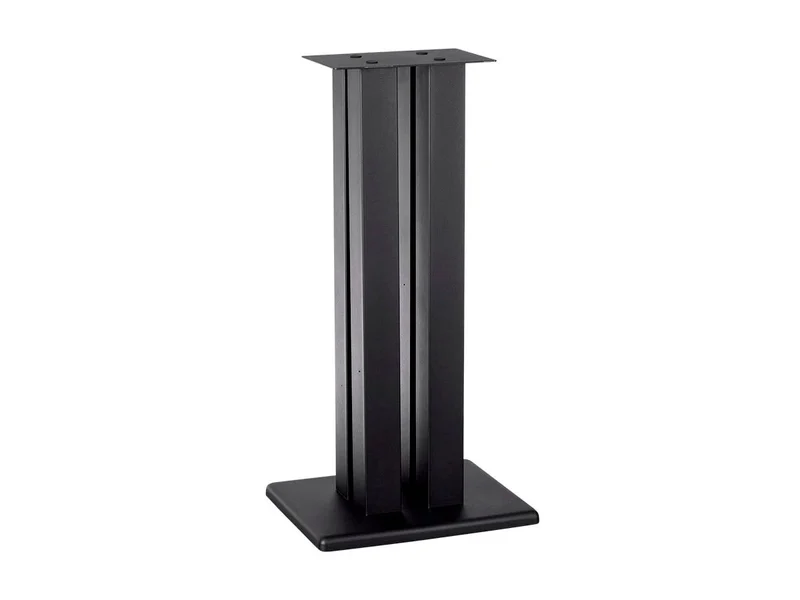
- Buy Monoprice Monolith by Monoprice 28in Speaker Stand Four fillable steel columns, a 100 lb rating and a sold-singly model that makes it the default for stereo and multichannel alike.
- Buy Kanto SX26 Fillable Speaker Stands The most thoughtfully finished fillable stand here, with contained fill bags, two top plates, a bubble level and genuinely hidden cables.
- It depends Sanus BF31 Basic Series Speaker Stands A tidy, cheap MDF-pillar pair that works well within its limits and falls apart as a recommendation the moment your speakers get heavy.
- Skip VideoSecu MS08B Adjustable Speaker Stands A telescoping clamp-top pole that gets small satellites high, and gets everything else wobbling.
What actually matters
- Height matched to seated ear level. Measure your ear height sitting on the sofa you actually use, then measure from the bottom of the speaker to the center of the tweeter and subtract. That number is your stand height, and for most bookshelf speakers it lands somewhere in the mid-20-inch range rather than the tall stands people assume they need.
- Mass and whether the column can be filled. A hollow column rings and a light stand rocks. Filling the column with sand or steel shot adds weight and damping at once, which is why fillable designs are worth seeking out even if you fill them later.
- Top-plate size versus your speaker's footprint. The plate carries the cabinet's whole base. If the speaker overhangs at the back or sides, the load path is concentrated and the stability you paid for goes away. Check plate dimensions against your cabinet before ordering.
- Load rating with margin. A stand working near its rated limit is a stand that flexes. Look for a rating comfortably above your speaker's weight rather than barely above it, especially on light MDF or thin-tube designs.
- Floor coupling hardware. Spikes for carpet, rubber or silicone for hardwood, tile and laminate. Threaded, adjustable feet also let you level the stand on an uneven floor, which matters more in older homes than anyone expects.
- Cable routing. Internal routing through the column keeps speaker cable invisible and out of the walkway. Stands without it need a plan for where the wire goes before you position everything.
- Sold as pairs or singles. For a surround system, stands sold individually let you buy three or five without paying for one you will never use.
The specs, in plain English
Green flags vs red flags
Green flags
- The stand is offered in several fixed heights, so you can match seated ear level instead of settling for whatever one height gives you
- A fillable column, ideally with supplied fill bags and ties so the sand goes in contained and comes out again if you move
- Both spikes and rubber or silicone feet in the box, on adjustable threads that let you level on an uneven floor
- A top plate quoted in real dimensions, wide and deep enough to fully support your speaker's base
- A load rating well above your speaker's weight rather than just above it
- Internal cable routing that enters near the plate and exits at the base
Red flags
- A telescoping or height-adjustable column being sold as the main feature, with no way to add mass
- Clamp brackets that grip the sides of a speaker instead of supporting its footprint from below
- A small top plate paired with a high load rating, which is a mismatch that will not hold a real bookshelf speaker steadily
- A tall stand advertised for bookshelf speakers, which usually puts the tweeter above ear level in a normal living room
- A thin hollow tube that is sealed and cannot be filled, so the mass you have is the mass you will always have
- A small base footprint under a stand designed to reach a lot of height
Who's who: the brands
- Monoprice (Monolith) - Its Monolith line focuses on heavy fillable steel columns with high load ratings, and stands are commonly sold singly, which suits surround systems.
- Kanto - Known for well-finished fillable stands with contained fill bags, multiple top-plate options and genuinely internal cable routing, at a premium over basic pairs.
- Sanus - A mainstream AV mounting brand whose budget stands use solid MDF pillars with concealed wire paths, tidy but with modest weight limits.
- VideoSecu - A high-volume budget brand best known for telescoping clamp-top poles aimed at small satellites rather than real bookshelf speakers.
- Pangea Audio - An audio-specialist brand offering heavy fillable stands for stand-mount monitors, aimed at listeners who care more about mass than about price.
- Atacama - A long-running British stand maker whose fillable steel designs are a familiar reference point in hi-fi circles for mass-loaded construction.
How to read a listing without getting fooled
Ignore the marketing photo and start with two measurements you take yourself: your ear height while seated on the actual sofa, and the distance from the bottom of your speaker to the center of the tweeter. Subtract the second from the first and you have the stand height you need. Next, find the top-plate dimensions in the specification list and compare them to the width and depth of your speaker's base, because listings love to show a small speaker perfectly centered on a plate that is too small for anything larger. Read the load rating as a limit rather than a promise, and be skeptical when a high rating sits next to a small base or a telescoping joint. Check whether the column can be filled and whether fill bags are supplied, since an unfillable stand can never be improved. Then look at what is in the box: spikes and rubber feet, top-plate pads, a level, and whether the cable path runs fully through the column or only hides part of the run. Finally, scan long-term owner reports for the words wobble, flex and tipping, because stability problems show up in use and never in specifications.
How much should you spend?
Cost in this category tracks materials and mass more than technology. The cheapest stands are light, sealed, and often adjustable, which is the combination that works against everything a stand is supposed to do. Stepping up to a fixed-height fillable design is the biggest single improvement available, and it is where the value sweet spot sits: you get a column you can load with sand, a top plate sized for real cabinets, both sets of feet, and a load rating with margin. Above that, extra money buys finish and convenience rather than more stability, things like contained fill bags instead of loose sand, a second top plate for different cabinet widths, a bubble level, silicone floor protectors and fully hidden cable routing. Those are worth paying for when the stands sit in a room you look at every day, or when your speakers only fit properly on a particular plate size. What is rarely worth paying for is height adjustability, exotic finishes, or a load rating far beyond anything a bookshelf speaker will ever demand. Spend enough to get mass and the right height, then stop.
Questions, answered
How tall should my speaker stands be?
Tall enough that the tweeter sits at your seated ear level. Sit on the sofa you actually use and measure from the floor to your ears, which usually lands somewhere in the mid-30s to low-40s of inches. Then measure from the bottom of your speaker to the center of the tweeter and subtract that from your ear height. Most bookshelf speakers end up wanting a stand in the mid-20-inch range. Taller stands only make sense for short speakers, unusually high seating, or surrounds meant to fire from above head height.
Why does the same speaker sound worse on a desk or a shelf?
Three reasons, and none of them are mysterious. The tweeter ends up well below or above your ears, so you lose treble detail and the stereo image collapses. The shelf or desk surface is large and thin, so the speaker drives it like a second, badly designed cabinet and adds boom and blur. And a nearby wall, shelf back or desk surface reinforces bass unevenly, which is what people mean when they say a speaker sounds muddy or boxy indoors. A stand fixes all three at once by raising the tweeter, decoupling the speaker from a resonant surface, and letting you pull it away from boundaries.
Should I fill my stands, and with what?
Fill them if the design allows it. Kiln-dried play sand is the cheap standard, steel shot is denser and costs more, and dry cat litter is a common improvised option. Use the supplied bags if the stand includes them, because loose sand eventually finds every seam. Leave a little air at the top rather than packing the column solid, and keep the filler dry. Adding mass makes the stand harder to rock and stops the column ringing, which is most of what a stand contributes.
Spikes or rubber feet: which should I use?
Spikes for carpet, rubber or silicone for hardwood, tile and laminate. On carpet the spikes push through the pile so the stand rests on the subfloor instead of on springy fibers. On a hard floor spikes will mark the finish and concentrate the load on four tiny points, so the supplied rubber or silicone feet are both safer and steadier. Most decent stands include both sets, and adjustable threads let you level the stand afterwards.
Do I need isolation pads on top, and does putty work?
Something between the speaker and the bare plate is worth having. Foam or neoprene pads stop the cabinet creeping forward over time and stop it chattering against metal. A small blob of removable adhesive putty at each corner does the same job, grips a little better, and comes off cleanly. Neither is a magic upgrade. The goal is simply that the speaker and the stand behave as one object rather than two that can rattle against each other.
Are adjustable-height stands a good idea?
Rarely, for bookshelf speakers. The adjustment mechanism puts a joint in the middle of the column, which is where you most want stiffness, and telescoping designs almost never accept mass loading. That leaves a light stand with a flex point and a small base. Their real use case is small satellite speakers with no flat bottom, in rooms where nobody will walk into them, and even then a wall bracket is often steadier. For anything that counts as a bookshelf speaker, buy the correct fixed height instead.
Or jump to the head-to-head: Monoprice Monolith by Monoprice 28in Speaker Stand vs Kanto SX26 Fillable Speaker Stands.