

Audio & Headphones
The Best Speaker Stands: 4 Compared (and One to Skip)
We compared four current speaker stands on height, mass loading, top-plate fit, isolation hardware and cable routing for bookshelf and surround speakers.
The short version
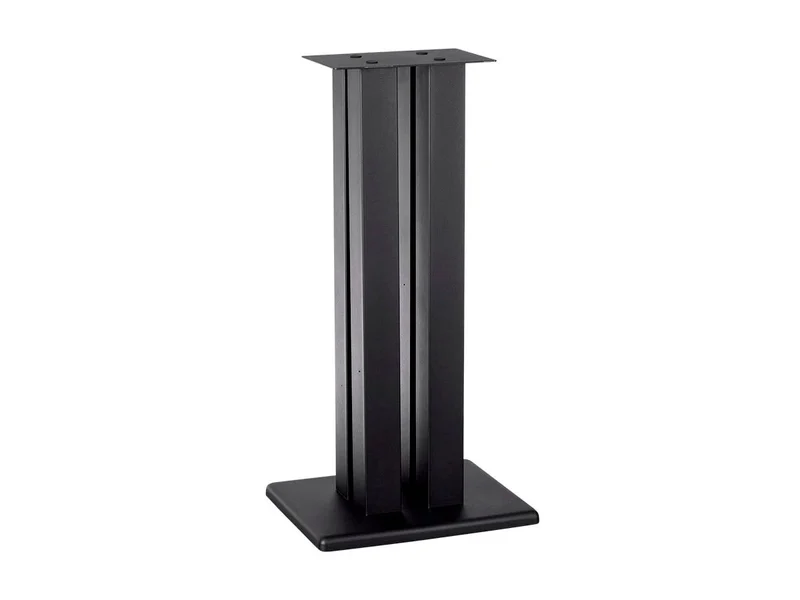
Buy the Monolith by Monoprice 28in Speaker Stand if you want the most mass and stability per dollar: four fillable steel columns, a 100 lb rating and singles rather than forced pairs. Buy the Kanto SX26 if the stands live in a room you look at, since the contained fill bags, two top plates, spikes with silicone protectors and internal cable path are the tidiest execution here. The Sanus BF31 is a reasonable cheap pair for light speakers, but the 20 lb ceiling, unfillable pillar and small top plate limit it, and its 31 inch height suits fewer rooms than people expect. Skip the VideoSecu MS08B for bookshelf speakers: a telescoping pole with clamp brackets and a small base cannot be mass loaded and stays easy to knock. Match height to seated ear level first, then buy the heaviest stand that fits your speaker's footprint. Best for: anyone putting real bookshelf speakers on stands who wants stability and correct tweeter height rather than a height-adjustable compromise.
Our picks at a glance
- Monoprice Monolith by Monoprice 28in Speaker Stand - Buy. Four fillable steel columns, a 100 lb rating and a sold-singly model that makes it the default for stereo and multichannel alike.
- Kanto SX26 Fillable Speaker Stands - Buy. The most thoughtfully finished fillable stand here, with contained fill bags, two top plates, a bubble level and genuinely hidden cables.
- Sanus BF31 Basic Series Speaker Stands - It depends. A tidy, cheap MDF-pillar pair that works well within its limits and falls apart as a recommendation the moment your speakers get heavy.
- VideoSecu MS08B Adjustable Speaker Stands - Skip. A telescoping clamp-top pole that gets small satellites high, and gets everything else wobbling.
The verdict in 30 seconds
What mattered most
- Height options
- Fillable column
- Top plate and fit
- Rated load
- Isolation hardware
- Cable routing
A speaker stand has one job: hold the tweeter at seated ear level on a base that will not rock, sway or ring. Everything past that is convenience. We compared four stands that cover the real decision, from a heavy fillable steel pillar to a telescoping satellite pole, and the gap between the best and worst here is larger than the price difference suggests.
Four fillable steel columns, a 100 lb rating and a sold-singly model that makes it the default for stereo and multichannel alike.
Best for: Anyone with real bookshelf speakers who wants maximum mass per dollar and may need an odd number of stands.
- All four hollow steel columns take sand or steel shot, so you can tune mass and damping yourself
- Roughly 24 lb empty before filling, with a 100 lb rating that no bookshelf speaker will trouble
- Wide rectangular top plate suits deep or wide cabinets, and even a center channel
- Sold as singles, so a 3.1 or 5.1 system does not leave you with a spare stand
- Adjustable spikes for carpet plus rubberized top pads in the box
- Filling four columns with sand is a messy afternoon job you only want to do once
- No rotating top plate and no dedicated internal cable channel, so wires tuck between the columns
- At 28 inches it is tall for low sofas, and the 24 inch version is the safer default there
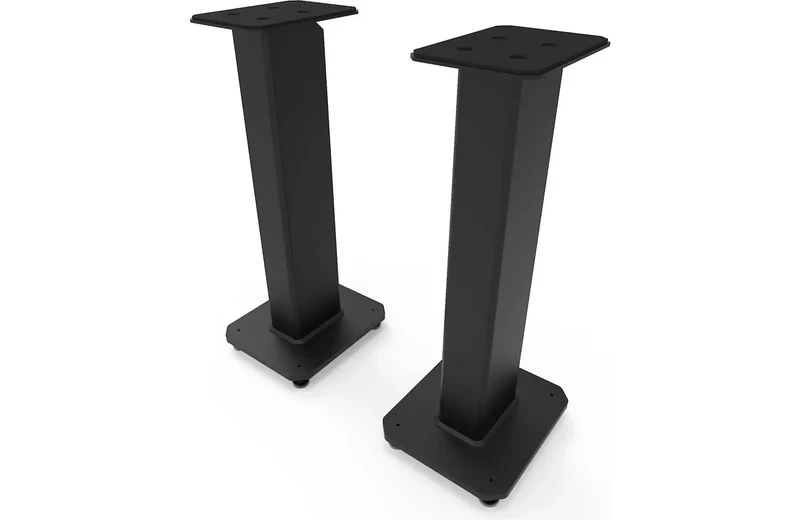
The most thoughtfully finished fillable stand here, with contained fill bags, two top plates, a bubble level and genuinely hidden cables.
Best for: Listeners with resolving stand-mount monitors in a visible living space who want the finish and the fit to match the speakers.
- Single wide fillable column with supplied fill bags and ties, far cleaner than pouring loose sand
- Two top-plate sizes with foam pads, so narrow and wide cabinets both sit properly supported
- Spiked feet, silicone floor protectors and a bubble level included for a level, rattle-free setup
- Cable routing runs fully inside the column and exits at the base
- Sold in 22, 26 and 30 inch heights, so you can match seated ear level instead of settling
- Costs roughly double the fillable competition per pair
- Rated to about 30 lb, which is plenty for bookshelf speakers but well under the steel-column alternative
- Top plates are sized for typical monitors and get tight under unusually wide cabinets
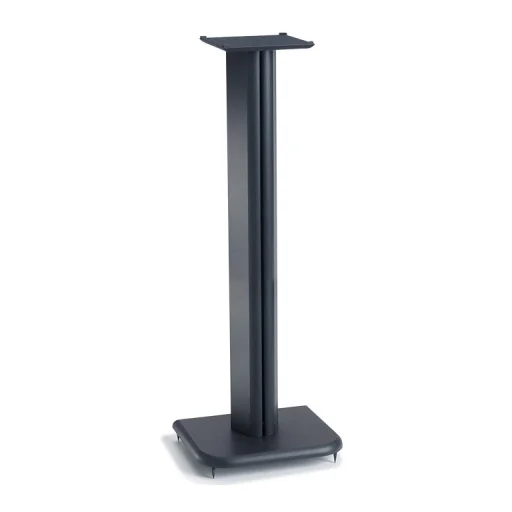
A tidy, cheap MDF-pillar pair that works well within its limits and falls apart as a recommendation the moment your speakers get heavy.
Best for: Small, light speakers or surrounds where budget and a clean look matter more than mass loading.
- Solid energy-absorbing MDF pillar rather than a thin hollow tube
- Concealed wire path keeps speaker cable out of sight
- Neoprene isolation pads for hard floors and push-in spikes for carpet, both included
- Assembles in minutes and sold as a pair, which keeps the total low
- Rated for speakers up to 20 lb, which rules out most heavier monitors
- The pillar cannot be filled, so you cannot add mass later
- The 5 by 5 inch top plate is small under wide or deep cabinets
- At 31 inches it overshoots seated ear level for a lot of rooms, and the 24 inch sibling is often the right call
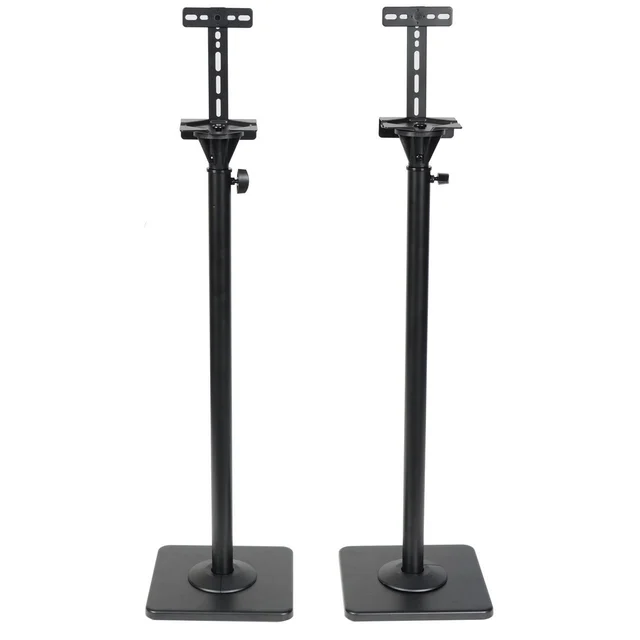
A telescoping clamp-top pole that gets small satellites high, and gets everything else wobbling.
Best for: Very small satellite cubes in a low-traffic room, and only when a wall bracket is not an option.
- Height adjusts across a wide range, useful for odd surround placements
- Clamp brackets fit satellites that have no flat bottom to rest on a plate
- Cable runs inside the column and base
- The telescoping joint is a flex point, and the base footprint is small for the heights it reaches
- Brackets clamp the sides instead of supporting the full speaker footprint
- No way to add mass, so the whole assembly stays light and easy to knock
- The 20 lb rating is theoretical: stability runs out long before the rating does
| Criteria | Monolith by Monoprice 28in Speaker Stand Top pick | Kanto SX26 Fillable Speaker Stands | Sanus BF31 Basic Series Speaker Stands | VideoSecu MS08B Adjustable Speaker Stands |
|---|---|---|---|---|
| Verdict | Buy it | Buy it | It depends | Skip it |
| Best for | Anyone with real bookshelf speakers who wants maximum mass per dollar and may need an odd number of stands. | Listeners with resolving stand-mount monitors in a visible living space who want the finish and the fit to match the speakers. | Small, light speakers or surrounds where budget and a clean look matter more than mass loading. | Very small satellite cubes in a low-traffic room, and only when a wall bracket is not an option. |
| Price tier | $$ · mid-range | $$$ · premium | $ · budget | $ · budget |
| Height options | 24in or 28in, fixed | 22in, 26in or 30in, fixed | 31in fixed (24in sibling available) | Telescoping, roughly 26.5in to 46in |
| Fillable column | Yes, all four steel columns | Yes, one wide column with fill bags supplied | No, solid MDF pillar | No, hollow steel tube |
| Top plate and fit | Wide rectangular plate, handles wide cabinets | Two plate sizes with foam pads | 5 by 5 inch plate with neoprene pads | Side-clamping brackets for satellites |
| Rated load | Up to 100 lb | About 30 lb | Up to 20 lb | 20 lb on paper, far less in practice |
| Isolation hardware | Adjustable spikes plus rubber top pads | Spikes, silicone protectors, foam pads, bubble level | ABS push-in spikes plus neoprene pads | Adjustable rubber feet only |
| Cable routing | Tucked between the columns, no dedicated channel | Fully internal, exits at the base | Concealed path through the pillar | Through the column and base |
| Sold as | Single stand, buy as many as you need | Pair | Pair | Pair |
| Price tier | $$ · mid-range | $$$ · premium | $ · budget | $ · budget |
Which one is right for you?
- Anyone with real bookshelf speakers who wants maximum mass per dollar and may need an odd number of stands. Buy it Monoprice Monolith by Monoprice 28in Speaker Stand
- Listeners with resolving stand-mount monitors in a visible living space who want the finish and the fit to match the speakers. Buy it Kanto SX26 Fillable Speaker Stands
- Small, light speakers or surrounds where budget and a clean look matter more than mass loading. It depends Sanus BF31 Basic Series Speaker Stands
- Very small satellite cubes in a low-traffic room, and only when a wall bracket is not an option. Skip it VideoSecu MS08B Adjustable Speaker Stands
How we judged the field
We do not run a lab. We synthesize independent testing, manufacturer specifications and a wide pool of owner reports, then weight the criteria that survive contact with a real room. For stands, that list is short and unglamorous: mass and rigidity, top-plate area relative to the speaker’s footprint, height relative to seated ear level, how the stand couples to the floor, and whether the cable path is genuinely hidden or just claimed.
We also weighted build details that only show up after a year of ownership. Whether the column can be filled and refilled without shedding sand into the carpet. Whether the feet thread far enough to level a stand on an uneven floor. Whether the stands are sold as pairs, which quietly matters if you are building a 3.1 or 5.1 system and need an odd count. And whether the top plate is large enough that the speaker’s rear corners are actually supported rather than overhanging into space.
One thing we deliberately did not weight: height adjustability. It sounds like flexibility and usually buys you a joint in the middle of the column, which is exactly where you want the structure to be stiffest.
This is the most stand per dollar in the comparison, and it is not close. Four hollow steel columns rise from a plate base to a wide rectangular top plate, and all four columns take sand or steel shot. Empty, each stand already weighs around 24 lb. Filled, it becomes the kind of object you do not accidentally move. The rating is 100 lb, which no bookshelf speaker will ever approach, and that headroom is the point: the structure is not working near its limit.
The wide top plate is the underrated feature. Deep or wide cabinets sit fully supported, and the same plate takes a center channel, which is why this stand shows up in home theater builds as often as in two-channel systems. It ships with adjustable spikes for carpet and soft rubberized pads for the top plate. Monoprice sells them individually rather than in pairs, so a five-channel setup does not leave you with a spare.
The compromises are real but small. Filling four columns is messy work, and you want to do it once, in a garage, with a funnel. There is no rotating plate for toe-in, so you aim the whole stand. Cables tuck between the columns rather than running through a dedicated channel, which looks fine from a listening seat and less tidy from three feet away. And 28 inches is on the tall side: if your sofa is low, the 24 inch version in the same family is the better height match.
The SX26 is what happens when someone designs a fillable stand for people who do not enjoy pouring sand. One wide central column takes supplied fill bags secured with ties, so the mass goes in contained and comes out again if you move house. That single detail removes the main reason people buy fillable stands and never fill them.
The rest of the package is consistently well thought out. Two top-plate widths ship in the box with foam pads, so a narrow monitor and a wider cabinet are both properly supported. Spiked feet handle carpet, silicone protectors handle hardwood, and a bubble level is included so you can actually get the stand plumb instead of eyeballing it. Cable routing runs inside the column and exits at the base, which is the cleanest implementation here. It comes in 22, 26 and 30 inch heights, so you can match ear level rather than accept whatever a single height gives you.
What you pay for is fit and finish. The pair costs roughly double the Monolith equivalent, and the rating of about 30 lb, while ample for bookshelf speakers, is a fraction of what the steel-column stand claims. If your speakers are unusually wide, check the plate dimensions against your cabinet before ordering, because these plates are sized for typical monitors rather than outliers.
The BF31 is a competent budget pair with a clearly drawn boundary. A solid MDF pillar, which absorbs energy better than a thin hollow tube, supports a 5 by 5 inch top plate with neoprene isolation pads. There is a concealed wire path, push-in spikes for carpet, and an assembly that takes about fifteen minutes. For small, light speakers, it does the job and looks tidy doing it.
The limits arrive quickly. The rating is 20 lb, which excludes a lot of the heavier monitors people buy stands for. The pillar is solid, so mass loading is not an option and never will be. The top plate is small enough that a wide cabinet will overhang, which undermines the stability you paid for. And at 31 inches, this is a tall stand: pair it with a normal bookshelf speaker and the tweeter can end up above seated ear level in most living rooms. Sanus sells a 24 inch version in the same series that is the right answer more often than the 31 inch one.
Buy it if your speakers are genuinely small and light, your budget is fixed, and you have measured the height. Otherwise the extra spend on a fillable stand buys more than it looks like on paper.
This is the stand people buy when they search for speaker stands and sort by price, and it is the one we would steer you away from. A telescoping steel pole adjusts across a wide height range and terminates in side-clamping brackets rather than a supporting plate. The base is a modest square plate, and there is no provision for adding mass anywhere.
Each of those choices trades stability for flexibility. The telescoping joint sits in the middle of the column, where you want maximum stiffness, and it is the first thing that flexes when a speaker cabinet pushes back. The clamp brackets grip the sides of the speaker instead of supporting its footprint, so the load path is concentrated rather than spread. And a light stand extended toward the top of its range with a speaker on it is easy to knock, which owners report exactly as you would predict.
It has a narrow use case: tiny satellite cubes with no flat bottom, in a room where nobody is going to walk into them. Even there, a wall bracket usually costs less and holds the speaker more securely. For anything that qualifies as a bookshelf speaker, this is the wrong tool.
Monolith 28in vs Kanto SX26: which should you buy?
Both are fillable, both are properly rigid, and either will beat a shelf or a side table. The decision comes down to what you are optimizing.
Buy the Monolith if you want maximum stability per dollar, if your speakers are large or heavy, or if you need an odd number of stands. Four steel columns, a 100 lb rating and a wide top plate give you margin everywhere, and the singles model means a 5.1 build costs what it should. Accept a messy fill job, a fixed plate and cables that tuck rather than disappear.
Buy the Kanto SX26 if the stands sit in a room you actually look at. Contained fill bags, two top plates, a bubble level, silicone floor protectors and fully internal cable routing add up to a setup that goes together cleanly and stays that way. You are paying a premium for the finish and the choice of three heights, and you are giving up load headroom you were unlikely to use.
If your seated ear level says 26 inches and your speakers weigh under 30 lb, the Kanto is the easier stand to live with. If it says 24 or 28 inches, or your speakers are heavy, the Monolith wins on physics and on price.
What to look for
- Height, measured not guessed. Sit on the actual sofa, measure your ear height, then subtract the distance from the bottom of your speaker to the center of the tweeter. That number is your stand height.
- A fillable column. Mass is the cheapest upgrade a stand can offer. Prefer designs with contained fill bags or a wide single column over four narrow tubes if you would rather not make a mess.
- Top plate versus speaker footprint. The plate should support the speaker’s base, not leave the rear corners hanging. Check the plate dimensions against your cabinet before ordering.
- Load rating with margin. A stand working near its rating is a stand that flexes. Look for a rating well above your speaker’s weight rather than just above it.
- The right feet for your floor. Spikes for carpet, rubber or silicone for hard floors. Good stands include both, and adjustable feet let you level on an uneven floor.
- A real cable path. Internal routing beats a channel that only hides part of the run. If the stand has none, plan how the cable will reach the speaker before you position everything.
- Pairs versus singles. For a surround system, stands sold individually save you from buying four to get three.
- Coupling at the top. Use the supplied pads, or a small amount of removable putty at each corner, so the speaker cannot creep or buzz against the plate.
Our final take
Speaker stands are one of the few audio purchases where the physics is legible and the marketing is not. Height fixes imaging, mass fixes stability, and top-plate area fixes the rest. Adjustability, the feature that sells the cheapest stands, works against all three.
The Monolith by Monoprice 28in Speaker Stand is the pick because it delivers the two things that matter in unusual quantity, mass and load margin, and because selling singles makes it the sane choice for multichannel systems as well as stereo. The Kanto SX26 earns its premium on execution: it is the stand you buy when the setup has to look as considered as it sounds, and its three heights make ear-level matching straightforward. The Sanus BF31 is fine within its 20 lb boundary and awkward outside it, and the 24 inch version of the same stand suits more rooms than the 31 inch one. The VideoSecu MS08B is the one to skip, since every design decision it makes trades away the stability you are buying a stand to get.
Whatever you choose, measure your seated ear height first. A cheaper stand at the right height will beat an expensive one at the wrong height every time.
Questions, answered
How tall should my speaker stands be?
Aim to land the tweeter at your seated ear level, which is usually around 36 to 42 inches off the floor. Measure your ear height while sitting on the actual sofa, then measure from the bottom of your speaker to the center of the tweeter and subtract. Most bookshelf speakers land in the right place on a 24 to 28 inch stand, and taller stands make sense only for short speakers, tall seating, or surrounds meant to fire above head height.
Should I fill my speaker stands, and with what?
Fill them if the design allows it. Adding mass lowers the resonant behavior of the structure and makes the stand harder to rock, which is most of what a stand contributes. Kiln-dried play sand is the cheap standard, steel shot is denser and more expensive, and cat litter is a common improvised option. Leave a little air at the top rather than packing a column solid, keep the filler dry, and use the supplied bags if the stand includes them since loose sand finds its way out of every seam.
Spikes or rubber pads: which should I use?
Spikes are for carpet, where they push through the pile and couple the stand to the subfloor. Rubber or silicone feet are for hardwood, tile and laminate, where spikes will mark the finish and can actually reduce stability on a hard surface. Most decent stands ship with both. On the top plate, use the supplied foam or neoprene pads, or a small amount of removable putty at each corner, so the speaker cannot creep or chatter.
Can I use these stands for surround and satellite speakers?
Yes, and the height rules change. Surrounds usually want to sit above ear level, roughly a couple of feet higher than the listening position, which is why taller stands and adjustable poles get marketed for that job. If the surround speaker is small and light, a wall bracket is often steadier and cheaper than a pole. If you need matching stands for a 5.1 layout, buying singles rather than pairs avoids paying for a stand you will not use.
Do speaker stands actually change how the speakers sound?
They change what you hear, mostly by fixing placement rather than by any mystery. Getting the tweeter to ear level, moving the speaker away from a shelf or a boundary, and stopping the cabinet from rocking all affect imaging and bass definition in ways reviewers and owners consistently report. A heavy, well-coupled stand also stops the surface underneath from being driven by the speaker. What a stand cannot do is fix a bad room or a badly positioned speaker, so treat it as the foundation, not an upgrade.
Deciding between the top two? See our head-to-head: Monoprice Monolith by Monoprice 28in Speaker Stand vs Kanto SX26 Fillable Speaker Stands.
More Audio & Headphones reviews
 The Best Acoustic Panels: 4 Compared (and One to Skip)
  The Best USB Audio Interfaces for Home Recording: 4 Compared (and One to Skip)
  The Best Small Audio Mixers for Podcasting: 4 Compared (and One to Skip)
  The Best AV Receivers: 4 Compared (and One to Skip)
  The Best Bluetooth Audio Transmitters: 4 Compared (and One to Skip)
  The Best Bone-Conduction & Open-Ear Headphones: 4 Compared (and One to Skip)